Eco Trash Couture
To View Project Details


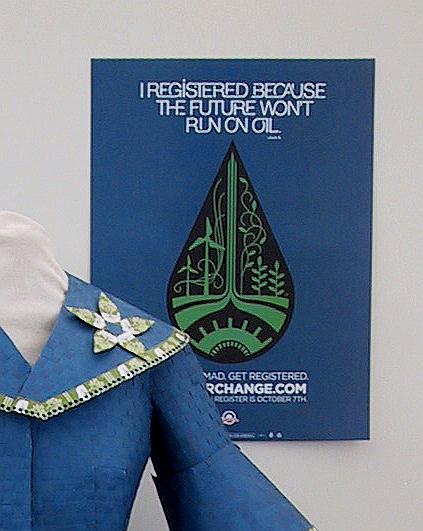
Change Couture Collection
This collection of garments fashioned out of discarded campaign materials, is made up of three garments: the Obamanos Coat, the Obama Cocktail Dress and the Voter Swing Coat. The Collection is a celebration of the millions of people who worked countless hours to assure the election of Barack Obama as the President of the United States.
Nancy Judd of Recycle Runway was a devoted volunteer in the Obama/Biden Campaign in Santa Fe. She organized hundreds of people in her neighborhood and inspired friends and relatives across the country to volunteer. This collection is a documentation of her experience being part of this exciting campaign.
The day after the election Ms. Judd went “dumpster diving” behind Obama Campaign headquarters in northern New Mexico. She filled her car with historic campaign materials that she transformed into elegant garments with the help of over 25 dedicated volunteers in two months!
Ms. Judd brought the Collection to the 2009 presidential inauguration in Washington D.C., showcasing it at the The Green Inaugural Ball, the reception to honor the New Mexico Congressional Delegation, and the New Mexico Inaugural Ball.
The Obamanos Coat has been accepted into the Smithsonian National Museum of African American History and Culture!

Nancy Judd Wall Street Journal Article
International Media Coverage for the Change Couture Collection
Wall Street Journal, January 13, 2009
Metro Paris, November 2009
Metro Santiago, November 2009
Metro Mexico City, November 2009
Metro New York, November 2009
Albuquerque Journal Video, Jan 9, 2009
Planet Green, January 20, 2009
Tree Hugger, January 19, 2009
トップ > ライフ・カルチャー > ライフ, January 19, 2009
Agence France-Presse (AFP), January 19, 2009
YahooNews.com, January 19, 2009
Kuwait Times, January 19, 2009
Las Vegas Sun, January 18, 2009
Media Fax Photo, January 18, 2009
Forbes.Com, January 18, 2009
Fox New.com, January 18, 2009
Santa Fe New Mexican, January 4, 2009
KSFR Radio, December 30, 2008
New Mexico Business Weekly, December 23, 2008
Channel 4, KTOA, December 23, 2008
Recycled Cowgirl
Outdated phone books created this little number!
Pages from old phone books were woven together to make the western style skirt and vest. The look continues with the pages applied to the used cowgirl hat and vintage “pee-wee” cowgirl boots. Used CDs create the silver accents on the outfit. This rough and ready suit required 125 hours to create. Created in 2002.
__________________________________________________
Opt-out of receiving unwanted phone directories by visiting: www.yellowpagesoptout.com
Phones books are made of 90% recycled paper, they can be recycled again and again, into new directories, roofing surfaces, insulation materials, grocery bags, paper towels, molded packing, compost and kitty litter. Check your local phone book for recycling information (usually in the front or back), or call your local Solid Waste Department.
Source: earth911.com
Voter Swing Coat
Leftover voter registration posters get the vote for this suit!
The coat is made from voter registration posters cut into half inch wide strips and woven together. This “paper fabric” was adhered to canvas remnants and the finished coat pieces were hand-sewn together. The collar, outer sleeves and bottom edge of the coat are accented with “lace” which was cut and punched from recycled matching voter registration reminder cards. This coat was made with the help of 10 volunteers in 200 hours. Created in 2009.
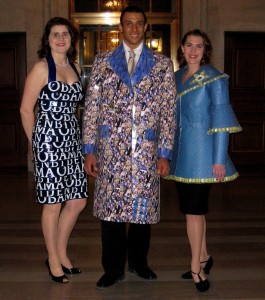
Change Couture Collection at the Green Inaugural Ball
The Voter Swing Coat is part of the Change Couture Collection which was showcased at numerous inaugural balls in Washington D.C. in 2009 for the presidential inauguration of Barack Obama.
Phoenix New Times
Waste Deep: Trashy fashions on display at Sky Harbor

By Wynter Holden
March 11, 2010
It’s amazing what we can do with garbage. Roads are paved with rubber from discarded tires. Boutiques sell purses crafted from gum wrappers. Even this year’s Olympic medals were partially made from electronic waste. Amazing.
Check out clothing made entirely from trash in the free public exhibit “Recycle Runway: Reclaimed Fashions” by Nancy Judd, which continues daily through August 8.
“Making trash into elegant and beautiful fashions attracts attention to the actions that we can each take in our everyday lives to care for the planet,” says Judd. Works on display include a soda-can dress commissioned by Coca-Cola, a recycled glass-bead evening gown, and an outfit made of Toyota parts. (Judd could probably make a boatload of cash selling the Toyota deal to angry Prius owners.)
Airport Revenue News
‘Recycle Runway’ At PHX Shows Dresses Made From Trash
 By Jamie Simon
February 24, 2010
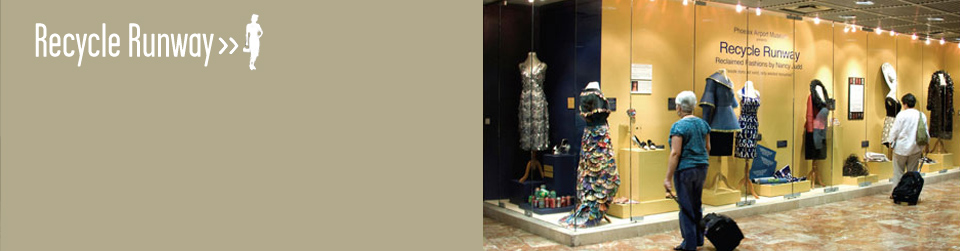
The Phoenix Airport Museum and artist/educator Nancy Judd have launched “Recycle Runway,” an exhibit of classic dresses made from materials often discarded, on display at Phoenix Sky Harbor (PHX).
“Environmental education is at the heart of all my work,” says Judd, who uses the art of fashion to raise environmental awareness. “Making trash into elegant and beautiful fashions attracts attention to the actions that we can each take in our everyday lives to care for the planet.”
Her garments are made using post-consumer materials such as aluminum cans, water bottles and junk mail.
“The Phoenix Airport Museum engages and entertains travelers while creating a sense of identity,” says Lennee Eller, Sky Harbor’s museum program manager. “Judd’s exhibition adds the extra bonus of educating and reminding all of us what wonderful things can happen when you are creative about recycling.”
“Recycle Runway” is a traveling exhibition of artist-designed garments created from recyclable materials. It travels the country to promote sustainability. Avila Retail, which owns and operates several shops at Phoenix Sky Harbor, and the Palo Verde group of the Sierra Club also sponsored the artist.
The exhibit is on display through Aug. 8 on Level 2 of Sky Harbor’s Terminal 3, pre-security.
Read article on Airport Revenue News website.
Blind Access Journal
Art Takes Off Down the Recycle Runway in New Airport Exhibition
February 19, 2010
A new art exhibition at Phoenix Sky Harbor International Airport features clothing made from recycled materials.
The artist, Nancy Judd, an environmental educator with over 20 years of experience in the recycling industry, began her career in art school.
“I watched the garbage can next to the pop machine fill up with cans and that felt wrong to me,” Judd said. “With the blessing of the art school’s administration, I put a recycling bin next to the machine and was wondering what happened to the material and what it got made into.”
Commissioned by companies such as Target, Toyota and the Glass Packaging Institute, Judd spends hundreds of hours making each couture garment from materials including aluminum cans, canvas, crushed glass, paper and reclaimed thread.
She said the airport exhibition includes 14 pieces from her collection representing over ten years of work.
“There’s a dress here which is made from 12,000 pieces of crushed glass that are individually glued to a floor-length evening gown made out of upholstery remnants,” Judd said.
She said the goal of her business, Recycle Runway, is to make garments that attract attention in public venues to the issues of environmental stewardship.
“It’s our everyday, moment-to-moment decisions we make, that have caused the environmental crisis we’re in now and it’s those same moment-to-moment decisions that can help us hopefully move out of this little pickle we’ve gotten ourselves in,” Judd said.
She explained the environmental impact of a simple decision to eat an orange.
“Did you buy it from a big-box store where it was shipped in from Florida or Mexico, or from a local farmer who is keeping the money in your community,” Judd asked. “After you eat it, what do you do with the skin? Do you throw it in the landfill where it sits for as long as 20 years or do you compost it and make it into a valuable nutrient that adds back to the land?”
Judd said she goes into schools to talk with children about environmental awareness.
“I bring dresses made out of aluminum, plastic and paper and I use each garment to talk about recycling”, she said. “I have them write down a pledge on a strip of recycled white office paper stating their name and something they’re going to do, which they haven’t been doing before, to help care for the planet. Those strips of paper are being made into paper link chains that will be sewn to this huge Scarlett O’Hara-style dress. It will be exhibited in the Atlanta airport next year for 12 months.”
Judd isn’t alone in her reliance on recycled materials.
Professional artist Sherrie Zeitlin of Phoenix said money for materials was tight when she started working with K-12 children in schools around Maricopa County 15 years ago.
“What I found was the schools had no money,” Zeitlin said. “I would empower the schools, before I came in, to collect the ribbons and wrapping paper left over from the December holidays, or to collect newspaper, plastic, zippers and even old socks for use in art projects. These materials would be cut up and woven into wall pieces.”
She said this early history was the basis for her 2004 founding of the Art Resource Center.
“I put together a center where I could collect the detritus from industry, corporations and individuals to offer back to any nonprofit organization to be able to make art projects,” Zeitlin said. “It’s all offered free of charge.”
She said she has used recycled materials in her own weaving business making large-scale constructions for architects and interior designers.
“I would go to salvage yards and buy metal and plastic for use in weaving,” she said. “I remember I did a huge weaving for a Dillard’s department store all out of plastic. It looked like a big bride and it went into the lingerie department.”
Zeitlin said the use of recycled materials is a huge trend in the art world.
“It’s a necessity,” she said. “In Feb. 2010, where nobody has any money anymore, it’s a financial issue. ”
“With all the detritus in this world, it’s necessary to just use it up in a different way,” Zeitlin said. “One of the mantras for the Art Resource Center is ‘recycling art worthy materials for creative minds’.”
Lennée Eller, program manager with the Phoenix Airport Museum, said her organization hosts exhibitions by studio artists like Judd and Zeitlin in 25 spaces around the airport system including locations in Terminal 4, Terminal 3, Terminal 2, the rental car facility and even the Deer Valley and Good year airports.
“We showcase the artist’s work through the changing exhibition program for 6 months, then we bring in a new group of work,” Eller said. “The idea is that every artist, gallery and museum has an opportunity to have their work displayed. Over the years it’s been wonderful, because I’ve shown a multitude of diversity.”
Eller said most of the museum’s displays are located outside the security areas for easy access by the airport’s nearly 20,000 employees and 40 million passengers who pass through annually.
“What you see are people who have come early and are getting ready to go down the concourse,” Eller said. “Here’s an interesting secret. If there are a lot of people in line (at the security checkpoint) people will panick and go stand in line. If there are not a lot of people in line, they will stay and go shopping or stop to look at the art.”
Eller said the art draws local residents who are looking for something free to do.
“I have people come and just do the airport tour,” she said. “They come to have coffee and do a walk about just looking at all the shows.”
“We’re the gateway to the state,” said Eller. “It’s really about putting our best foot forward when you’re welcoming people and you want to show them what you’re about.”
Nancy Judd’s Recycle Runway exhibition is on display through Aug. 8 in Terminal 3, Level 2 of the airport next to Starbucks.
Eller said the Phoenix Airport Museum strives to reasonably accommodate people with disabilities who need special assistance accessing exhibitions. They are invited to call 602-273-2105 to set up an appointment.
KTVK Channel 3 News, Good Morning Arizona
Recycle Runway — New Exhibition
KTVK Channel 3 News- February 12, 2010
By Catherine Holland
February 12, 2010
PHOENIX –The Recycle Runway exhibit will be on display at Sky Harbor’s Terminal 3 from Feb. 13-Sept 2010.
Southwest Flair
Nancy Judd : The Art of Green Couture
 By Cheryl Yale-Bruedigam
February 2010
Artist Nancy Judd transforms trash into elegant couture fashions and showcases the Recycle Runway Collection in airport exhibitions, class rooms and media outlets around the nation. Her unique work inspires environmental stewardship in millions of people internationally!
Recycle Runway strives to change the way the people live on the earth through innovative environmental educational programs and couture fashions made from trash. The Recycle Runway fashions are exhibited in high-traffic airports to grab travelers’ attention and inspire personal action. Community-based presentations and workshops launch young peoples’ imaginations while providing information on how to conserve resources. Recycle Runway partners with businesses, non-profits, governmental agencies, foundations and individuals who actively support environmental conservation.
Encouraging people to reflect upon their personal environmental impact and take action to reduce their carbon footprint is the heart of Nancy Judd’s mission for Recycle Runway. Ms. Judd strives to live her life and run her business on these principles. She believes that it is the culmination of our individual actions that created the environmental crisis we now face, and that the solution lies in our personal daily choices at home and work. She hopes to inspire people in a fun, creative and positive way to change the decisions we make around food, consumption, transportation, recycling and reuse.
The Recycle Runway Collection: Global corporations including Toyota, Coca-Cola, Target, Novelis Recycling and the Glass Packaging Institute, have sponsored Recycle Runway garments over the last 10 years. Each garment is a one-of-a-kind piece of wearable art that takes between 100 to 450 hours to create. Nancy Judd’s goal is to design all of her garments to last at least 100 years, thus inspiring generations of people to reduce their environmental impact.
The Airport Project: The intent of the Airport Project is to exhibit the Recycle Runway Collection in glass cases in airports around the world, encouraging millions of people to reflect upon sustainability issues in a creative, fun, and eye-catching venue. The Recycle Runway exhibit also showcases organizations that are helping to find solutions to the sustainability issues facing our planet. Following is the Recycle Runway Airport Exhibit schedule for 2010:
• Phoenix Sky Harbor International Airport, Feb 2010-Aug 2010
• Hartsfield-Jackson Atlanta International Airport Exhibit, Nov 2010-Oct 2011
Youth Education: Working with youth is at the core of the Recycle Runway mission. Nancy Judd gives presentations and workshops to young people across the country using her couture recycled garments to capture the kids’ imaginations. She also invites the children to make a new garment with her! The Youth Eco-Dress will be created from environmental pledges, made by the children, on strips of recycled paper turned into paper-link-chains and attached to a Scarlett O’Hara style dress. It will be completed in time for the Atlanta Airport Exhibit and seen by over 13 million people!
Ms. Judd offers workshops and presentations to adult audiences as well as youth.
Background on Nancy Judd: In 1998, while working as the Recycling Coordinator for the City of Santa Fe, Ms. Judd helped to found an annual event called the Recycle Santa Fe Market. The weekend long recycled art market and exhibit begins with a trash fashion contest. Ms. Judd began making recycled garments to promote the contest and soon had an impressive collection of recycled outfits. The National Recycling Coalition invited her to put on a recycled fashion show at their annual conference in 2003 and soon she was booked all over the country.
In 2000 Ms. Judd left her job at the city, started a consulting business, and served as the Executive Director of the New Mexico Recycling Coalition through 2005.
During this time Nancy Judd traveled through the US giving over 30 recycled fashion shows and youth presentations.
In 2006 Ms Judd decided to turn all of her attention to her recycled fashion project fulltime. She renamed the business Recycle Runway and realized that exhibitions in airports would give her a larger audience for her message of environmental stewardship.
Ms. Judd grew up in Portland Oregon and received her BA from Pitzer College (Claremont, California) in Art and Sociology. She spent time at the Laguna Beach Art Institute and the University of Georgia’s art program in Cortona, Italy. A self-taught seamstress, Nancy Judd has been sewing, designing clothing and jewelry and making
art since she was a child.
She began her career in the recycling field immediately after she graduated in 1990 by developing a recycling program for Pitzer College. She completed a Solid Waste Certification Program at the University of Los Angeles, California while serving as recycling coordinator for the Los Angeles Conservation Corps. In 1995 she moved to
Santa Fe, New Mexico to work as waste reduction/recycling coordinator for the City of Santa Fe. In 2000 she became the executive director of the New Mexico Recycling Coalition and in 2006 formalized Recycle Runway into a full time business venture.
For more information please visit www.recyclerunway.com
Editor’s Note: Ms. Judd is likely one of the most talented people in today’s world. I highly encourage you to visit her website, learn about her methods and explore the photos available showcasing her talent. I know that you will be as impressed as I was for she is truly an artistic midwife with the ability to birth into being that which is born only of the creative spirit.
Earth Odyssey
From trash to couture fashions
By Ann Haver-Allen
January 1, 2010
Clothing made using paper, aluminum, nails, car wiring and tape cassettes—anything is game for Nancy Judd’s unique recycling.
Nancy Judd is not your ordinary recycler. Sure, she does the ordinary recycling things, but Judd’s Earth-friendly actions go way beyond ordinary. She has built a successful business around the idea of extreme recycling.
Judd creates haute couture fashions out of trash and garbage. She displays her Recycle Runway fashions at airports nationwide.
“I love the challenge of making garbage beautiful, glamorous and sexy,” Judd said. “I strive to transform the concept of ‘waste’ into ‘resource’ and encourage individual responsibility for the environment in a fun, playful and positive context.”
Judd has had commissions from many corporations, including Coca-Cola, Target, Toyota and Starbucks. Each original hand-sewn garment takes between 100 to 400 hours to make and the finished product becomes part of the Recycle Runway Collection.
“The garments are displayed in airports nationwide and continue to ‘work’ capturing people’s attention so that I can talk about environmental topics,” Judd said. “So the companies get to be associated with the environment, art, fashion and youth in front of tens of millions of people through the airport exhibits, the youth presentations and the associated press.”
The airport exhibits encourage people to rethink their definition of “waste” and inspire people to consider the impact of their choices on the Earth. “I want to change the way the people think about their relationship to the environment,” Judd said.
“I want them to realize that it is the culmination of each of our individual moment-to-moment decisions that has caused the polluted air, the polluted water and the polluted land as well as the global warming and species extinction that we hear about everyday. Likewise, it is our moment-to-moment decisions at home, at work, at school, at church and in all our social activities that can mitigate the damage we have created.”
Judd began Recycling Runway 11 years ago. She was working as the recycling coordinator for the City of Santa Fe and realized that art and fashion could be used to raise the consciousness of the public about recycling in a fun and positive way.
She started the Recycle Santa Fe Art Market to provide a forum for recycling artists to share their creations. The Art Market always opens with a recycled fashion contest.
“I would make a dress every year to promote the contest,” Judd said. “Soon, I had a wonderful collection of recycled garments and I started to get invited by other recycling coordinators around the country to give recycled fashion shows in their communities.”
She did that for about two years. “I realized that I could reach more people with my message of sustainability in airports,” she said. “I also wanted an audience that was not already environmentally minded.”
Education is a big part of what Judd does. “The focus of everything I do is environmental education,” Judd said. “In addition to the airport installations, I also give presentations to youth. I encourage people to change at least one thing in their lives to benefit the environment.”
As part of her education effort, Judd plans to make an Eco-Youth dress.
“I ask youth to take a pledge, to do just one thing for the environment,” she said. “These pledges will be made into the Eco-Youth dress.” But where, you ask, does she get the ideas for her garments?
“My design sensibility is influenced by fashions from 1900 to 1950,” she said. “I get most of my ideas from watching old movies and poring over fashion books from that period.”
When she is commissioned by a company to make a garment out of specific materials, she begins by thinking about the properties of the material and how she might transform them into something beautiful. “At the same time, I am looking in my vintage fashion books and the two sources of information seem to come together in a daydream—and a dress is born,” Judd said.
She said the most unusual material that she has recycled into a garment was car parts. “Toyota commissioned me to dig through their recycling containers,” Judd said. “They recycle between 80 percent to 95 percent of their garbage, so there is not much in their trash cans to choose from! This garment proved to ME that I could make anything elegant…even car parts!”
The Toyota two-piece suit was made using two different convertible soft tops. The “faux fur” on the lapel of the jacket is made from electrical wire. The hat is made from a front-end mask and accented with electrical copper wire. The purse is woven out of electrical wire and metal paper that is wound around electrical components.
Judd’s ingenuity incorporates a vast collection of garbage and recycled materials, including old rusty nails that are sewn and glued to a 1950’s style cocktail dress. The accompanying hat is made from canvas remnants. Completing the outfit is a vintage purse and a matching pair of shoes, also adorned with old rusty nails.
Judd made a 1920’s flapper dress from an old cloth shower curtain that features aluminum teardrops and circles cut from cans and hand sewn onto the material. She created a stylish coat from old cassette tapes that were woven into the fabric of a thrift-store coat. Discarded video tape made the collar and cuffs. The coat’s lining was once a prom dress.
Her “Fan Mail Dress” is made from junk mail that she folded into fans and sewed onto a skirt and dress made of scrap canvas. The Spanish influenced dress has a matching mantilla for the hair and vintage shoes that are covered with old postage stamps. Although Judd is no longer directly involved with the Recycle Santa Fe Art Market, she still shows a new garment in the fashion show each year.
“A number of people in Santa Fe follow my work, so it’s always fun to debut my latest piece there,” she said. “This show has become one of Santa Fe’s celebrated arts events. People come from all over the country to both sell artwork and shop.” Judd said that change starts with small steps and while many people already recycle, she wants to build on this.
“I have a very strong belief that if we pay attention to what is interesting, to what makes us curious, to what is fun and to what we love to do then we find ourselves in some amazing places,” Judd said. “This has been my experience and it has led into this incredible career. I share this message with the thousands of kids that I talk to but I think it is applicable to anyone! I feel so fortunate for this unusual, fun, meaningful and very fulfilling career!”
In February, Recycle Runway will be coming to Phoenix Sky Harbor International Airport. The show will run through August.
Read article on Earth Odyssey website.
Clothing made using paper, aluminum, nails, car wiring and tape cassettes—anything is game for Nancy Judd’s unique recycling
By Ann Haver-Allen
Nancy Judd is not your ordinary recycler. Sure, she does the ordinary recycling things, but Judd’s Earth-friendly actions go way beyond ordinary. She has built a successful business around the idea of extreme recycling.
Judd creates haute couture fashions out of trash and garbage. She displays her Recycle Runway fashions at airports nationwide.
“I love the challenge of making garbage beautiful, glamorous and sexy,” Judd said. “I strive to transform the concept of ‘waste’ into ‘resource’ and encourage individual responsibility for the environment in a fun, playful and positive context.”
Judd has had commissions from many corporations, including Coca-Cola, Target, Toyota and Starbucks. Each original hand-sewn garment takes between 100 to 400 hours to make and the finished product becomes part of the Recycle Runway Collection.
“The garments are displayed in airports nationwide and continue to ‘work’ capturing people’s attention so that I can talk about environmental topics,” Judd said. “So the companies get to be associated with the environment, art, fashion and youth in front of tens of millions of people through the airport exhibits, the youth presentations and the associated press.”
The airport exhibits encourage people to rethink their definition of “waste” and inspire people to consider the impact of their choices on the Earth. “I want to change the way the people think about their relationship to the environment,” Judd said.
“I want them to realize that it is the culmination of each of our individual moment-to-moment decisions that has caused the polluted air, the polluted water and the polluted land as well as the global warming and species extinction that we hear about everyday. Likewise, it is our moment-to-moment decisions at home, at work, at school, at church and in all our social activities that can mitigate the damage we have created.”
Judd began Recycling Runway 11 years ago. She was working as the recycling coordinator for the City of Santa Fe and realized that art and fashion could be used to raise the consciousness of the public about recycling in a fun and positive way.
She started the Recycle Santa Fe Art Market to provide a forum for recycling artists to share their creations. The Art Market always opens with a recycled fashion contest.
“I would make a dress every year to promote the contest,” Judd said. “Soon, I had a wonderful collection of recycled garments and I started to get invited by other recycling coordinators around the country to give recycled fashion shows in their communities.”
She did that for about two years. “I realized that I could reach more people with my message of sustainability in airports,” she said. “I also wanted an audience that was not already environmentally minded.”
Education is a big part of what Judd does. “The focus of everything I do is environmental education,” Judd said. “In addition to the airport installations, I also give presentations to youth. I encourage people to change at least one thing in their lives to benefit the environment.”
As part of her education effort, Judd plans to make an Eco-Youth dress.
“I ask youth to take a pledge, to do just one thing for the environment,” she said. “These pledges will be made into the Eco-Youth dress.” But where, you ask, does she get the ideas for her garments?
“My design sensibility is influenced by fashions from 1900 to 1950,” she said. “I get most of my ideas from watching old movies and poring over fashion books from that period.”
When she is commissioned by a company to make a garment out of specific materials, she begins by thinking about the properties of the material and how she might transform them into something beautiful. “At the same time, I am looking in my vintage fashion books and the two sources of information seem to come together in a daydream—and a dress is born,” Judd said.
She said the most unusual material that she has recycled into a garment was car parts. “Toyota commissioned me to dig through their recycling containers,” Judd said. “They recycle between 80 percent to 95 percent of their garbage, so there is not much in their trash cans to choose from! This garment proved to ME that I could make anything elegant…even car parts!”
The Toyota two-piece suit was made using two different convertible soft tops. The “faux fur” on the lapel of the jacket is made from electrical wire. The hat is made from a front-end mask and accented with electrical copper wire. The purse is woven out of electrical wire and metal paper that is wound around electrical components.
Judd’s ingenuity incorporates a vast collection of garbage and recycled materials, including old rusty nails that are sewn and glued to a 1950’s style cocktail dress. The accompanying hat is made from canvas remnants. Completing the outfit is a vintage purse and a matching pair of shoes, also adorned with old rusty nails.
Judd made a 1920’s flapper dress from an old cloth shower curtain that features aluminum teardrops and circles cut from cans and hand sewn onto the material. She created a stylish coat from old cassette tapes that were woven into the fabric of a thrift-store coat. Discarded video tape made the collar and cuffs. The coat’s lining was once a prom dress.
Her “Fan Mail Dress” is made from junk mail that she folded into fans and sewed onto a skirt and dress made of scrap canvas. The Spanish influenced dress has a matching mantilla for the hair and vintage shoes that are covered with old postage stamps. Although Judd is no longer directly involved with the Recycle Santa Fe Art Market, she still shows a new garment in the fashion show each year.
“A number of people in Santa Fe follow my work, so it’s always fun to debut my latest piece there,” she said. “This show has become one of Santa Fe’s celebrated arts events. People come from all over the country to both sell artwork and shop.” Judd said that change starts with small steps and while many people already recycle, she wants to build on this.
“I have a very strong belief that if we pay attention to what is interesting, to what makes us curious, to what is fun and to what we love to do then we find ourselves in some amazing places,” Judd said. “This has been my experience and it has led into this incredible career. I share this message with the thousands of kids that I talk to but I think it is applicable to anyone! I feel so fortunate for this unusual, fun, meaningful and very fulfilling career!”
In February, Recycle Runway will be coming to Phoenix Sky Harbor International Airport. The show will run through August.
AAA Magazine, New Mexico Journey
Can Do Attitude
AAA Magazine
By Megan Kamerick, photograph by Ann Murdy
December 2009
Eleven years ago, Nancy Judd made her first dress out of recycled materials for the Recycle Santa Fe Art Festival, which she cofounded. Today, her mission is education through fashion. She creates recycled garments through her company, Recycle Runway, and exhibits them in public spaces and in schools. What is the Recycle Santa Fe Art Festival? It was created to attract people to a fun event that, at the same time, would encourage recycling, reuse, and waste reduction. There is a recycled-art market, a juried art exhibition, a kids’ exhibit, information booths, and a recycled-fashion contest.
Why did you want to start it? As Santa Fe’s recycling coordinator, I was responsible for public education. I put recycling and art together and came up with this. People can come do their Christmas shopping and see their kids in the fashion show and their kids’ artwork displayed.
Were you always an environmentalist? During college, I took a year off to go to art school. One day, I saw a garbage can filling up with aluminum cans and asked the school to get a recycling bin. Then I just got interested in who picked up that material and where it went and what it was made into. I did an independent study on recycling and waste management and that led to my career in recycling. It was Recycle Santa Fe that brought me back to art. I’d been sewing my whole life, but I’d never made a recycled dress before.
What goes into making a dress? For one dress, I folded origami fans out of junk mail and sewed them to a skirt. It took me about 200 hours to make because I had to choose the mail pieces, then cut them into squares and fold them. Then I hand-sewed them onto a skirt I made.
Do you have a favorite? I’m particularly fond of one made of aluminum cans cut into teardrop shapes and sewn to a dress made from ,a cloth shower curtain. It sounds beautiful when you wear it—it’s like being a human tambourine.
Are your designs inspired by the materials? What inspires me is the idea of taking something we consider trash and transforming it into something beautiful or elegant or sexy. My goal is to abolish the whole concept of waste and to redesign how we manufacture so everything becomes a resource.
The Recycle Santa Fe Art Festival takes place November 13-15 at El Museo Cultural de Santa Fe. (505) 603-0558; recyclesantafe.orq. For information about Recycle Runway, go to recyclerunway.com.

