Eco Trash Couture
To View Project Details


Los Angels Times, Culture Monster
Obama cocktail dress, from dumpster to fashion runway

Obama Cocktail Dress
By Suzanne Muchnic
May 27, 2009
Nancy Judd, a 1990 graduate of Pitzer College who heads a company called Recycle Runway, will return to her Claremont alma mater Saturday with a one-day exhibition of fancy garments made from trash and ingenuity.
Judd makes outlandish clothing from castoffs such as phone book pages, junk mail, plastic bottles, aluminum cans and cassettes. But the star of the show at Pitzer’s Nichols Gallery is likely to be the “Obama Cocktail Dress.” It’s a slinky, body-hugging number crafted from the president’s campaign posters. As the “fabric” winds around the body, from above the knee to below the armpits, white letters form a crisp graphic pattern on a black background and the name “Obama” pops up over and over.
The eye-popping dress and other couture fashions in the show are products of a company that aims to transform waste into a valuable resource. With a goal of changing “how the world thinks about the environment,” Judd says that “making garbage beautiful, glamorous and sexy” may entice people to redefine their concepts of rubbish.
The Obama dress got its start the day after the election, when Judd harvested armloads of plastic posters from dumpsters. She soon turned the refuse into a line of garments dubbed the Obama Campaign Collection, which debuted at the Green Inaugural Ball in Washington, D.C.
The Claremont exhibition will coincide with a ceremony at Pitzer, where the artist will receive the college’s 2009 Distinguished Alumni Award. The gallery will be open from 8 a.m. to 6 p.m.
Planet Green
Discover Trashion (Trash Fashion) at the Green Inaugural Ball
 By Heather Sperling
January 20, 2009
Trash + Fashion = Trashion. Simple, right? Not necessarily—one of Nancy Judd’s winter coats, made from Obama fliers, took 200 hours to cut, paste and sew.
The Wall Street Journal has a slide show of some of Judd’s work, which will be modeled at the all-organic Green Inaugural Ball in Washington, DC, on the 20th. The vintage-inspired pieces are clever and ornate, if not user-friendly (you can’t sit down in them, says Judd). A personal favorite is the glass evening gown, which has a ruby slipper-like appeal with an edge—literally—thanks to 12,000 pieces of crushed glass from the City of Albuquerque Recycling Program.
Judd’s “Recycle Runway” pieces are exhibited at airports around the country with the hope that they’ll inspire travelers to personal action-to think twice before throwing out that old sweater, or at least put their coke can in the recycle bin. Because who knows—it could be turned into something chic!
You’ll see Judd’s designs if you pass through the Pittsburgh airport this year. They’ll be in Orlando airport in summer 2009, and in Atlanta in 2011.
Read article on Planet Green website
Agence France-Presse
Dumpster couture makes foray into Obamaworld

Nancy Judd at the Green Inaugural Ball
January 18, 2009
By Olivia Hampton
WASHINGTON (AFP) — It was the day after Barack Obama’s historic November 4 election win, when environmental artist and educator Nancy Judd went dumpster diving behind the Obama campaign headquarters in Albuquerque, New Mexico, desperate to collect any salvageable materials.
“I made a mad dash around town. In many cases, they had already started throwing things in dumpsters and I was pulling material out of dumpsters,” Judd told AFP.
“I started seeing posters and decals and I was finding drawings by children and all kinds of amazing materials that I felt like I just wanted to save … then it was just an obvious next step: since I make clothing out of trash, I am going to make a collection of garments and take it to the inauguration.”
Judd unveiled her “Campaign for Change Couture Collection” Saturday at the Green Inaugural Ball that drew about 1,000 environmentalists, an event among dozens in Washington honoring Obama’s inauguration.
The centerpiece was “Obamanos,” a 1950s vintage men’s coat adorned with countless 1.5-inch (4-centimeter)-long strips of Obama campaign door hangers that Judd said took 200 hours to make.
“I interpret it as we are Obama, we are this movement. It’s a tribute to the millions of people who worked for him,” she said.
Even Obama’s defeated opponent, John McCain, has his place on the coat — under the right armpit. Although the suit was tailored to fit Obama, wearing it would not be an easy affair.
“There’s a little bit of movement back and forth, but he can’t wave,” Judd explained.
At the ball, Judd wore an “Obama cocktail dress,” fashioned from campaign yard signs sewn in overlapping layers on a recycled sheet.
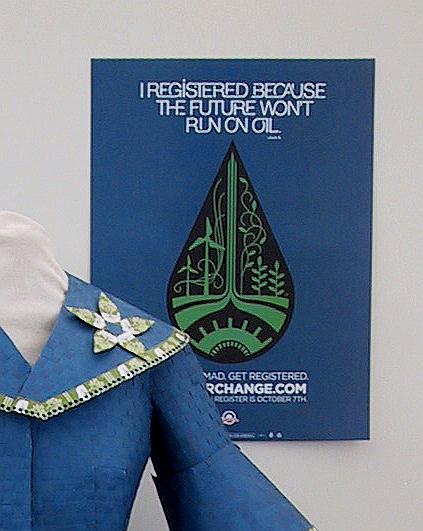
A model showed off the “Voter Swing Coat,” made from voter registration posters for New Mexico, a swing state, cut into strips and woven together into a paper fabric adhered to recycled canvas. A paper lace from punctured voter registration cards covered the coat’s collar and outer edges.
Crafting a single one of her handmade garments usually takes about six months to make, Judd said. But with the help of some 20 people in her studio, she wrapped up all three pieces in just two months.
She is also selling tote bags made from discarded yard signs to help finance her trip to Washington, where she will present her Obama-themed collection again on Monday at a reception for a New Mexico delegation and will organize workshops for local students.
Judd, 40, is no stranger to “trashion.” She first started making clothing out of discarded materials a decade ago and made her hobby into a business, Recycle Runway, two years ago.
Among her dumpster chic are a faux fur coat with thousands of loops of cassette and video tapes and an evening gown adorned with some 12,000 pieces of crushed glass — both of which took 400 hours to make.
“When you can engage people in a really positive way that is fun and playful and makes them smile and is creative, I feel like the message can be stronger than the doom and gloom, we’re all going to die kind of thing,” Judd said.
Judd’s hopes are also echoed in the energy and environmental policies of the incoming administration. Obama has called for an effort to overhaul US energy policy on the scale of the Apollo project that first landed a man on the Moon.
His plan includes unleashing 150 billion dollars over 10 years to create five million new “green” jobs, an 80 percent reduction of greenhouse gas emissions by 2050 and ensuring that 10 percent of US energy consumed comes from renewable sources by 2012 and 25 percent by 2025.
“This time must be different,” Obama said in December when referring to his environmental and energy policies.
“This will be a leading priority of my presidency and a defining test of our time. We cannot accept complacency, nor accept any more broken promises.”
The Wall Street Journal

Nancy Judd, Wall Street Journal Drawing
SANTA FE, N.M. — In the world of trashy fashion, designer Nancy Judd has hit the big time.
FRONT PAGE
January 13, 2009
By Stephanie Simon
Read article on-line.
Ms. Judd spends her days in a studio here crafting clothing from castoff plastic bags, electrical wire and old cassette tapes. Now, her Dumpster couture has caught the eye of environmental activists, who plan to showcase her work in Washington at Saturday’s Green Inaugural Ball honoring President-elect Barack Obama.
The star piece: A man’s coat made from Mr. Obama’s campaign fliers. She says it took her 200 hours to cut and paste and sew it.
Showing her stuff in the nation’s capital is a big step for a woman who used to put on a furry blue costume and sweat her way through parades as Carlos Coyote, Santa Fe’s recycling mascot. Working for the city trash department, Ms. Judd did the coyote gig for years. She also ran workshops and recorded radio ads urging New Mexicans to recycle. But she worried that nobody was paying attention.
Ms. Judd began to wonder whether she could spark new interest in solid waste by making garbage glamorous.
Ms. Judd, who is 40 years old, has no training in fashion. She can’t sketch. She gets design ideas from old paper dolls. Still, she figured out how to craft a saucy cocktail dress from a shower curtain and aluminum cans. She fashioned a slinky black gown from canvas scraps and hundreds of rusty nails. When worn, it clinks alluringly.
She once spent 400 hours, she says, unspooling cassettes and crocheting the crinkled tape into a fake-fur coat.
As attire, the outfits have their limitations. An evening gown sparkling with 12,000 bits of glass tends to shed; a fitted jacket cut from the vinyl top of a convertible is so well insulated, it doubles as a sweat lodge.
Also, says Ms. Judd, “you can’t sit down in any of them.”
What steps are you taking to live “green” or protect the environment?
.But these aren’t meant to be wardrobe mainstays. Ms. Judd conceives of them more as wearable sculpture. “I like the idea of making aluminum elegant, or rusty nails sexy,” she says.
Turns out, she isn’t alone.
A decade ago, when Ms. Judd was making her first rescued-from-the-landfill dress — a somewhat revealing number made of bubble wrap — recycling had already hit the mainstream. Manufacturers were turning plastic bottles into fleece outdoor wear.
But the world of environmentally conscious designers was small, says Delia Montgomery, founder of Chic Eco, an “earth friendly” fashion consulting firm. “Now I can’t keep up,” she says.
Woven Candy Wrappers
Artisans in developing countries sell purses woven from candy wrappers. Online boutiques market belts made from the inner tubes of bicycles. A designer in Chile recently announced she had pulled apart the filters in cigarette butts and woven them into a coarse thread to crochet vests.
By necessity, most of this experimentation is small-scale. It takes a whole lot of time to scrub the coffee residue from empty Starbucks bags, then snip out the mylar lining for use in a gown. “Anyone trying to mass-produce this throws their hands up in the air,” Ms. Montgomery says.
But for boutique designers, the niche market is enough. “The sheer weirdness of it — people just love it,” says Robin Worley, a fashion designer in Seattle who studs her clothes with gears from discarded watches.
The concept has infiltrated pop culture on cable television, thanks to the Bravo reality series “Project Runway,” which has challenged aspiring designers to construct outfits from recyclables.
Two years ago, Ms. Judd decided to try to capitalize on the emerging trend by turning her hobby into a full-time job through a business she calls Recycle Runway.
She doesn’t sell her work; she markets it as an educational tool. She wants to use her Dumpster couture — otherwise known as “trashion” — to illustrate talks about the solid-waste problem and to raise awareness through instructive art exhibits.
“You can’t be didactic or shaming or all gloom-and-doom” when talking about sustainability, or the audience may tune out, Ms. Judd says. “So you sneak in the back door” with fanciful fashions.
The concept intrigued curators at the Pittsburgh International Airport, who organized a show on Concourse C this past fall. When she came to set up the exhibit, Ms. Judd also spoke to several youth groups.
“The children were amazed to see that something so beautiful could be created out of something we would normally throw away,” says Pat Bluett, assistant executive director of a suburban Boys and Girls Club. The club’s recycling volume has since doubled, she says.
The educational theme also appealed to Jenna Mack, co-producer of Saturday’s Green Inaugural Ball. The all-organic, $500-a-ticket event is expected to draw 1,000 environmentalists. Models will show off Ms. Judd’s fashions on platforms in the lobby.
“Maybe the mental image of that dress made from glass might make people think twice before they throw out a bottle next time,” Ms. Mack says.
The whimsy factor also gives Ms. Mack bragging rights on a party-packed weekend with dueling environmental-themed galas. The other Green Inaugural Ball has Al Gore. This one has Ms. Judd’s canvas-scrap dress embroidered with shiny flowers cut from Coke cans.
Glad as she is to be heading to Washington, Ms. Judd won’t make any money from the show. (In fact, she’s selling tote bags made from recycled Obama signs to cover her expenses.) In general, she has found profits don’t match her passion; these past two years, she has been living mostly on savings and a small-business loan. But she is undeterred.
The morning after the November election, Ms. Judd hoisted herself into a Dumpster outside an Obama campaign office and scooped up armfuls of posters. She collected a precinct map, a phone list, a pink flier advertising sweatshirts, a child’s drawing of the Obama logo as a scoop of ice-cream, over the slogan, “Yum We Can.”
Dumping it out on her studio floor the other day, Ms. Judd gazed at her loot. Some of the paper was crumpled and torn; there were footprints on one sign, and smears of paint. “Won’t it be so fun to use this?” she asked.
She has already made three items of Obama-wear: A sun dress stitched from plastic yard signs; a suit woven from strips of voter-registration posters; and the man’s coat, made from stiffly lacquered door hangers.
Ms. Judd looked up Mr. Obama’s measurements and tailored the coat for him. She wishes he would stop by to try it on. After some trial and error, she figured out how to hinge the sleeves to give him some measure of mobility. “He can’t wave,” she says. “But he can shake a hand.”
The New Mexican
Campaign couture: Recycle Runway owner to show off Obama fashions at inaugural ball
The New Mexican January 3, 2009
By Dennis J. Carroll
January 03, 2009
Nancy Judd, Santa Fe’s Dumpster fashionista, will be strutting her environmentally correct ensembles made from recycled materials — from crushed glass and audio cassette tapes to soda tabs and campaign signs — Jan. 17 at The Green Inaugural Ball in Washington, D.C.
Judd, 40, owner of Recycle Runway, also has been invited to the inaugural party hosted by New Mexico’s congressional delegation on Jan. 19, the night before the Barack Obama’s presidential inauguration.
Green Ball producers said “every facet of The Green Ball is designed to reduce the impact on the environment.” Catering will be 100 percent organic, and the bars will feature local and organic beverages. Food waste and floral arrangements will be composted and bottles will be recycled. Lighting systems and decorative features have been designed to be energy efficient.
The event is expected to be attended by about 1,000 individuals and representatives of environmental organizations. The ball will be held at the Andrew W. Mellon Auditorium.
Judd, a former waste-management manager for the city of Santa Fe, is sewing, gluing and stapling 24/7 to complete what she calls her Campaign for Change Couture Collection to be showcased at the event.
The outfits — “you just can’t sit down” — include a 1950s-style cocktail dress made from Obama yard signs, a man’s winter coat covered with paper campaign door hangers, a woman’s “swing” coat stitched together using voter-registration materials and a ball gown made from campaign posters.
The man’s coat “is essentially the feeling of the campaign,” Judd said, featuring many of the people who supported Obama and worked on the campaign.
Judd said it took about 200 hours to make the coat and 25 hours for the dress.
What probably won’t be noticed is a humorous jab at Republicans — a photo of John McCain under the coat’s right armpit.
Judd said live models will be showing off the pieces on pedestals set up in the lobby entrance to the Mellon Auditorium.
Jenna Mack, one of the ball’s producers, described Judd’s collection as “beyond fabulous,” and said Judd was invited to the ball because her work fit so well with the theme of the ball and many of the president-elect’s expected environmental and conservation policies.
She said Judd’s work “makes a statement to remind people” of the necessity of recycling and conservation and “gets the dialogue started” among people who view Judd’s creations.
Judd also expects to be conducting conservation workshops at Washington, D.C.-area schools.
Judd said that the day after the Nov. 4 election she went campaign Dumpster diving in Santa Fe and Albuquerque, retrieving such items as posters, yard signs and even original artwork done for the Obama campaign.
To finance her trip, Judd hopes to raise about $25,000 from corporate sponsors and through the sale of Obama tote bags, $50 each, made from recycled yard signs.
Judd also has been using Santa Fe’s WESST Corp. to help her organize the project, and Southwest Creations to make the tote bags.
Many of Judd’s outfits are on a road tour of sorts at airports around the country.
“Elegant garments created from recycled materials are exhibited in high-traffic airports to grab travelers’ attention and inspire personal action,” Judd says on her Web site, www.recyclerunway.com. She also conducts environment and recycling workshops for children in the cities where her airport fashion runways are on display.
Recycle Runway also has drummed up sponsors as diverse as Toyota, Coca-Cola and the Glass Packaging Institute.
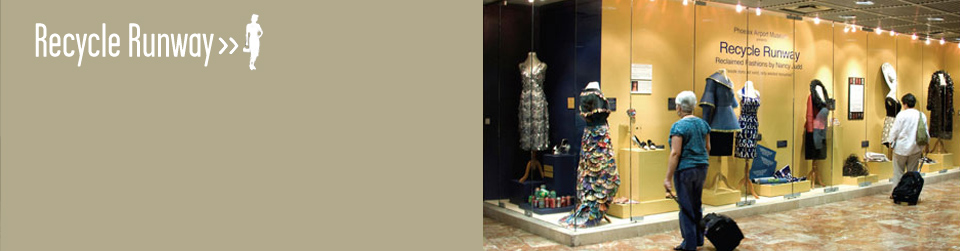
The airport displays include a faux-fur jacket made of with thousands of loops of cassette and video tape; a dress train made of origami junk-mail fans, sewn together like fish scales; and an evening gown glittering with thousands of pieces of crushed recycled glass.
Judd’s creations have been on display at the Pittsburgh International Airport since August.
Her first airport show was at the Albuquerque International Sunport in October 2007.
Judd’s outfits combine elements of art, fashion and politics (she was a volunteer for the Obama campaign).
“I don’t make them to resell them. I don’t make them to mass produce them. They are wearable sculptures. That’s how I look at it. I don’t have fashion background.”
Judd started Recycled Runway seven years ago while working as the recycling coordinator for the city of Santa Fe. She was subsequently executive director of the New Mexico Recycling Coalition.
Pittsburgh Post-Gazette
Trash fashion: Nancy Judd’s sustainable styles bring message of recycling to cities’ runways
By LaMont Jones
August 11, 2008
Nancy Judd insists she’s not a folk artist, an outside artist, a fine artist or a fashion designer.
Yet, the clothing she creates from recycled materials often seems to combine elements of each.
Ms. Judd’s “Recycle Runway” project includes a collection of dresses made of throwaways ranging from broken glass to junk mail, and she displays in airports across the country as part of a program she conceived to educate people about the importance of recycling and sustainable living.
She recently brought her message to Pittsburgh, staging interactive presentations with 250 children at four Boys & Girls Clubs. A selection of her sartorially sustainable styles will remain on display at Pittsburgh International Airport through the end of the year.
After that, it moves to Atlanta’s Hartsfield, the busiest airport in the world.
“I like being in the airports because nobody asks me to define myself,” said Ms. Judd, 39.
Although she isn’t easily pigeonholed as an artist, you can file her creations under “couture with a conscience.”
It all began during Ms. Judd’s childhood in Portland, Ore., where bike riding and bottle recycling were the norm. The daughter of an art college director, she also learned at a very young age how to sew, although she never received formal training in fashion or design.
Recycling and fashion came together for her when she took a break from studying sociology and art as an undergraduate at Pitzer College in Claremont, Calif., to attend the Art Institute of Southern California for a year. One day in 1989 while she was at the Laguna Beach school, a can-filled garbage receptacle near a soda vending machine caught her eye.
She got permission to place a recycling bin nearby. Then she began thinking about how the cans should be disposed of, which led to creating an independent study on recycling when she returned to Claremont.
For the past 15 years, Ms. Judd has worked as an administrator in recycling for the city of Santa Fe, N.M. Because the community is arts-oriented, she thought a weekend-long recycled art market might be fun. So she planned one in 2000, kicking it off with a “trash fashion” contest in which the public could participate.
“Recycle Runway” was born.
And it has grown. As executive director of the New Mexico Recycling Coalition, she thought the fashion show would be hip entertainment at the group’s annual conference. It was a big hit, she said, and representatives of the National Recycling Coalition who saw it asked her to do it on a national scale.
Related groups began to commission her to design apparel from recyclables for their events, and she’s participated in 30 shows across the nation in the past eight years.
The movement took on such a life of its own that she decided last year to make it her main career — with a few changes.
“I really wanted to get back to what, for me, was the heart of what it was all about — public education on recycling and environmental issues,” she said. “I felt there was not much of an impact from past events. It was sort of like preaching to the choir.”
Ms. Judd wanted a different audience, one that was much larger and not environmentally savvy. Then, one day when she was in O’Hare Airport in Chicago, she had a “eureka!” moment — airports have legions of people every day.
So she devised a program and began identifying the 35 busiest U.S. airports to schedule displays. And when she visits an airport to set up the display, she visits groups of children to educate them about the importance of recycling.
Although Pittsburgh can’t claim one of the nation’s busiest airports, she was mindful that the National Recycling Coalition had planned a conference here next month.
The exhibit features a bulk mail fan skirt and a rusty nail dress in display cases in concourses C and D in the airside terminal.
“They’re really charming pieces,” said JoAnn Jenny, the airport’s director of communications. “They are really attractive and very pleasing, and I see people stopping and looking at them. I’m really delighted that she approached us about it. It’s very timely, and I think it’s an important issue to increase awareness of.”
Ms. Judd’s workshop was well received by more than 70 kids ages 5 to 13 at the Duquesne-West Mifflin Boys & Girls Club, said Pat Bluett, the club’s assistant executive director.
“She was fantastic,” said Ms. Bluett. “The kids couldn’t believe it. They were interested in how she did it and what made her decide to do it. She kept their interest by involving them. It was unbelievable to see what she could do with things we just normally throw away.”
As she meets with groups of youngsters, she collects scraps of used office paper on which they have written a specific commitment about how they can help preserve the environment by recycling. She plans to turn the scraps into a huge “Scarlett O’Hara” dress like that worn by the “Gone With the Wind” protagonist by the start of the Atlanta exhibit.
When “Recycle Runway” is in the international concourse at Atlanta’s airport from July 9, 2009, through June 2010, 35,000 people a day in that concourse will have a chance to see it.
That makes Ms. Judd a happy woman.
But she has another recycle-related dream she’d like to realize.
