Eco Trash Couture
To View Project Details


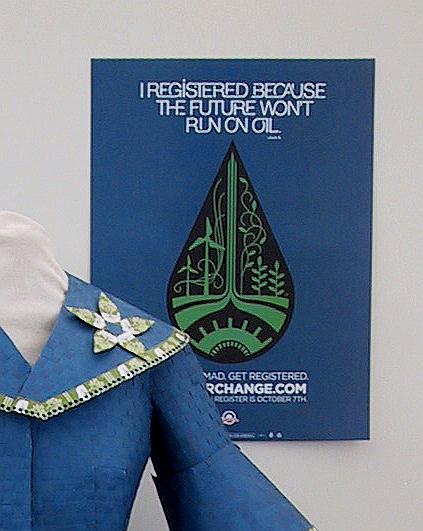
My recent blog post, Declining $10,000, was my most popular post to-date. It was re-blogged, shared on facebook, forwarded and re-twitter– reaching thousands more people around the world! I have received many (primarily) supportive comments, which has caused me to reflect even more on the experience. I have attempted to organize these thoughts into two primary concepts:
1. Everyone is welcome at the table!

Stained glass window by David and Michelle Plachte
My objective with my last post was to create a “teachable moment” about the environmental, social and health issues related to drinking bottled water. I did not intend to vilify the company that made me the offer and have in fact removed their name from both blog posts on the subject.
This experience helped me to clarify my belief that our problems need to be solved by working together and that the energy used to create “us versus them” scenarios hinders our ability to find long term solutions to the many critical issues facing the world today. I believe that everyone brings something to the table, and that INCLUSIVITY is imperative.
During my TogetherGreen Fellowship retreat, sponsored by the National Audubon Society and Toyota, we spent a whole day talking about diversity and exploring the biases (filters, lenses, perspectives, and histories) that can impact the effectiveness of creating solutions to our numerous worldwide crises. When we think about diversity we often think about gender, race, nationality or religion, but diversity is about inclusion, and inclusion means EVERYONE! But can I work with everyone, NO… that is where the fine art of exploring our individual truth comes in.
Watching coverage of the Earth Summit in Rio this year, I am also really appreciative of the voice of the most radical environmentalists who ceaselessly push the issues representing the voice of the animals, the plants, the children and the earth itself. Yes, every voice is needed at the table!
2. Embracing Complexity
In Santa Fe, where I live, we are having a film-festival of the great Japanese animator Miyazaki, Spirited Away and Ponyo are two of his films you may have seen. I love the duality of his characters, one may at first appear to be “bad” only later to reveal a loving heart with good intentions and actions despite other questionable activities.
It is so easy to categorize a person, entity or situation as good or bad, but life is much more complicated than that. Right and wrong are relative to numerous factors and most decisions in this world are quite complex.
Yes, all of my sponsors could be questioned for various reasons, but the companies I have chosen to work with have tremendous influence and the environmental (and social) initiatives they have started and funded have had far reaching positive effects. Like a Miyazaki character, they are neither 100% malevolent or benevolent.
Also, corporations are made of people, many of whom are working on the inside to do what they can to reduce the carbon footprint of the products/services that their company provides. I don’t want to negate the good work that these folks are doing, I want to recognize it.
I was able to reflect on these issues with some of my colleagues at the TogetherGreen retreat and many of them had faced similar sponsorship quandaries and agreed that these decisions are never easy and are always based on numerous circumstances. This is true for each of us in our daily lives as well because we have to make choices such as what we eat and buy, where we shop and live or how we get around that carry the same complex dilemmas.
I did not feel comfortable endorsing the use of bottled water and turned down the generous offer. I received a lot of praise for that act, however tomorrow I may make a different decision (on another topic) that is right for me, but wrong for you. Heroism can be very short lived!
I have a good friend whose initial response to everything is always: “interesting”. I am learning to use her simple reply, “interesting”, as a way to look more closely at the multi-faceted nature of situations and remain open to options that might have more inclusive, deep and long term outcomes.
Thank you for taking the time to read my philosophical musings on the nature of right and wrong and how this influences our daily decisions. Tell me about similar decisions you have had to grapple with, I would love to hear your experiences too!
Re-visoning Erté
Made from silk scraps, leftover from a jacket my mother made over 30 years ago, and aluminum cans. This dress stands only 33 inches tall, half the size of my full-size garments.
Completed in 2012 in 100 hours.
Read a blog post about creating Re-visoning Erté.

Last month I indulged myself in designing a new recycled fashion sculpture JUST FOR ME! Though I love the way that some of my projects more structured parameters influence my garments, it felt luxurious to dive into the purely aesthetic experience of creating Re-visioning Erté! I’d like to tell you about the three aspects of this piece that made it especially fun to create: 
1. Erté- For years I have been pouring over this incredible designer’s work. If you are not familiar with Erté, he was a Russian-born French artist who created very whimsical designs, most notably during the art-deco period. Some of his designs were made into actual garments, but many were not, because they were often impossible to wear. You may have seen his illustrations in old Harper’s Bazar magazines– I have always been inspired by his fanciful creativity! Designing a garment inspired by Erté was pure pleasure!
2. Silk – After years of working with materials like shower curtains and convertible soft-tops, I yearned to work with natural fibers that flow and drape. I remembered that a long time ago my Mom gave me some beautiful silk scraps, leftover from a jacket she made for herself. While working on Re-visioning Erté I thoroughly enjoyed the feel of the silky material on my fingers and the lovely subtle colors.
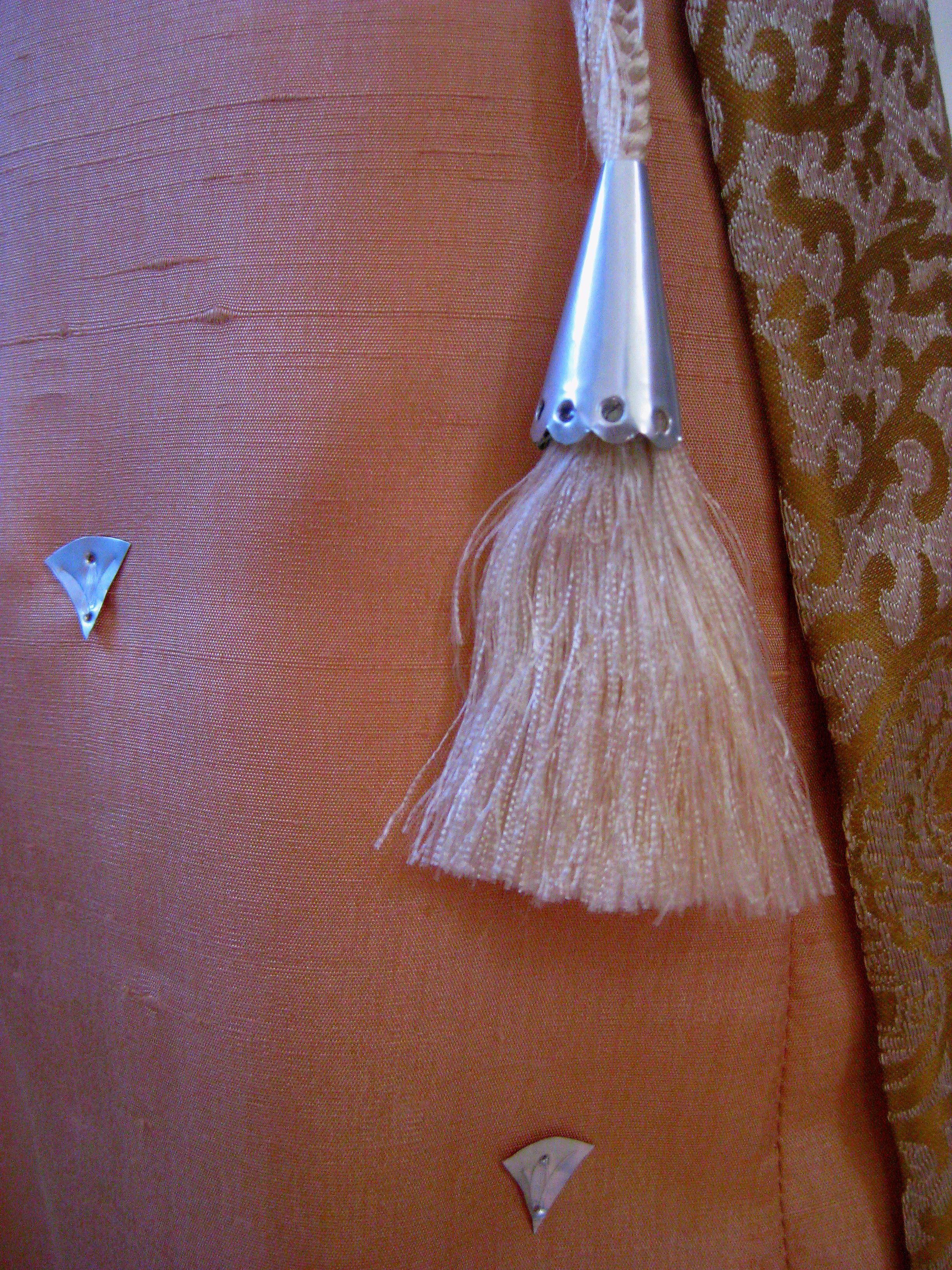 However, the recycling bin is always close at hand, and I could not help but accent the front of the dress with aluminum cans cut into elegant little shapes and engraved with an old pen!
3. Miniatures – You might not realize it from the photos, but this garment stands only 33 inches tall! For years all of my work has been full size and wearable, but recently I have enjoyed the freedom gained from taking these requirements away. For example, the cape on one of my pieces made last year called the Environmental Steward-ess, is bolted into the dress-form making it impossible to be worn. Making miniature garments seemed like another interesting direction to explore. The dimensions of this dress-form are approximately one half of a woman’s size 10 form. I made it out of foam scraps left over from Astilli Fine Art Services, the business that crated my Obamanos Coat sent to the Smithsonian last year. (They are also going to crate 18 more pieces for my traveling exhibition’s upcoming museum tour– but that is another story, stay tuned.)
I wondered if creating a smaller fashion sculpture would take less time, 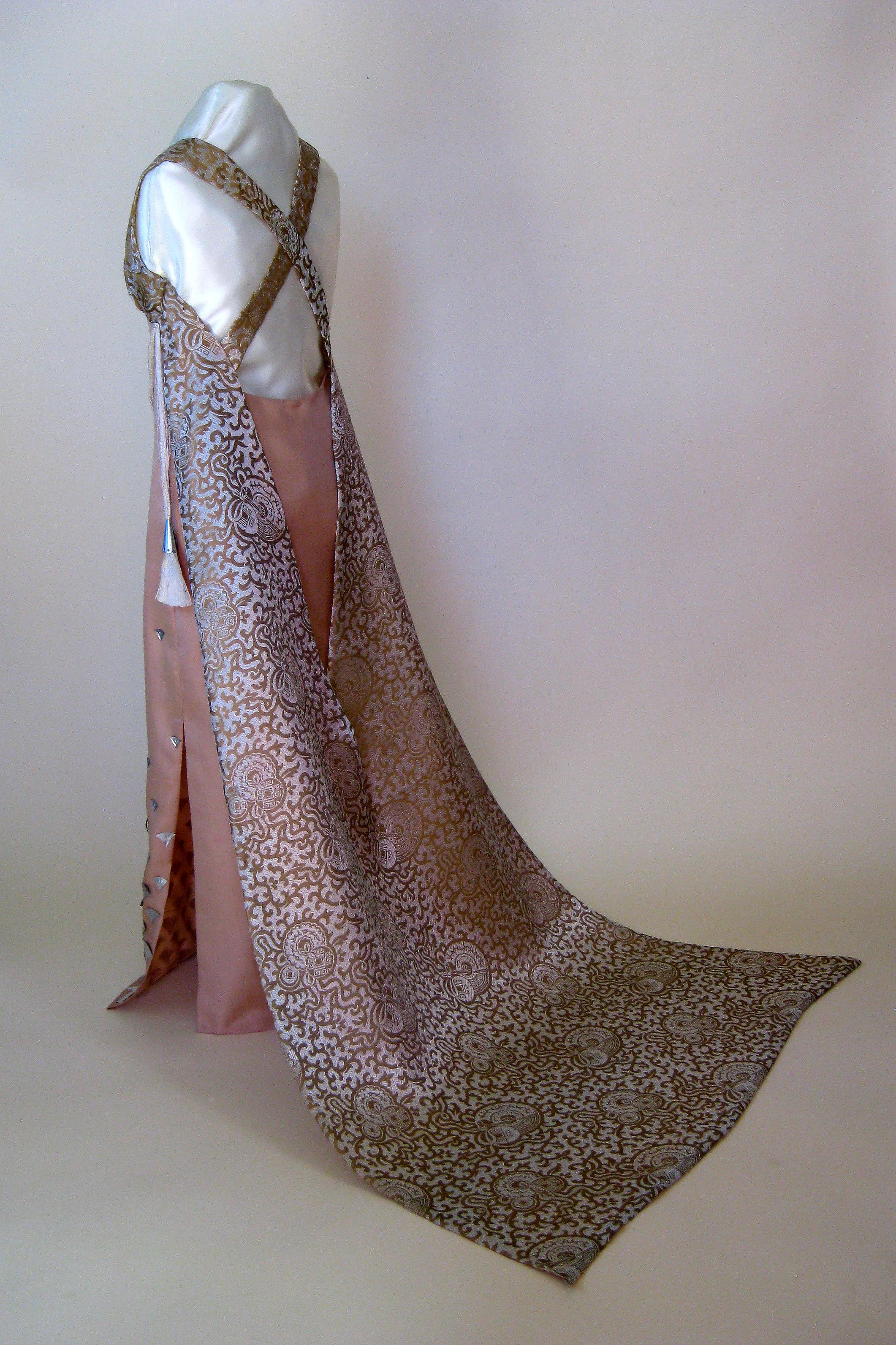 and the answer is: yes, and no. The garment itself actually took about 55 hours to design and create because the unusual design required a lot of tinkering to get it just right. However since the dress was so small it did take less time to cut, prepare and sew all of the aluminum accents. (Thank you to Samantha Brody, my new intern from the Santa Fe University of Art and Design, for helping to cut the aluminum cans.) My other garments have taken from 100-650 hours to complete, this piece took me about 100 fully enjoyable hours to create!
Re-visioning Erté will make its début this week at an exhibition called the Art of the Dress at the Millicent Rogers Museum in Taos, New Mexico. I was invited to participate in this show by Susan Berk the Chair of the Board of Directors for the New Mexico Committee of the National Museum of Women in the Arts. The exhibition will be on display from March 16 – April 15, 2012.
I look forward to seeing everyone’s response to my winter indulgence!
 In December I had the adventure of a lifetime traveling in India for three weeks! I was mesmerized by all the beautiful colors and patterns everywhere I looked– saris worn by women riding on the back of motorcycles, bright ornamentation on trucks carrying rubble, and tiny red bracelets and garlands of marigolds as offerings in roadside temples– the eye was always resting on something stunning!
This amazing trip was made possible by some international plane tickets that I received as partial payment for the Environmental Steward-ess garment that Delta Air Lines sponsored last year. It is a part of my current exhibition on display in the Atlanta Airport through May 2012.
While visiting this wonderful country, my partner, Nicole, and I were fortunate to visit a very special program in Mumbai called MarketPlace: Handwork of India. It is a fair trade, not-for-profit organization which creates lasting change in the lives of low-income women in India. An impressive 480 artisans are organized into 14 independent co-operatives which produce women’s apparel and home decor. In addition, programs offer educational and enrichment opportunities designed to help the artisans overcome personal, cultural and financial obstacles.
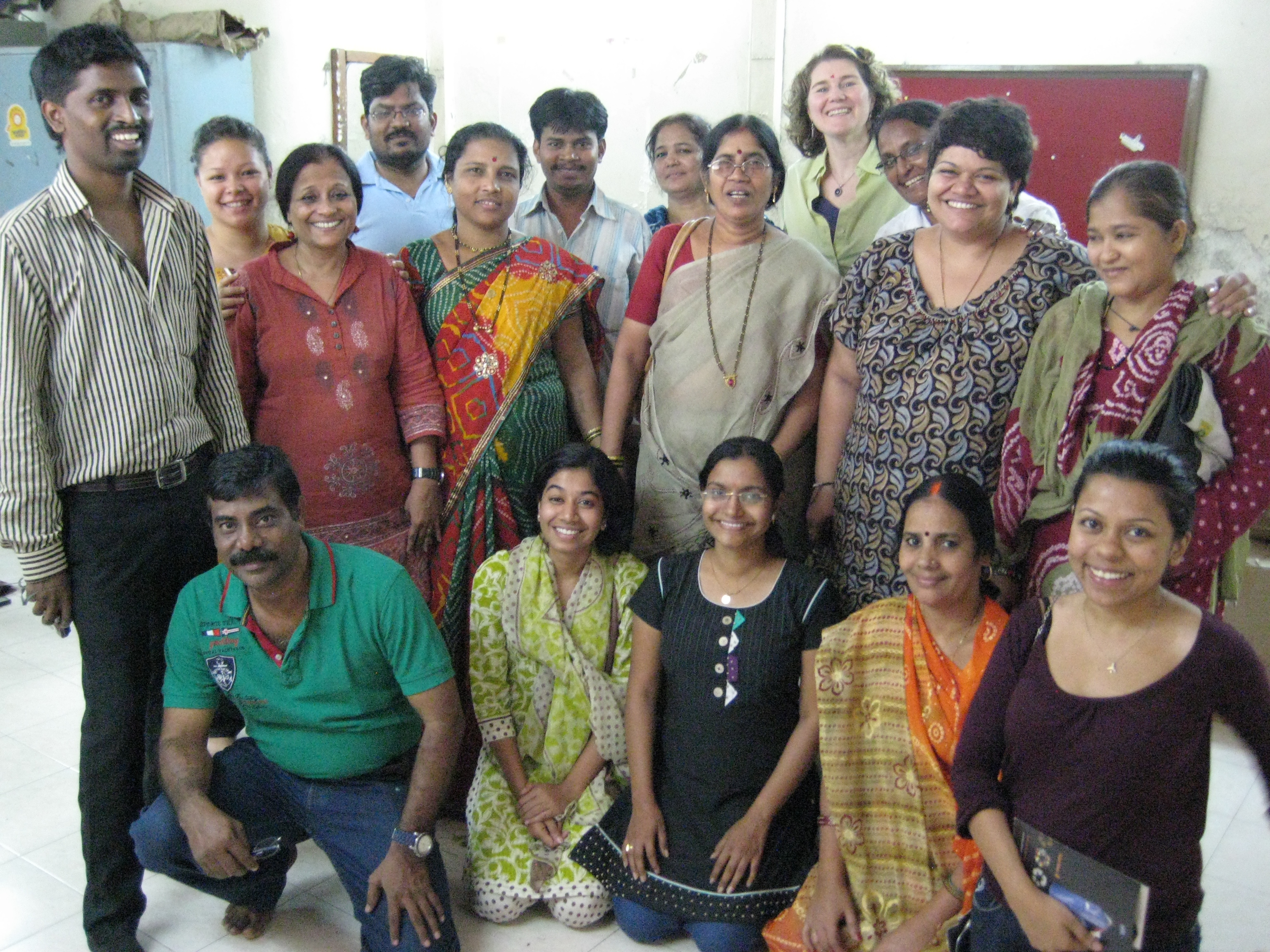
We were warmly welcomed to a gathering of about 20 primary staff members with a cup of masala tea (chai), a rose, and red powder blessings placed on our foreheads (bindis). As we sat around a circle with the whirring of the fans keeping the room cool, I gave a brief description of the recycled fashions that I make from trash and the environmental education goals behind my work. Then each staff member described their role in the MarketPlace while the team leaders explained the focus of each of their co-operatives. Many had beautiful samples and talked about their teams with great pride. Most of the work they do involves sewing and embroidery – clothing, purses, oven mitts and even computer bags. Like any successful garment business, MarketPlace has multiple designers (from around the world,) a quality control department, beautiful (and educational) catalogs, plus an excellent website and blog. I was impressed at how many of the staff had been with the organization for so long… some for over 25 years. MarketPlace is clearly more than an employer; it is a close-knit family that cares for each other!
Yogesh, pictured in the photo with me on the right, was our very gracious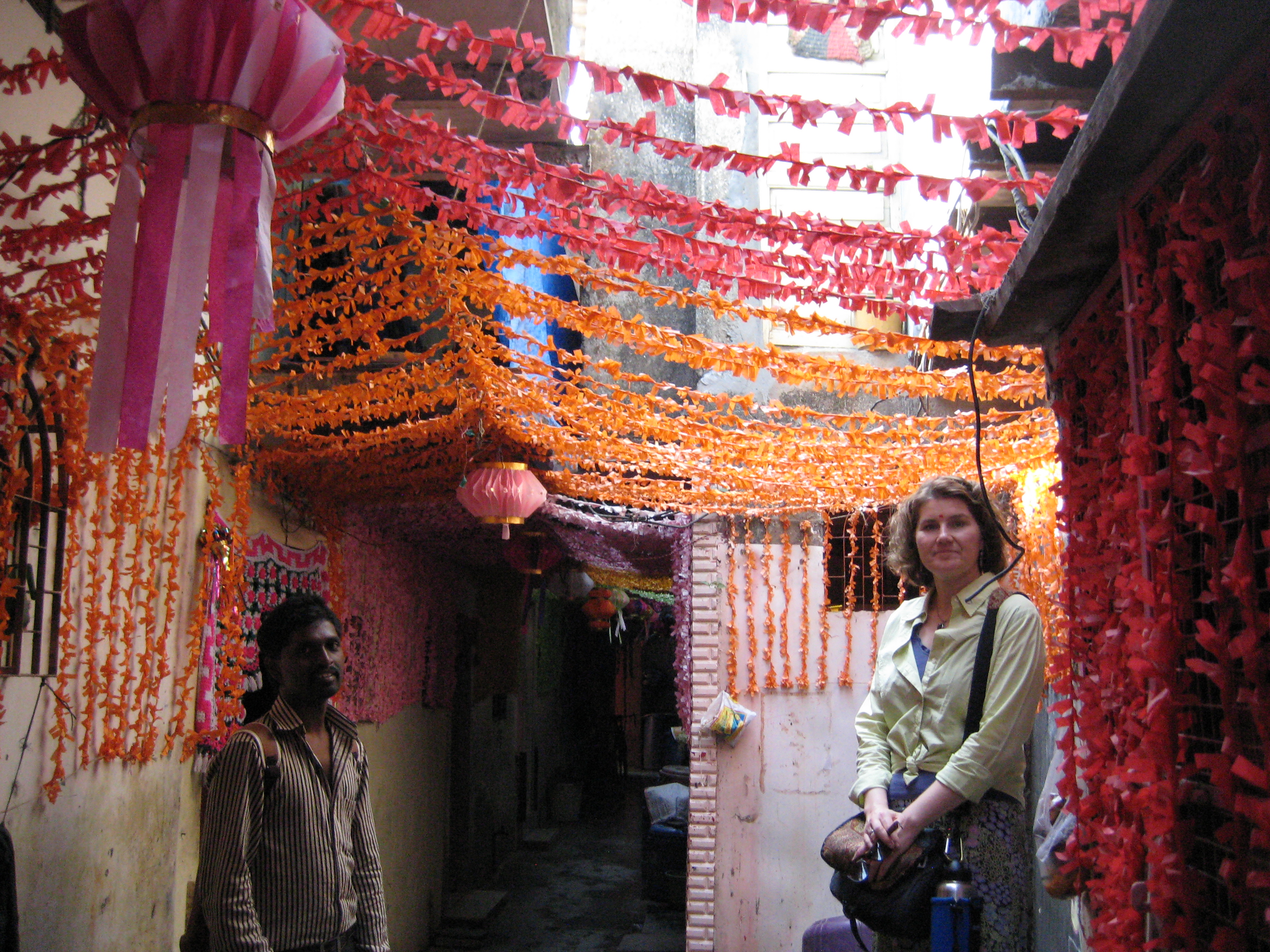 guide and translator for the afternoon. He gave us a special tour of several of the nearby workshops, many of which were located in one of the large city slums. We toured through some of the corridors and alleys behind the scenes off the major streets on the way to the various workshops. In one alley we saw a beautiful canopy of lanterns and flowers from the festival of lights celebrated in November.
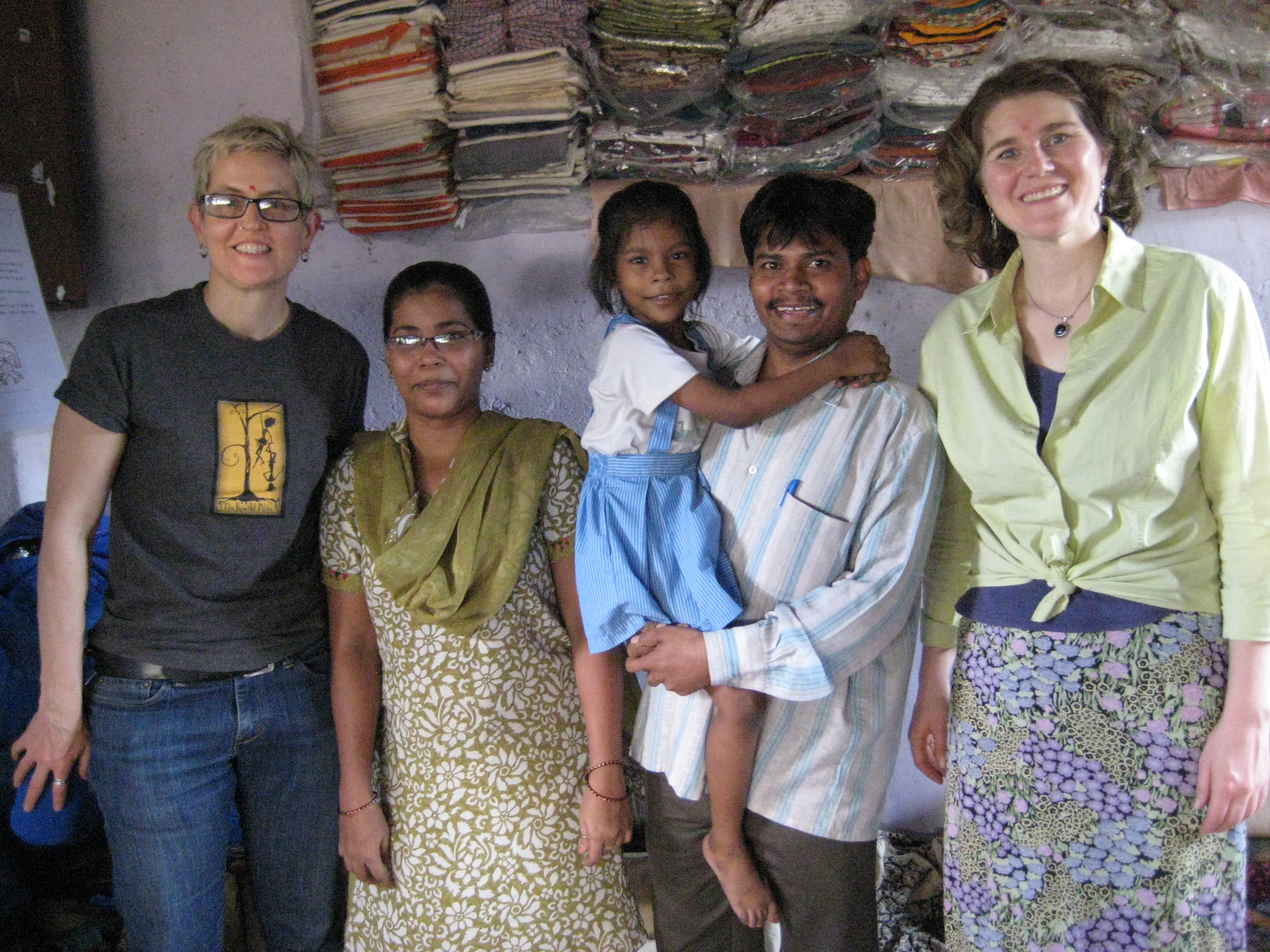 At one of the workshops we met the manager’s wife who delighted in assisting us with picture taking and his daughter who wore a very clever smile and pranced cheerfully in her school uniform. Visiting the workshops and meeting the women that worked there was such a great honor and delight. The spaces themselves were very simple and some might be, to American standards, a bit crowded. But they are clearly very productive, and all the women were very good natured, laughing and talking. The close knit relationships were very clear and the banter, though we could not understand it, was delightful! Often someone would translate or ask us a question in English. One of the really neat things that MarketPlace provides is the capability of the employee to work at home since many of the women are mothers and wives who are also tending to a family.
MarketPlace is designing new products using “chindi”, scrap pieces of fabric. They 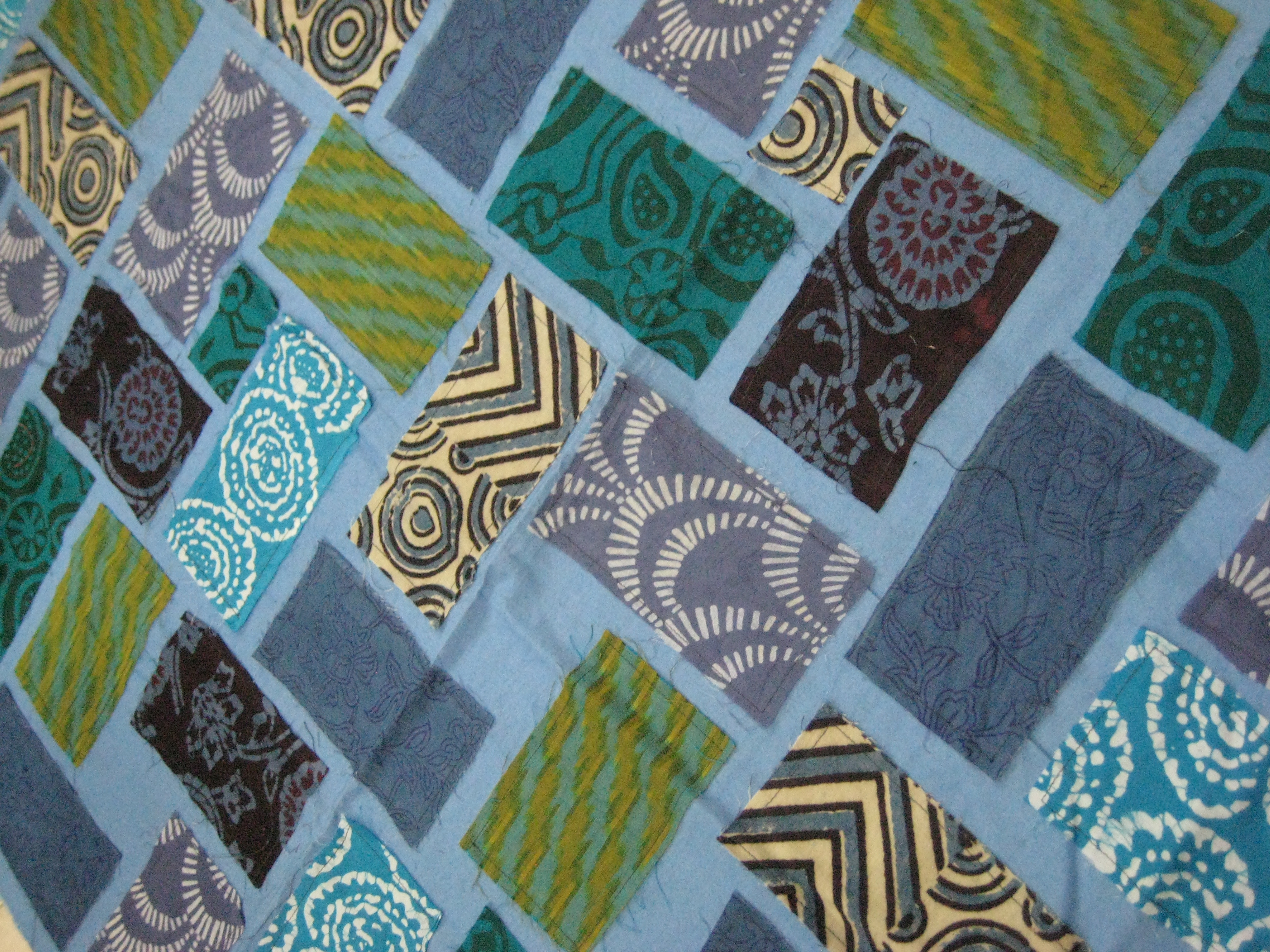 asked us for design suggestions and we have been giving ideas as they come– hopefully they will be of some use. I’m sure, however, that their VERY creative group of artists and designers will have no shortage of fantastic ideas! On the right is a photo of a “patchwork fabric” they have created with scraps that can be made into any number of items.
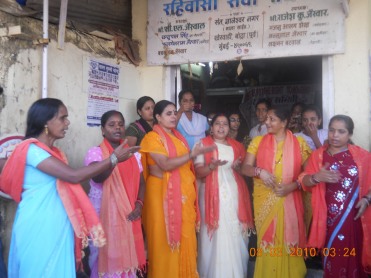 Before we left, we watched some of the women practicing a play about domestic abuse. Even before it was interpreted for us, we were moved by the passion of the women. It was sad to learn about the role that in-laws (especially mother-in-laws) often play in domestic abuse. The issues of arranged marriages and dowries complicate the problem as well. This play is presented to the public for educational awareness and discussion of a topic that can still be taboo.
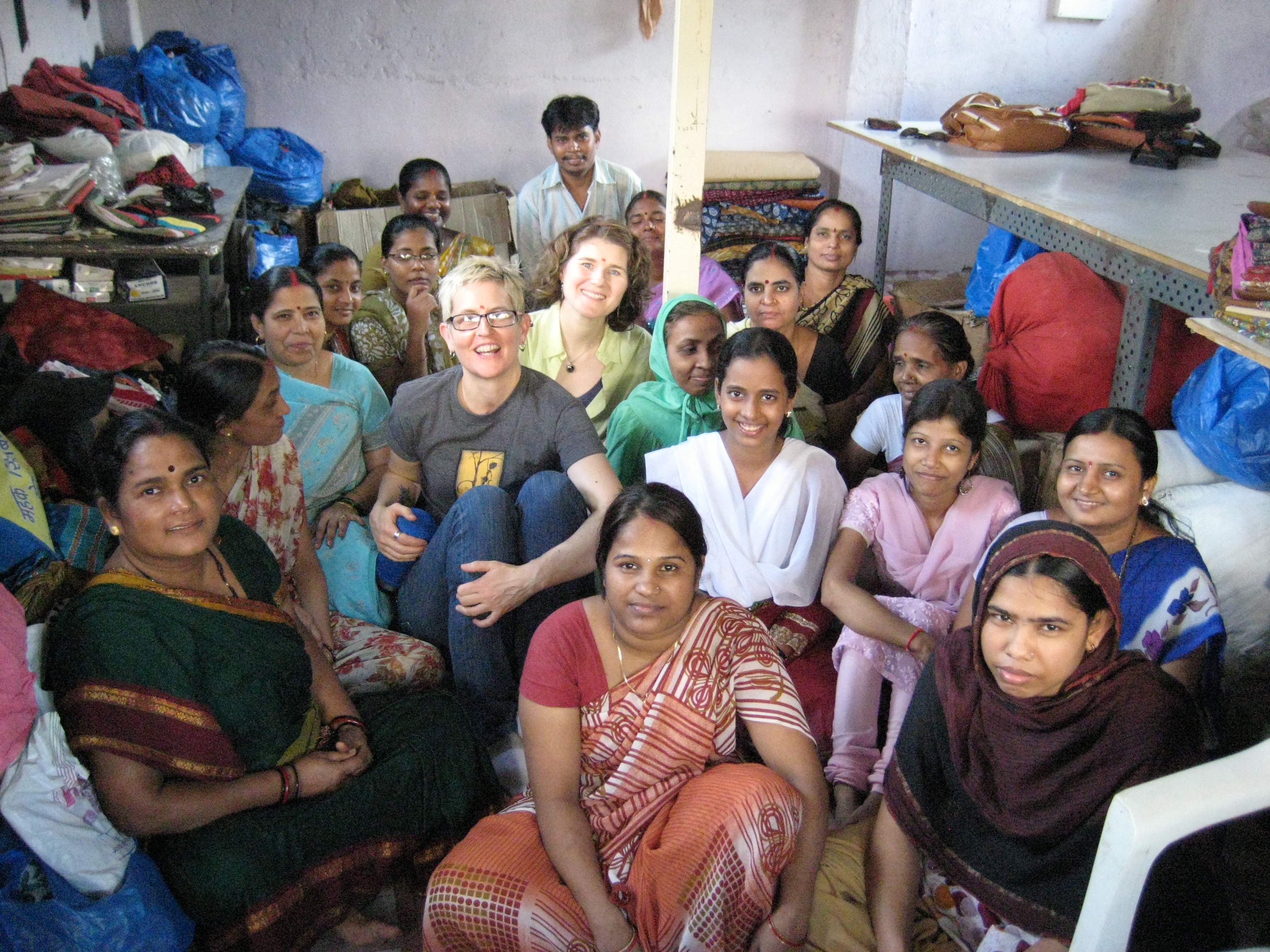 My favorite part of the day was captured in this photo. We spent a long time sitting and chatting with a group of artisans in the afternoon. We asked each other questions about our work and personal lives. I was stealing up-close peaks at their beautiful saris and scarves, thick black hair and lovely gold jewelry. Though I felt quite plain in comparison, I caught several curious glances my way too. Our day with the women and men who work for the MarketPlace rivaled even the exquisite Taj Mahal for my favorite experience in India!
Crime Scene
Police tape is fashioned into “warning-wear”.
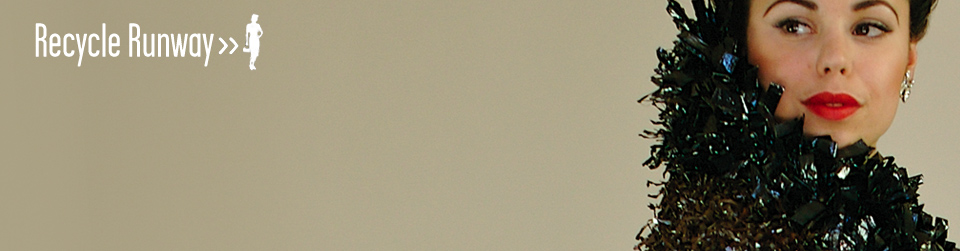
Tape from police crime scenes across the west, cover a dress made from torn table cloths. This cautionary costume took 50 hours to create and was completed in 2011.
Read a blog post about creating Crime Scene.
__________________________________________
Scientists estimate that everyone alive today carries within her or his body at least 700 contaminants.
90 percent of the 85,000 synthetic chemicals registered today in the United States, have NOT been tested for their effects on human health. Many of these chemicals persist in the environment and accumulate in our bodies creating susceptibility to cancer as well as many other health problems.
Don’t let your body be a crime scene! Reduce your families exposure to toxins by eating organic food; eliminating pesticides, chemical cleaners and air fresheners from home and work; and “air out” new carpets, painted rooms, furnishings, and anything else with that “new smell” before indoor use. Better yet – buy safer products that don’t off-gas toxic fumes.
Sources: Coming Clean, Breast Cancer Fund, Healthy Child/Healthy World
Eco-Flamenco
5,000 people helped create this passionate dress!
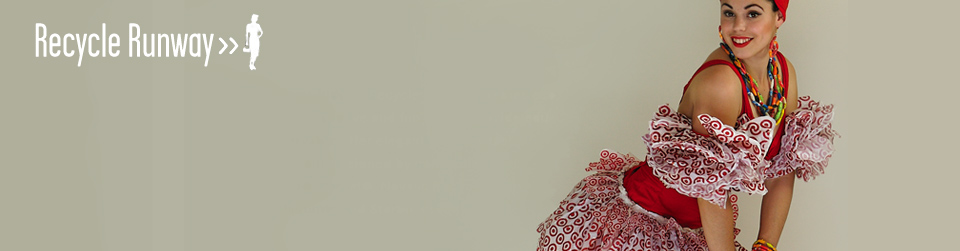
Cereal boxes painted with recycled paint have been transformed into cascades of ruffles that contain over 5,000 eco-pledges—commitments of actions that people will take to help the environment. The ruffles cover a dress made from parachute scraps. This dramatic dress took 650 hours to create and was completed in 2011.
___________________________________________________________________________________
Which one of the following was NOT an eco-pledge sewn to this dress?
- I will shop locally.
- I will eat organic food.
- I will live in a tree and eat bananas.
- I will use my car less.
- I will reuse and recycle everything I can.
Answer: 3.
We don’t have to live like monkeys to live lighter on the earth! Every moment we make simple decisions that affect the planet. What can you do in your life to help the environment?
ReDress: Upcycled Style
Eighteen of Nancy Judd’s enchanting couture fashion sculptures made from trash traveled to museums and art centers around the United States from 2013-2017. Watch this interview with Nancy talking about the ReDress exhibition.
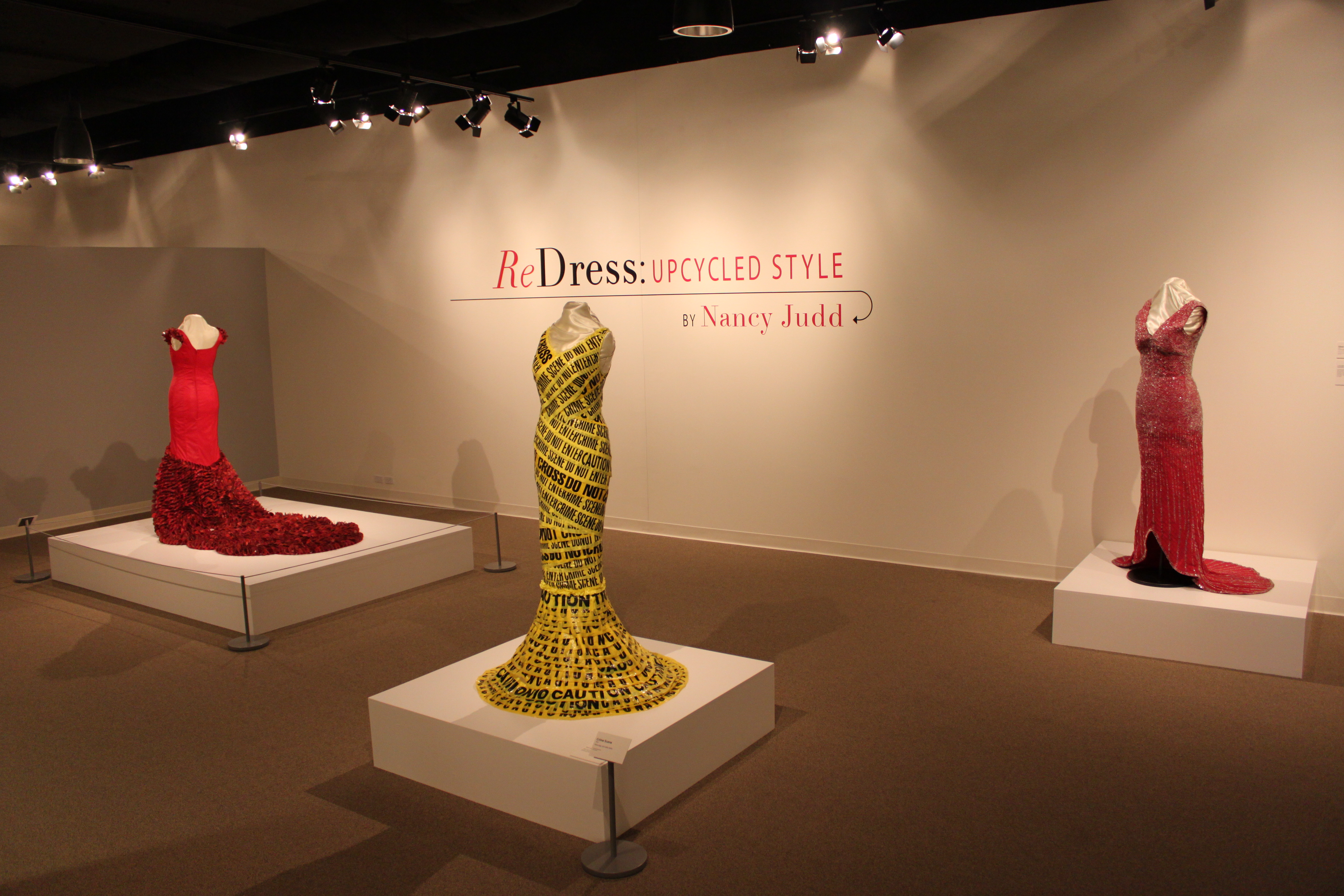
Ruth Funk Center for Textile Arts, 2013
“The ReDress exhibit has been a gem to have within our walls and has sparked conversation and imagination among visitors, volunteers, staff and the campus. Your message is delivered in such a positive way that it motivates and excites individuals to want to become more aware of the impact their daily life has on the planet.”
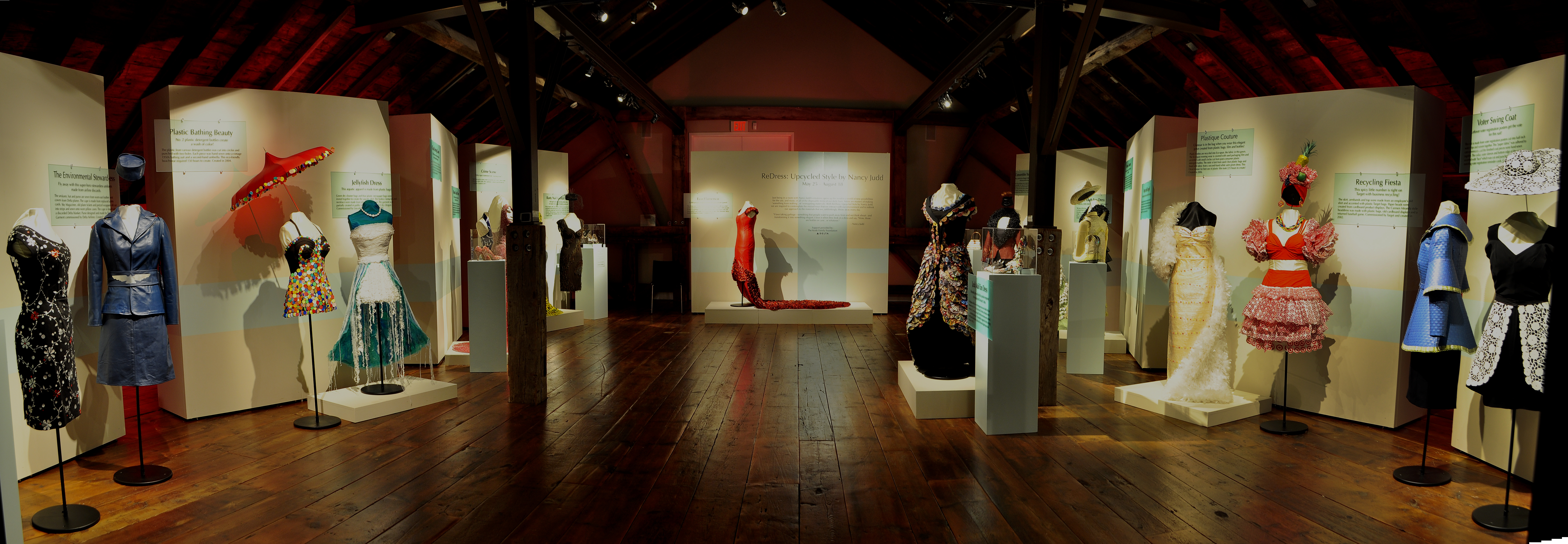
Bascom Center for Visual Arts
“Everyone in Highland is talking about your exhibition – lots of good buzz about the Bascom.”
“We are absolutely thrilled to have this show and the response from visitors is nothing shy of amazing.”
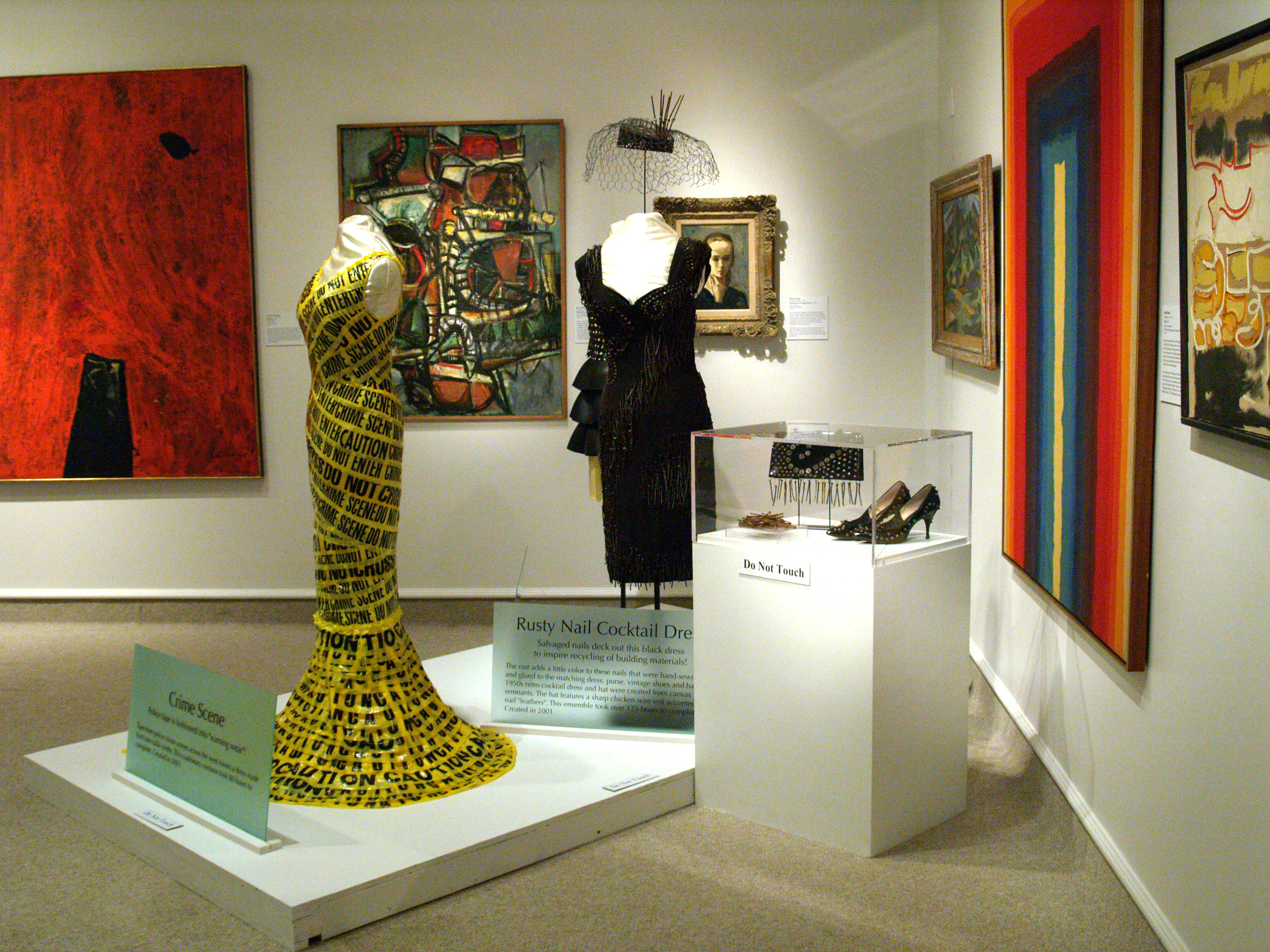
The Reading Public Museum
“ReDress:Upcycled Style by Nancy Judd is more than just an exhibit. It’s an idea transformed into something people will remember, something that will make an impression on them. Judd takes discarded waste and turns it into something beautiful. Trash becomes a dress, shoes a purse or a hat that can be displayed to show people how they can help the environment and upcycle.”
Article from a student review of the exhibition.
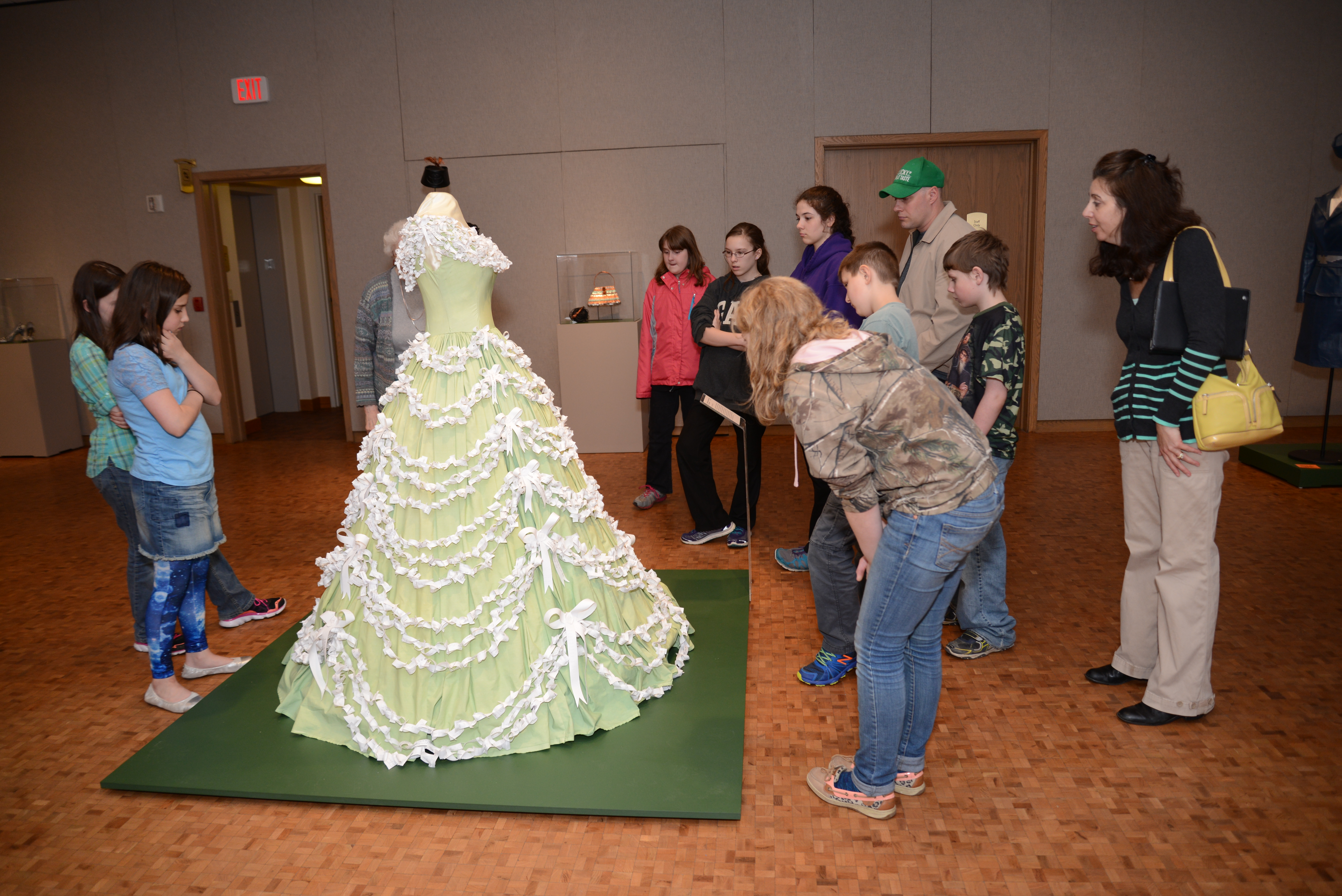
Woodson Art Museum
“Nancy led a gallery walk on the final afternoon of her artist residency, May 1-4. On the first sunny afternoon after a long Wisconsin winter, more than 30 visitors flocked to the Museum for this program. Nancy ascertained the makeup of the group and tailored her comments to ensure she provided fresh content, different from her previous residency programs so that it wouldn’t be repetitive for those who attended previously. Her frank, open comments about her artwork and acceptance of commissions were well received and appreciated and likely encouraged visitors to pursue their career path with a realistic mix of passion and pragmatism.”
Exhibition Schedule:
- The Ruth Funk Center for Textile Arts in Melbourne, Florida – Winter 2013
- Bascom: Center for Visual Arts in Highlands, North Carolina – Spring 2013
- Reading Museum in Reading, Pennsylvania – Fall 2013
- Woodson Art Museum in Wausau, Wisconsin – Spring 2014
- Stamford Museum in Stamford, Connecticut – Spring 2015
- Artesia Historical Museum and Art Center in Artesia, New Mexico – Winter 2016/Spring 2017
- Farmington Museum in Farmington, New Mexico – Winter 2017/Spring 2018
- Fort Collins Museum of Art in Fort Collins, Colorado – Summer 2017
See a video of ReDress at the Ruth Funk Center.
Photos by Sarah Jane Smith (Funk) and Ian Michael WardPs (Bascom)
Recycle Runway in Airports
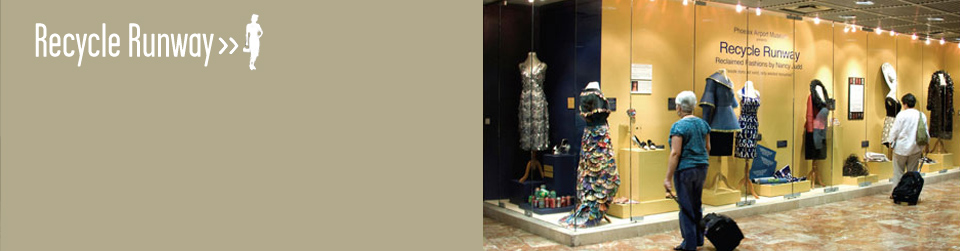
Airports provide Recycle Runway an opportunity to reach millions of international travelers often with time to spare. Airports include public art in their buildings to reduce the stress associated with airline travel, and Recycle Runway provides an engaging and educational experience to passengers while they wait for their plane.
Nancy is excited to announce that due to the popularity of her first exhibition in the Atlanta Airport, they have invited her back to install a 2nd show of all new work in 2017!
Following are the airports participating with Recycle Runway:
- 2nd Exhibition, Hartsfield-Jackson Atlanta International Airport, Fall 2019
- Hartsfield-Jackson Atlanta International Airport, Feb 2011- Mar 2012
- Phoenix International Airport, Feb 2010-Sept 2010
- Pittsburgh International Airport, Aug 2008-Aug 2009
- Albuquerque Sky Harbor International Airport, Oct 2007-Jan 2008
Recycle Runway in the Phoenix International Airport
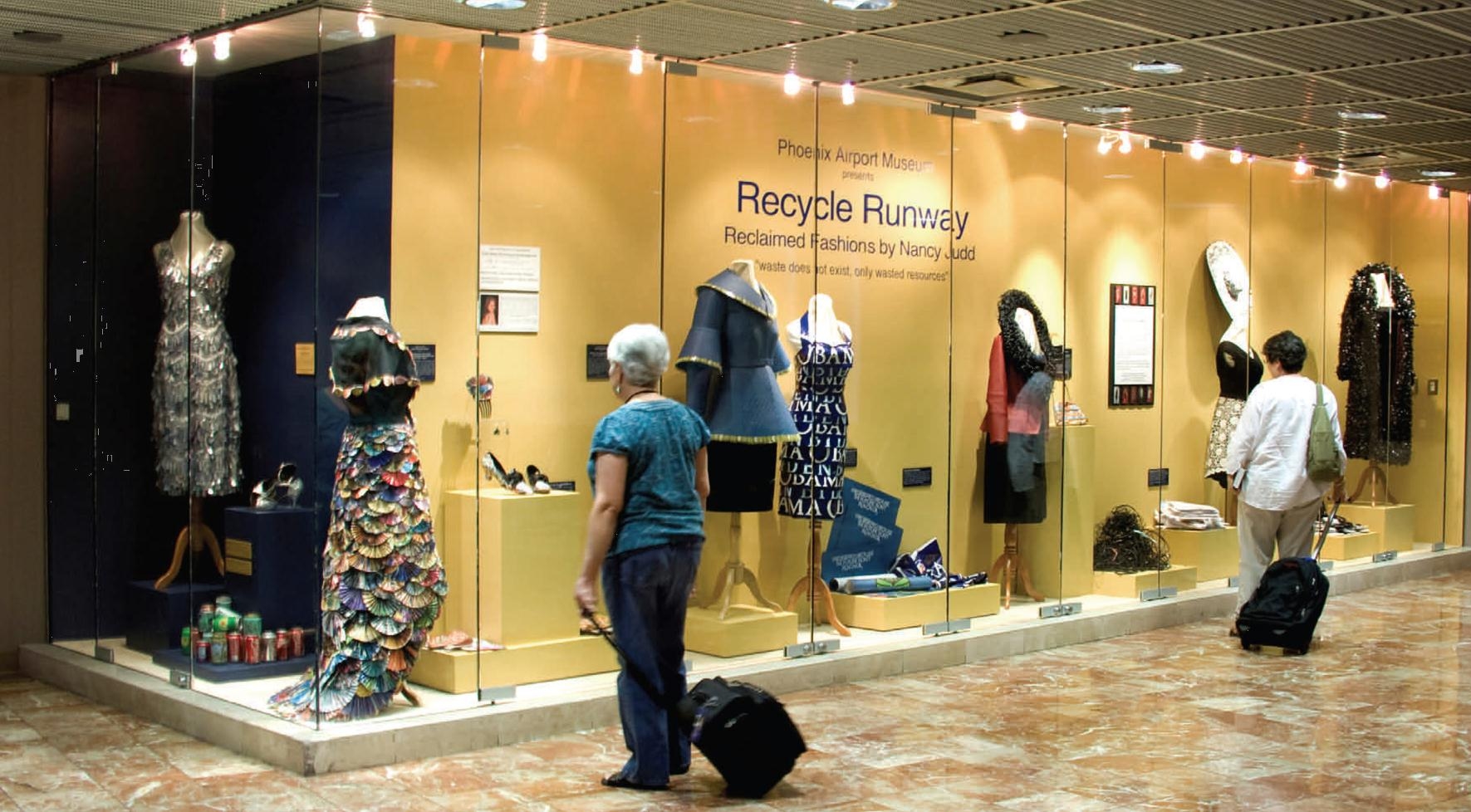
Praise about the Recycle Runway Exhibition:
“Nancy Judd’s Recycle Runway installation was one of our most popular exhibitions.”
David Vogt, Hartsfield-Jackson Atlanta International Airport, Airport Art Program Manager
2012 Hartsfield-Jackson Atlanta International Airport Exhibition
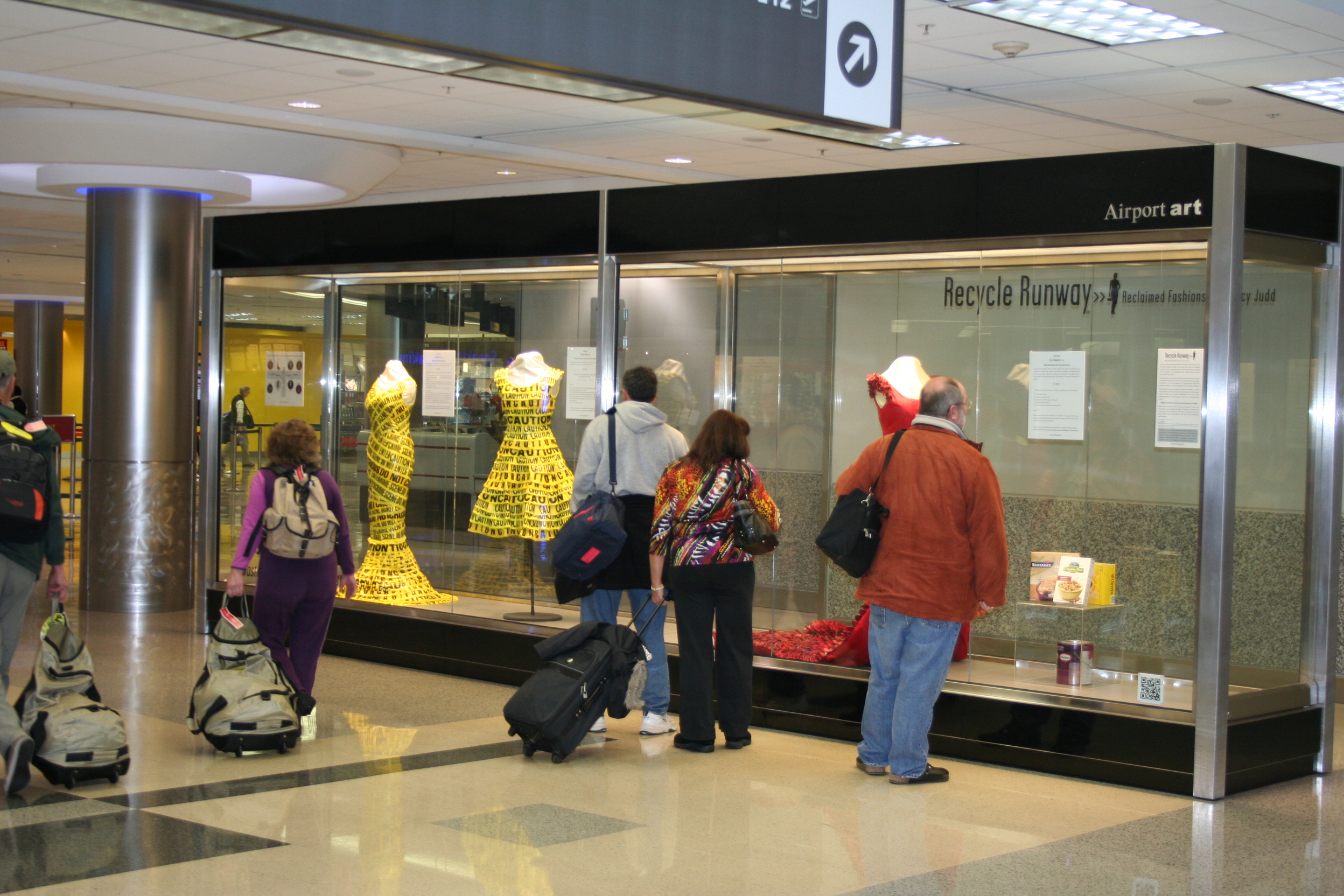
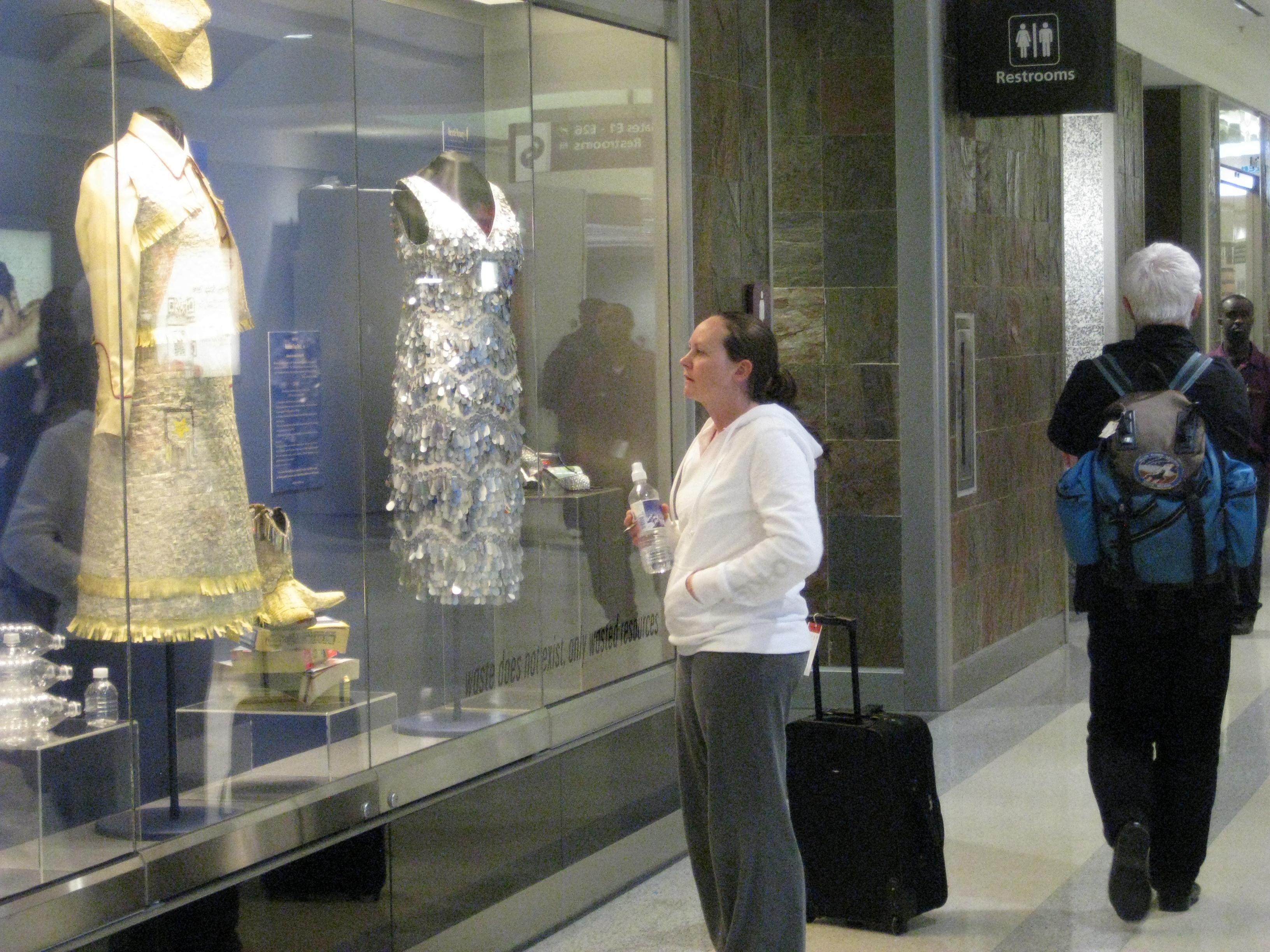
Nancy Judd’s Recycle Runway exhibition in the ATL Airport, 2012
Twenty one of Nancy Judd’s eco-fashion sculptures were installed in ten cases located throughout international Concourse E from May 2011-June 2012. You can read blog posts about her midnight adventures installing the exhibition and a final report on the installation. You can also take the Eco-quiz and perform some E-activism that was a part of the show.
The following video showed on the CNN channel at every gate through out the Atlanta Airport several times a day during the exhibition!
 |
Thank you to Atlanta’s Airport Art Program staff and the sponsors for making this exhibition possible! |
Caution Dress
Made from caution tape, this dress signals a strong warning!
Caution tape recovered from the side of the road was sewn onto a vintage sundress. This serious eco-wear took 50 hours to create and was completed in 2011.
Read a blog post about creating the Caution Dress.
__________________________________________
Global output of heat-trapping carbon dioxide jumped by 6% in 2010. This increase in carbon dioxide is very disturbing for two reasons: 1.) it marks the biggest increase on record, and 2.) the new figures for 2010 mean that levels of greenhouse gases are higher than the worst case scenario outlined by climate experts just four years ago. This information represents a clear CAUTION that the world’s efforts to slow man-made global warming are not enough, and we need to take more drastic measures.
Source: U.S. Department of Energy
