Eco Trash Couture
To View Project Details


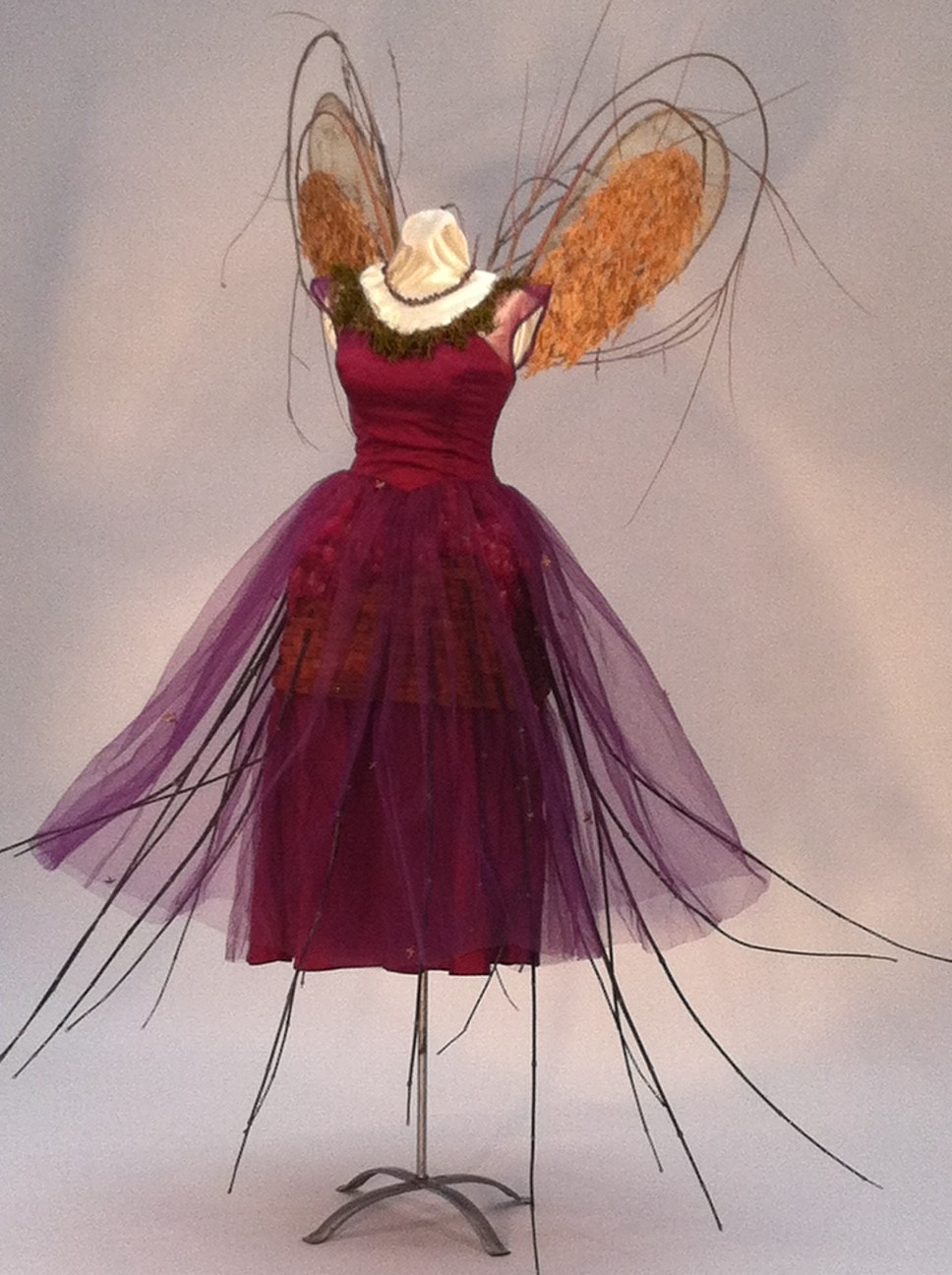
“Opal” by Nancy Judd
This spring of 2013 I was invited, along with 15 other Santa Fe artists, to create a new sculpture for a fundraiser for the Nature Conservancy and the Santa Fe Farmers Market. The event is called “Picnic for Earth” and is organized by the Patina Gallery next to the Santa Fe Plaza.
Each artist was given a beautiful oak picnic basket and encouraged to transform it in anyway that inspired us . The day I picked up my basket from the Patina Gallery, I took it home and buried it in the back yard! Having worked exclusively with trash for the last 15 years, the newness of the basket was blinding to me. It felt strange and pretty ironic to intentionally ruin the new basket but such are the dilemmas I face as an environmental artist! So, first I submersed it in my rain barrel, and then I buried it in the dirt. When I went to dig it up a month later, it was frozen in the ground and took me several weeks to finally unearth.
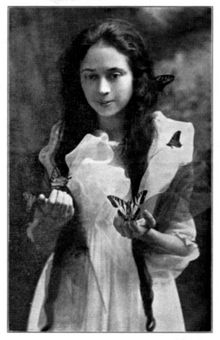
Opal Whitely
The inspiration for this piece I knew had to come from nature, but I was not clear exactly what that would be until, one morning, I awoke thinking about Opal Whiteley. As a teenager I had read “The Story of Opal”, the diary of a young girl living a hard life in logging camps amongst the forests of western Oregon. I remember being very inspired by her vision of, and conversations with, the spirits of the natural world. Creating a fairy that personified the spirit of the land seemed like a perfect fit for this project.
I had read Opal’s diary at Cascade Head Preserve, a Nature Conservancy site on the Oregon Coast. My parents had bought adjacent land in Cascade Head Ranch in the 1970s and had built a house overlooking the Salmon River Estuary. Starting when I was 7 years old, I had spent most weekends and summers at Cascade Head.
I am very grateful to the Nature Conservancy because it was on their land that I developed my appreciation for nature, which lead to my career in environmental education. It is a great honor to create this piece to benefit the Conservancy and the Santa Fe Farmers Market, which I visit religiously every week.

Nancy collecting materials at the Santa Fe Canyon Preserve
In addition to the picnic basket, I used a vintage dress given to me by a friend; plants that I collected at the Conservancy’s Santa Fe Canyon Preserve; and dried flowers from the Santa Fe Farmers Market. The branches are from different types of willows; the seeds on the wings are from a box elder; the necklace is made from juniper berries; the pods on the dress are clematis; the foliage around the neck is juniper mistletoe; and the petals on the picnic basket are dried peonies, marigolds and roses from the Santa Fe Farmers Market.
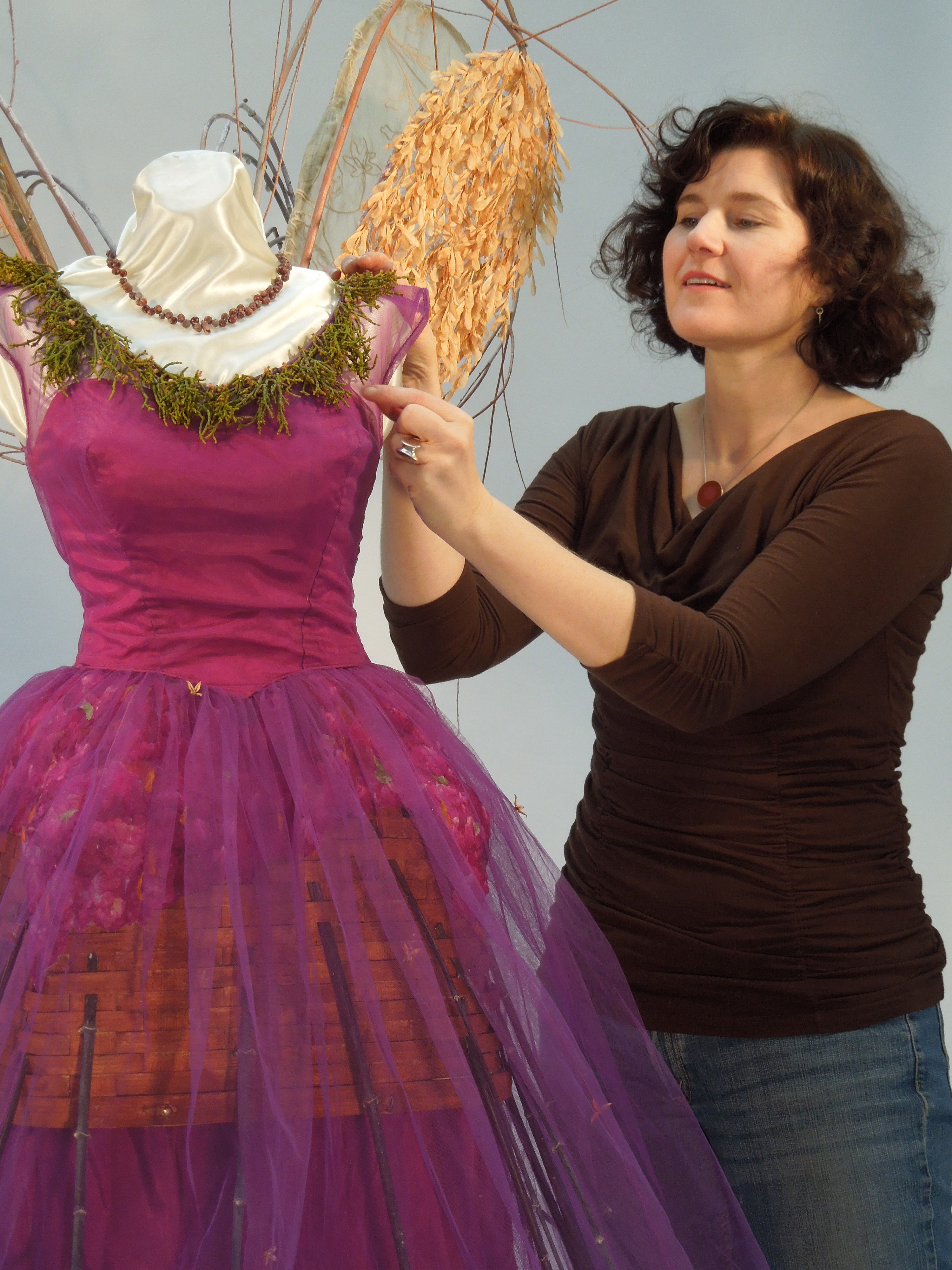
Detail of mistletoe and picnic basket on” Opal”
I did not know that the chartreuse foliage around the neckline was mistletoe until someone at the Nature Conservancy identified it for me. After a bit of research, I realized that it is a perfect fit for this garment. Mistletoe is a parasitic plant, deriving nutrients from its host. It is reported to have “a disproportionately pervasive influence over its community”. It can kill its host through invasion, but is also said to have a positive effect on biodiversity, providing high quality food and habitat for a broad range of animals in forests and woodlands worldwide.
As the spirits of nature create an image that we might recognize as human, what more perfect plant than mistletoe could they chose? Humans, like mistletoe, are often invasive and destructive, but our actions can also be beneficial, as seen by inspiring organizations such as the Nature Conservancy and the Santa Fe Farmers Market!
One morning while creating this dress, I awoke with the following poem in my head. It is the first time I have written a poem to accompany a garment and it felt like a perfect fit.
More and more, the spirits of the land
felt forgotten by humans,
and before they disappeared altogether
they decided to make themselves seen.
So branches, flowers and seeds
wove themselves together
and created a sprite to say:
As you pollute the air, the water, the soil,
as you cause plants and animals to die away
as you change the very earth itself
DON’T FORGET US.
While you live your lives–
dancing, working, singing, loving, praying–
remember our wildness in yourselves!
Nancy Judd, 2013
The opening for the “Picnic for Earth” is at the Patina Gallery on April 5, 2013 from 5:30pm-7:30pm. The show will be on display through April 26th. Patina Gallery is located at 131 West Palace Avenue, Santa Fe.
If you live in or near Santa Fe, I hope you can come to the opening on the 5th to see “Opal” in person!
Also, watch this video created by the Nature Conservancy about creating Opal.
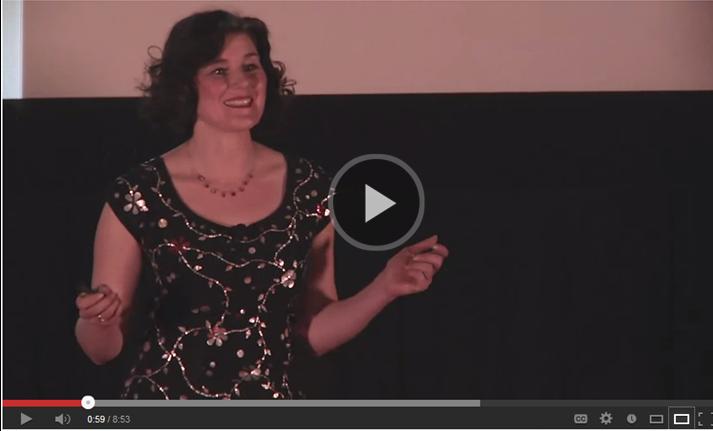
In November 2012 I gave my second TEDx talk at an event called TEDxAcequiaMadre in Santa Fe, NM. My first TEDx talk was in Albuquerque (TEDXABQ).
If you are not familiar with TED talks they are global conferences focused on “ideas worth spreading.” TED stands for Technology, Entertainment and Design, the beginning of their inspiring mission reads: “We believe passionately in the power of ideas to change attitudes, lives and ultimately, the world. So we’re building here a clearinghouse that offers free knowledge and inspiration from the world’s most inspired thinkers, and also a community of curious souls to engage with ideas and each other.” It is a great honor to be part of this community! TED talks can be viewed for free at www.TED.com. In 2009 local, self-organized conferences called TEDx events began internationally. As of the end of 2012, more than 16,000 talks have been given at more than 5,000 TEDx events in 1,200 cities in 133 countries.
Having given one TEDx talk already I did feel more prepared, but it still took a tremendous amount of time to write, reflect and practice. Since it is required that you memorize your talk, NO reading or notes, I spent 100s of hours practicing. Giving a TED talk is a commitment and experience unlike any other I have had!

Crime Scene and the Caution Dress
in the Atlanta Airport Exhibition, 2012
In my presentation I focused on a garment I created in 2012 called “Crime Scene” for my exhibition in the Atlanta Airport. The dress is part of a mini-collection made from police tape– the other dress, the “Caution Dress”, I made to wear for TEDxABQ. For my talk in Santa Fe I wore a dress commissioned by Coca-Cola in 2006 called Pop Can Couture made from aluminum cans cut into flowers, leaves and petals and sewn to a dress made from canvas scraps.
I titled my TEDxAcequiaMadre talk: “Undressing the Crime Scene– Addressing how to Slow Climate Change”. I feel like it is the first time that I have addressed the climate crisis this directly in any of my presentations.
I used the dress, Crime Scene, to explore how we have poisoned both the body of Mother Earth and our own bodies. As I share in the talk, when researching this presentation I fell into an armageddon panic about what we have done to the planet and the myriad of overwhelming problems that humanity is facing as a result. However, after a couple of weeks I managed to find my way back to the essence of what my work is about: creating a positive way to address these serious issues that does not instill guilt nor fear but instead inspires hope and action.
I would love to hear your reflections on my talk in the comment box below!
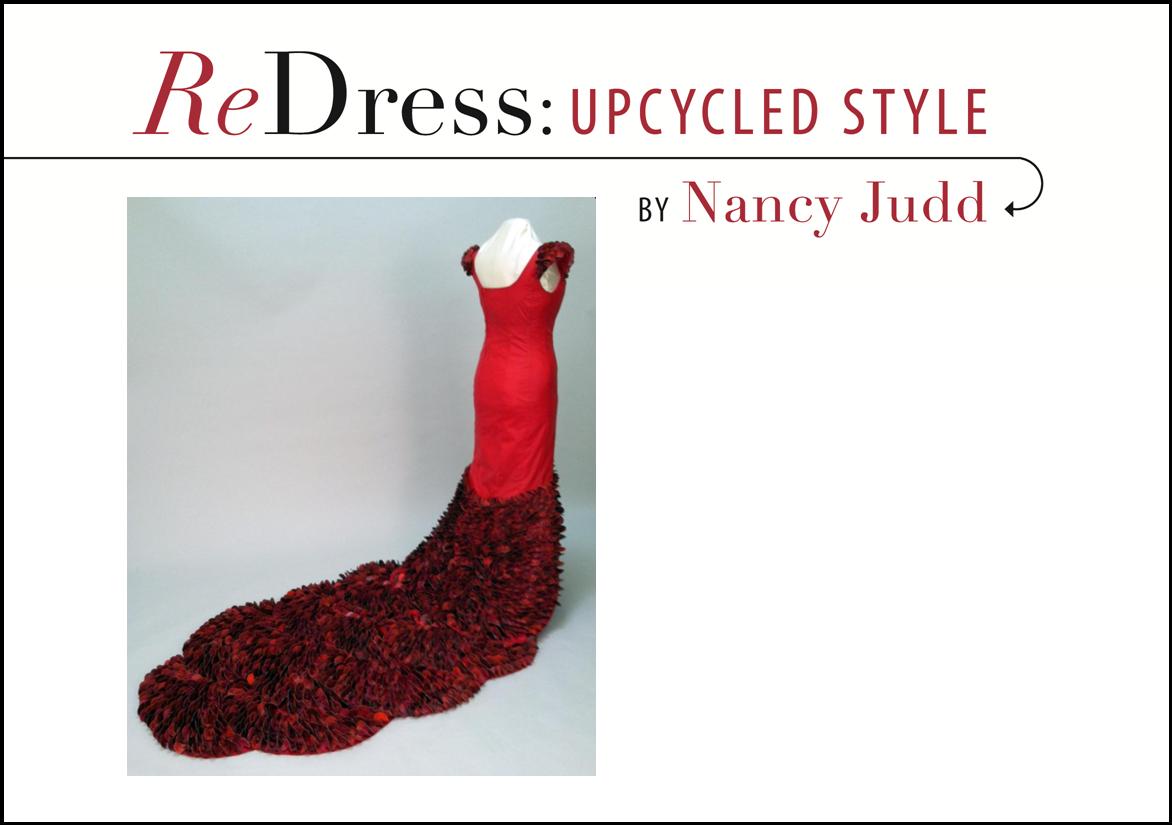
I am thrilled to announce that this month my collection of recycled fashions will begin a tour of museums around the United States!
ReDress: Upcycled Style is the name of the traveling exhibition that features eighteen of my pieces. Each site will host the show for approximately three months. I hope this exhibition will be touring for at least the next five years. Following are the first three organizations that have signed-up to host the ReDress exhibition:
- January 2013 – Ruth Funk Center for Textile Arts at the Florida Institute of Technology in Melbourne, Florida
- Spring 2013 – The Bascom Visual Arts and Education Center in Highlands, North Carolina
- Spring 2014 – Leigh Yawkey Woodson Art Museum in Wausau, Wisconsin
I am very excited to work with each of these institutions and see how they choose to exhibit my garments and interpret the educational portion of my work.
My idea for this traveling exhibition began when I was introduced to Cynthia Graves by my friend Aurelia Gomez at the The Museum of International Folk Art in Santa Fe. Cynthia’s company, Guest Curator, is an independent traveling exhibitions service which means that she offers museum quality exhibits in art, history and popular culture to arts institutions. I showed her my work and asked if she thought that museums might be interested in what I do. Her response was very positive and she agreed to represent me. For the last two years we have worked closely to develop the ReDress: Upcycled Style traveling exhibition and are both thrilled with the enthusiastic response it has received from art institutions across the country.

Crate for the Jellyfish Dress
Museums require that the artworks they receive are professionally crated to assure that the work arrives in good condition. Crating my garments has been no small undertaking, just ask David Astilli. We first met when his company, Astilli Fine Art Services, was hired by the Smithsonian to crate my piece, “The Obamanos Coat”, which the Smithsonian accepted into their permanent collection in 2011. For my traveling exhibition, David and his wonderful crew custom built twealve crates that hold the eighteen garments.
Each piece is being sent on a mannequin so that when the museums receive the show, the garments are ready for installation. This is a thrill for me because it takes a VERY long to time to set them up. I spent at least two months putting the garments on their mannequins and getting them just right… I am so relieved that this was the last time.
Several of my pieces needed to be restored after they were damaged by light in the Atlanta Airport exhibition last year. I was fortunate to find a very talented conservator of textiles, Ilona Pachler, who redyed and painted three of the garments. The Youth Eco-Dress was one of the pieces that had faded significantly. We found a huge soup caldron tucked away at the Greer Garson Theater in Santa Fe that could hold the many yards of fabric. The new color is a much brighter green than the original. This initially made me nervous, but after I reattached the paper chains I decided that the new color actually enhances the piece quite a bit.
I was very excited the day the shipping company finally picked-up the garments to deliver them to the first exhibit in Florida. Six people, and three dollies loaded the twealve crates in the truck, they took up about half the big-rig! The first box, pictured below holding the Youth Eco Dress, is the largest– it’s almost 6 feet square.
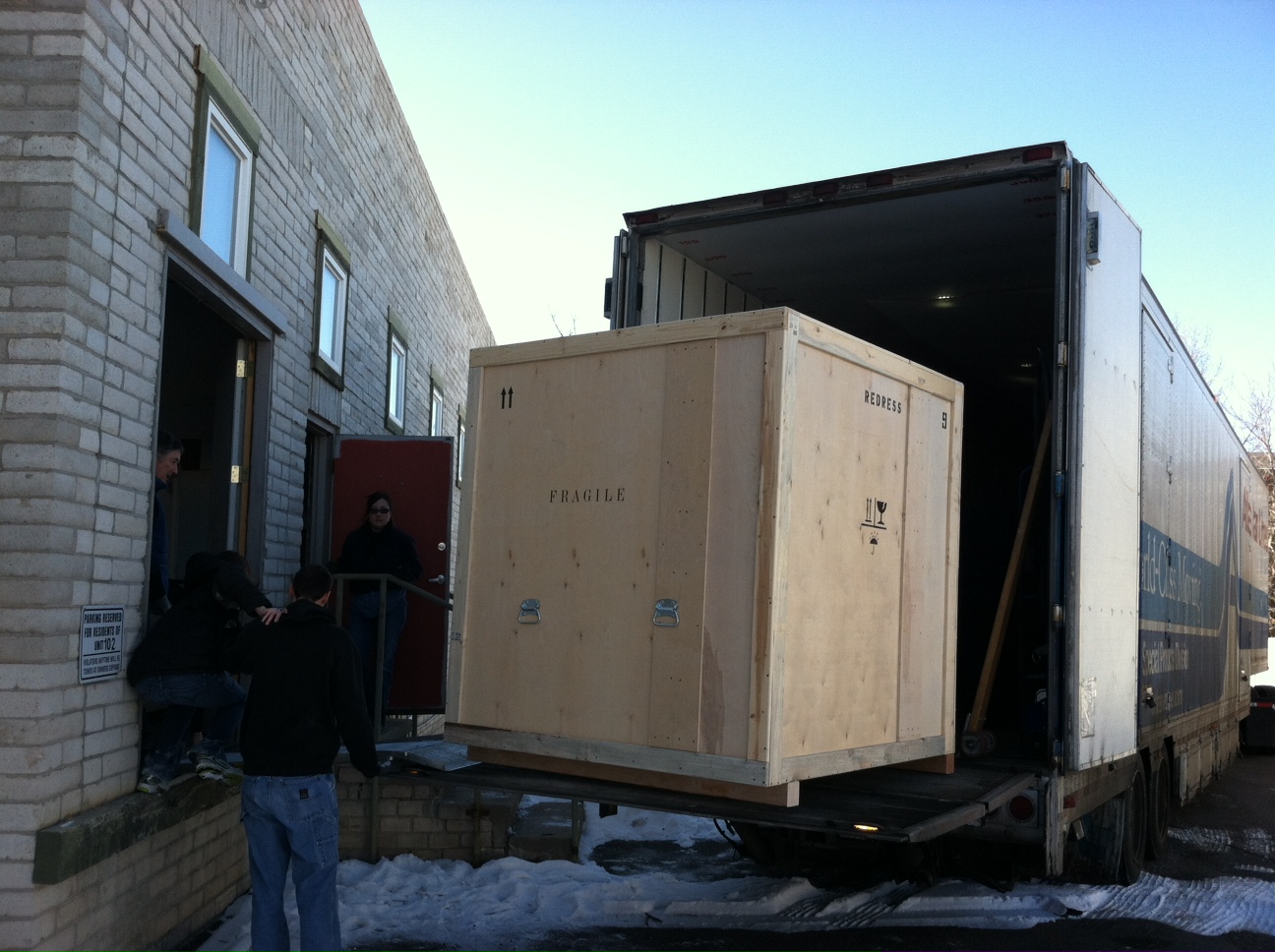
Loading the crates for shipment
We also created an installation guide that gives museum staff exact directions on how to install each piece, including how to attach hats to the mannequins and place purses on special stands. Dan Radven, an Exhibition Preparator and Artifact Mount Maker for the New Mexico Museum and Monuments system, custom-made all the stands, mounts and mannequin bases for me.
It was a true team effort to prepare the ReDress exhibition for this tour and I’m so thankful to all the talented people who helped make it happen!
The museums also require that the exhibition be accompanied by a condition report binder which notates the condition of each garment and accessory. Our condition report binder was over 500 pages! The registrar at each institution fills out incoming and outgoing reports for each garment and accessory noting anything that might have happened to the work while in their care. This museum tour is kind of like going to Club Med for my garments; they have never been so pampered.
I also am creating additional materials for the museums to use that include: information for docents; recommended films related to waste reduction; for the museum shops, a list of artists who use recycled materials in their art; and eventually an educational guide for students of all ages.
The museums have invited me to give workshops and presentations in conjunction with the exhibitions. I’m very excited to visit each site, meet the staff and talk with people about my work and the critical environmental issues it raises.
I know that the preparations associated with this exhibition such as shipping, printing and my travel will create their share of green house gas (CO2) emissions. I will off-set the carbon footprint of this project by donating to renewable energy projects through carbonfund.org.
I feel so honored and lucky to have this experience and can’t wait to see where the ReDress tour takes us!
If you know of any museums that might be interested in my exhibition, please let me know. Below is a link to information for museum curators: ReDress: UpCycled Style.
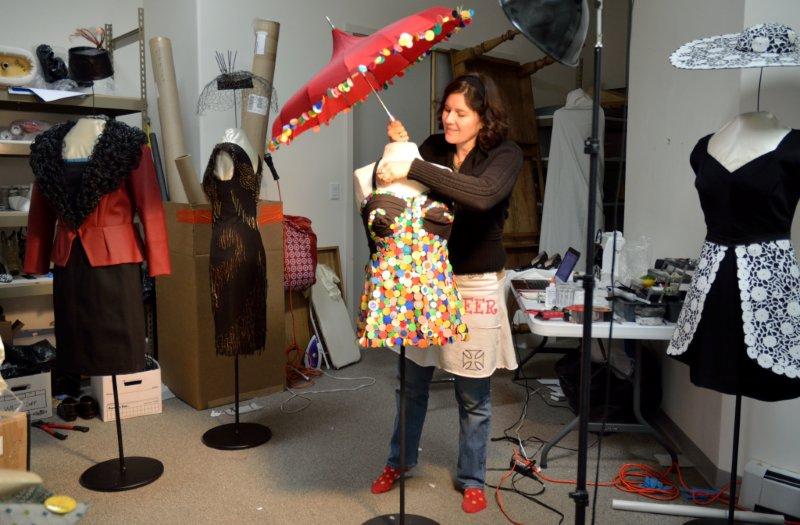
Preparing the garments in my temporary workspace at Astillis
I am thrilled to be a part of six new events in Northern New Mexico this year. Usually Recycle Runway takes me out of the state, so it is a pleasure to be spending so much time in my beautiful community. Here are the highlights:
1. Exhibition in the New Mexico Museum of Art in Santa Fe
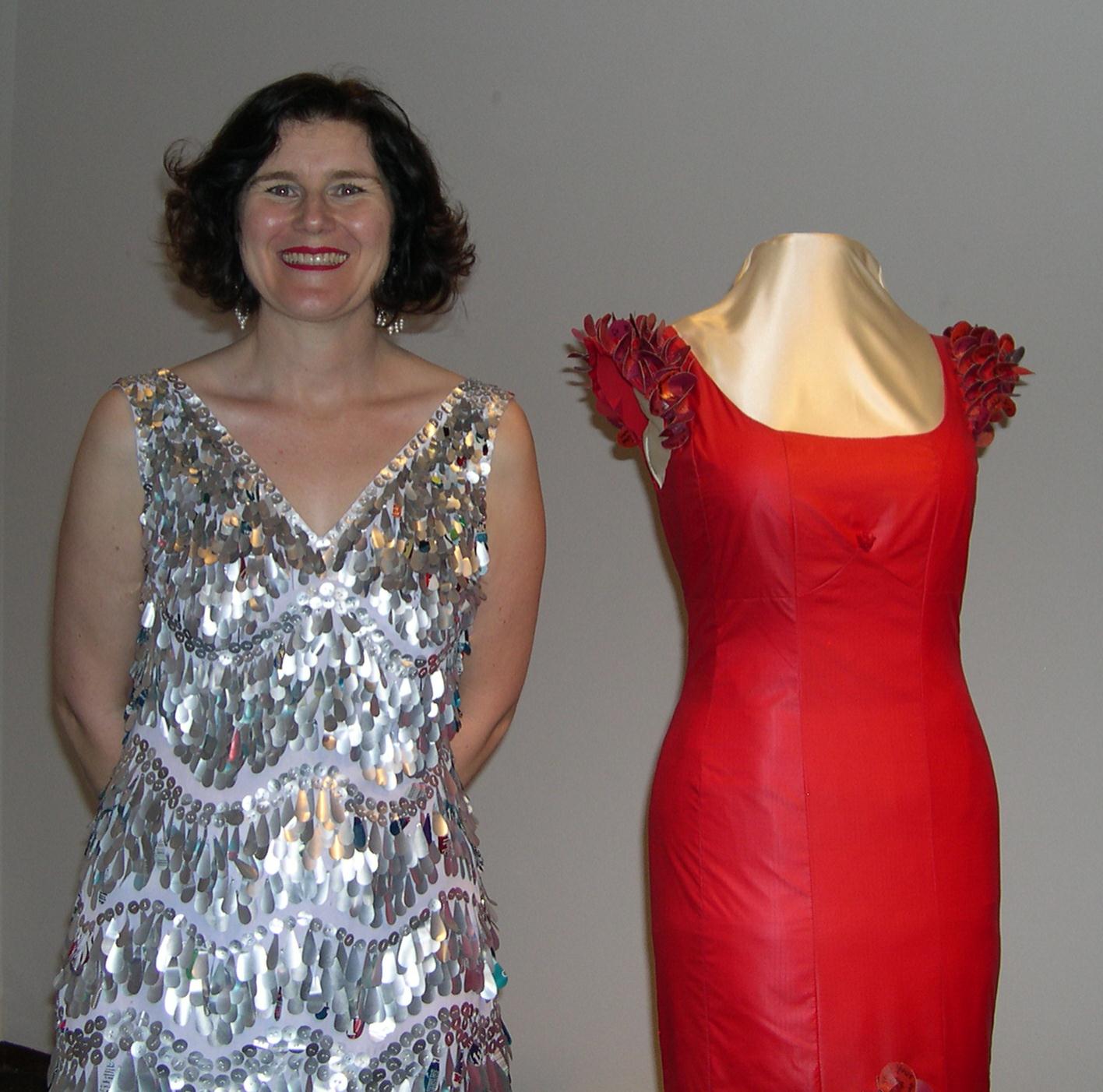
Nancy and Eco-Flamenco, Opening Night at the NM Museum of Art
I am excited to have my work on exhibit in the New Mexico Museum of Art through September 7, 2012. It is part of the Museum’s Alcove Shows that can be traced back to the 1917 founding of the Art Gallery of the Museum of New Mexico. The museum is continuing this tradition with a cycle of nine exhibitions that will include forty-five artists from across the state. Five artists are being exhibited for five weeks at a time. It is an honor to be part of this historic tradition and exhibit alongside some of New Mexico’s most inspiring contemporary artists!
2. Honor from the New Mexico Committee of the National Museum of Women in the Arts
In the beginning of August I was privileged to be honored by the NMC NMWA at their Women and Creativity luncheon. The audience was full of museum directors and curators, gallery owners, artists and people that support the arts in various ways. I gave a 10 minute talk about my work and showed a couple of my recycled garments. I was really touched to be honored by such an influential group of women (and men) that support the arts!
3. The Next Big Idea Festival in Los Alamos
I have been helping the County of Los Alamos organize their first Trash Fashion Contest on September 15th. It is part of the Next Big Idea Festival, an event designed to inspire, illuminate and educate through science, technology and the arts. In preparation for the contest I will be giving two trash fashion workshops for both beginning and advanced students/artists during the weekend of August 25th. If you live in the region, please join us, it will be a lot of fun! Contact Tom Nagawiecki with Los Alamos County at 505-662-8383 to register.
4. Albuquerque Mini Maker Faire
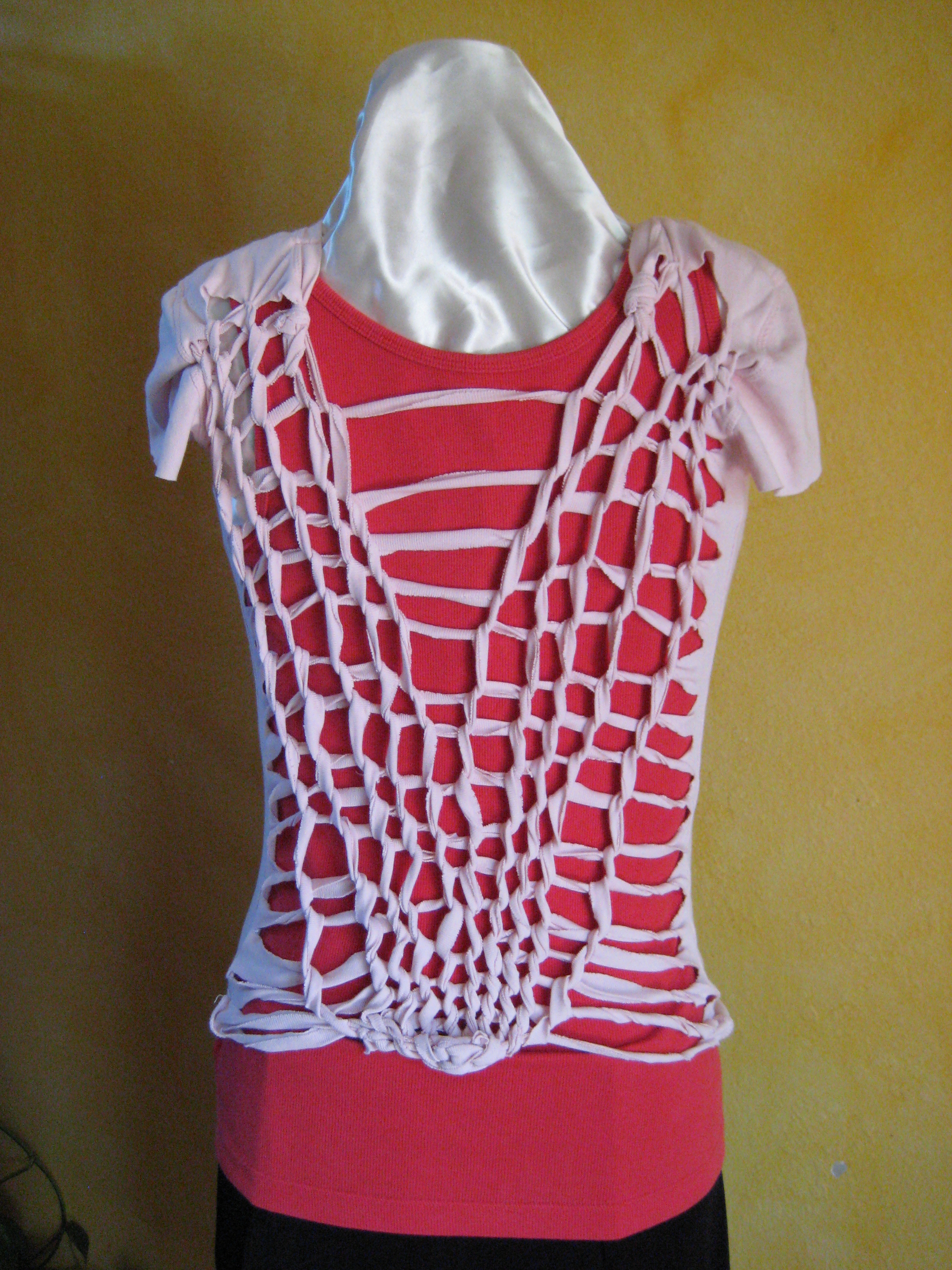
Transformed T-shirt back
On September 23rd I’ll be giving workshops all day on transforming T-shirts into new styles and accessories at the first ever ABQ Mini Maker Faire.
If you are not familiar with Maker Faires, they are the World’s Largest Show (and Tell) festival—a family-friendly showcase of invention, creativity and resourcefulness, and a celebration of the Maker movement. It’s a place where people show what they are making, and share what they are learning. Makers range from tech enthusiasts to crafters, educators, tinkerers, hobbyists, engineers, artists, science clubs, students, authors, and commercial exhibitors. Also this event will be part of another VERY COOL event called the the International Symposium on Electronic Art, ISEA2012 Albuquerque: Machine Wilderness which explores art, technology and nature.
These are new audiences for me and I am really excited to be part of this local and international community exploring the connections between art and science!
5. TEDxAcequiaMadre in Santa Fe
On November 3rd I will be giving my second (!) TED talk at Santa Fe’s first TEDx event: TEDxAcequiaMadre. My talk is called: “Undressing the crime scene—addressing how to slow climate change”. In this talk I will describe how a dress can be an agent of change and will undress Crime Scene—my most provocative garment to-date, to reveal the personal and planetary violence it embodies. I will also issue a call to action, reflecting current thinking on addressing global warming. There will only be 100 seats available for this event so if you are in the area, buy your tickets soon.
6. New Recycle Runway Garment promoting Energy Efficiency
This summer I was awarded a fellowship from Toyota and the Audubon Society called TogetherGreen. Over the next year I will create and institute an energy efficiency curriculum for 6th grade students in Santa Fe. The project will culminate in a new Recycle Runway garment that documents the amount of CO2 avoided by the students during their assignment. I will share more details on this exciting project as it progresses.
I de-installed my Recycle Runway exhibition in the Atlanta International Airport last month and sent it home to Santa Fe– it was sad to say goodbye to such a great venue!

Giving a tour of the exhibition to passengers and airport employees
I first met with the Atlanta’s Airport Art Program staff, David Vogt and Katherine Dirga, over 5 years ago for 15 minutes in-between flights. They generously agreed to meet at my gate for a quick introduction and look at my portfolio. When they informed me a couple of weeks later that they would like to exhibit my work, I was thrilled because they have curated such a wonderful permanent collection and rotating exhibitions. Also, knowing that ALT is the busiest airport in the WORLD; I was humbled by such an incredible opportunity to reach so many people with my message of environmental stewardship.
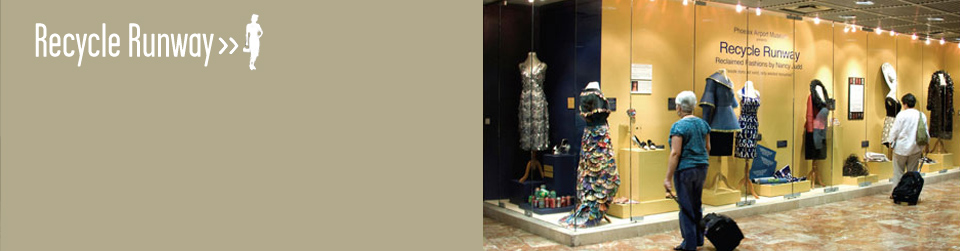
We installed the exhibition in May of 2011 (you can read about our midnight adventures in my blog post from May 10, 2011) and we took it down in the second week of July, 2012. Nineteen garments were initially installed in nine cases and an additional three were added to a tenth case that the Airport Art Program installed in January of 2012 in the entrance to the terminal between the escalator and the information desk. The airport estimates that during this time over 15 million passengers passed through Concourse E!
The exhibition was advertised with a 30 second video on the CNN TV monitors located throughout the entire airport. It was seen several times each day that it was aired. Click here to view the video.
The exhibition was generously sponsored by Coca-Cola, Delta Air Lines, Janome, and Novelis and my Green Partners: Earth911.com, the Georgia Chapter of the Sierra Club, the Georgia Recycling Coalition, Keep America Beautiful, Keep Georgia Beautiful, the Phoenix Airport Museum and the Turner Foundation.
I was overwhelmed by the number of print and electronic media outlets that covered the exhibition over the 14 months it was on display.
| Misc Press Outlets -USA Today Travel -CNN -Yahoo -NBC/ 11 Alive -Delta’s Sky Magazine -Clayton News Daily -Atlanta Day Book -Metromix Atlanta -Future News Network -Orbiz.com Blog Posts -Delta -Atlanta Airport -BlueGreen -Chimeras -Fashiongraphia -Stuck at the Airport -Talking with Tami FlickR -Atlanta International Airport -HaveIgotastory4u’ -FilipinoOnSkis |
Websites -TrendHunter -Chic Republiq -Examiner -Terminal U -Ecouterre -PolarTREC Magazines and Newsletters -Resource Recycling -Southern Seasons -New Mexico Recycling Coalition -Georgia Recycling Coalition -Glass Packaging Institute Pintrist -Click to view numerous “pins” of the exhibition. Other Social Media -FourSquare -Tumblr -Twitcsy -Twyla |
There were so many really heart-harming moments for me during this exhibition, here are a few samples:
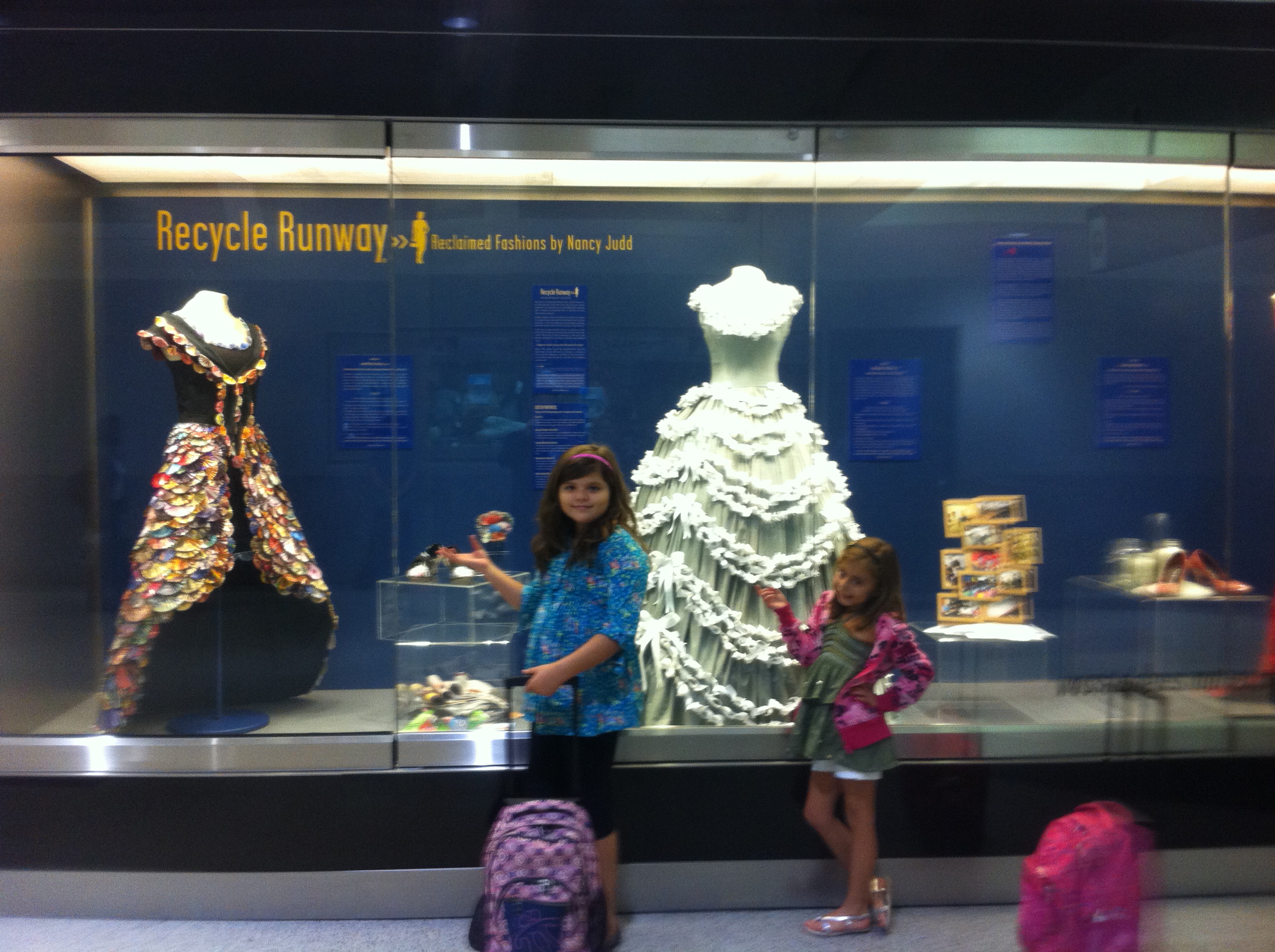
- I received several notes from friends who I have not see for over 20 years that came across my exhibition in the Airport and sent photos of their kids in front of favorite garments.
- An Army Sergeant that flew through Concourse E numerous times while the exhibition was on display wrote to me often. The installation motivated him to contacted the airport to find out how he could help to improve their recycling program.
- A Grecian hair-dresser saw the exhibition and was inspired to start a trash fashion show in Drama City, Greece, outside the National Bank of Greece.
- One of the airport employees, Mr. Jones, who buffs the floor at night in Concourse E told me this: “I will be sad to see this exhibition go, I watched a lot of passengers taking photos of it. In fact I took a photo of one of the dresses and showed it to my son. He got inspired and did a recycling project for his middle school class!”
THANK YOU to everyone that helped to make this exhibition a success!
˜ ˜ ˜
What’s next for the Recycle Runway Collection? Last week it began a tour of museums starting with the New Mexico Museum of Art in Santa Fe. It is also scheduled to be exhibited in the The Bascom Visual Arts and Education Center in North Carolina and the Leigh Yawkey Woodson Art Museum in Wisconsin. If you know of any museums or art centers in your region that might be interested in hosting the exhibition, please let me know!
My recent blog post, Declining $10,000, was my most popular post to-date. It was re-blogged, shared on facebook, forwarded and re-twitter– reaching thousands more people around the world! I have received many (primarily) supportive comments, which has caused me to reflect even more on the experience. I have attempted to organize these thoughts into two primary concepts:
1. Everyone is welcome at the table!

Stained glass window by David and Michelle Plachte
My objective with my last post was to create a “teachable moment” about the environmental, social and health issues related to drinking bottled water. I did not intend to vilify the company that made me the offer and have in fact removed their name from both blog posts on the subject.
This experience helped me to clarify my belief that our problems need to be solved by working together and that the energy used to create “us versus them” scenarios hinders our ability to find long term solutions to the many critical issues facing the world today. I believe that everyone brings something to the table, and that INCLUSIVITY is imperative.
During my TogetherGreen Fellowship retreat, sponsored by the National Audubon Society and Toyota, we spent a whole day talking about diversity and exploring the biases (filters, lenses, perspectives, and histories) that can impact the effectiveness of creating solutions to our numerous worldwide crises. When we think about diversity we often think about gender, race, nationality or religion, but diversity is about inclusion, and inclusion means EVERYONE! But can I work with everyone, NO… that is where the fine art of exploring our individual truth comes in.
Watching coverage of the Earth Summit in Rio this year, I am also really appreciative of the voice of the most radical environmentalists who ceaselessly push the issues representing the voice of the animals, the plants, the children and the earth itself. Yes, every voice is needed at the table!
2. Embracing Complexity
In Santa Fe, where I live, we are having a film-festival of the great Japanese animator Miyazaki, Spirited Away and Ponyo are two of his films you may have seen. I love the duality of his characters, one may at first appear to be “bad” only later to reveal a loving heart with good intentions and actions despite other questionable activities.
It is so easy to categorize a person, entity or situation as good or bad, but life is much more complicated than that. Right and wrong are relative to numerous factors and most decisions in this world are quite complex.
Yes, all of my sponsors could be questioned for various reasons, but the companies I have chosen to work with have tremendous influence and the environmental (and social) initiatives they have started and funded have had far reaching positive effects. Like a Miyazaki character, they are neither 100% malevolent or benevolent.
Also, corporations are made of people, many of whom are working on the inside to do what they can to reduce the carbon footprint of the products/services that their company provides. I don’t want to negate the good work that these folks are doing, I want to recognize it.
I was able to reflect on these issues with some of my colleagues at the TogetherGreen retreat and many of them had faced similar sponsorship quandaries and agreed that these decisions are never easy and are always based on numerous circumstances. This is true for each of us in our daily lives as well because we have to make choices such as what we eat and buy, where we shop and live or how we get around that carry the same complex dilemmas.
I did not feel comfortable endorsing the use of bottled water and turned down the generous offer. I received a lot of praise for that act, however tomorrow I may make a different decision (on another topic) that is right for me, but wrong for you. Heroism can be very short lived!
I have a good friend whose initial response to everything is always: “interesting”. I am learning to use her simple reply, “interesting”, as a way to look more closely at the multi-faceted nature of situations and remain open to options that might have more inclusive, deep and long term outcomes.
Thank you for taking the time to read my philosophical musings on the nature of right and wrong and how this influences our daily decisions. Tell me about similar decisions you have had to grapple with, I would love to hear your experiences too!
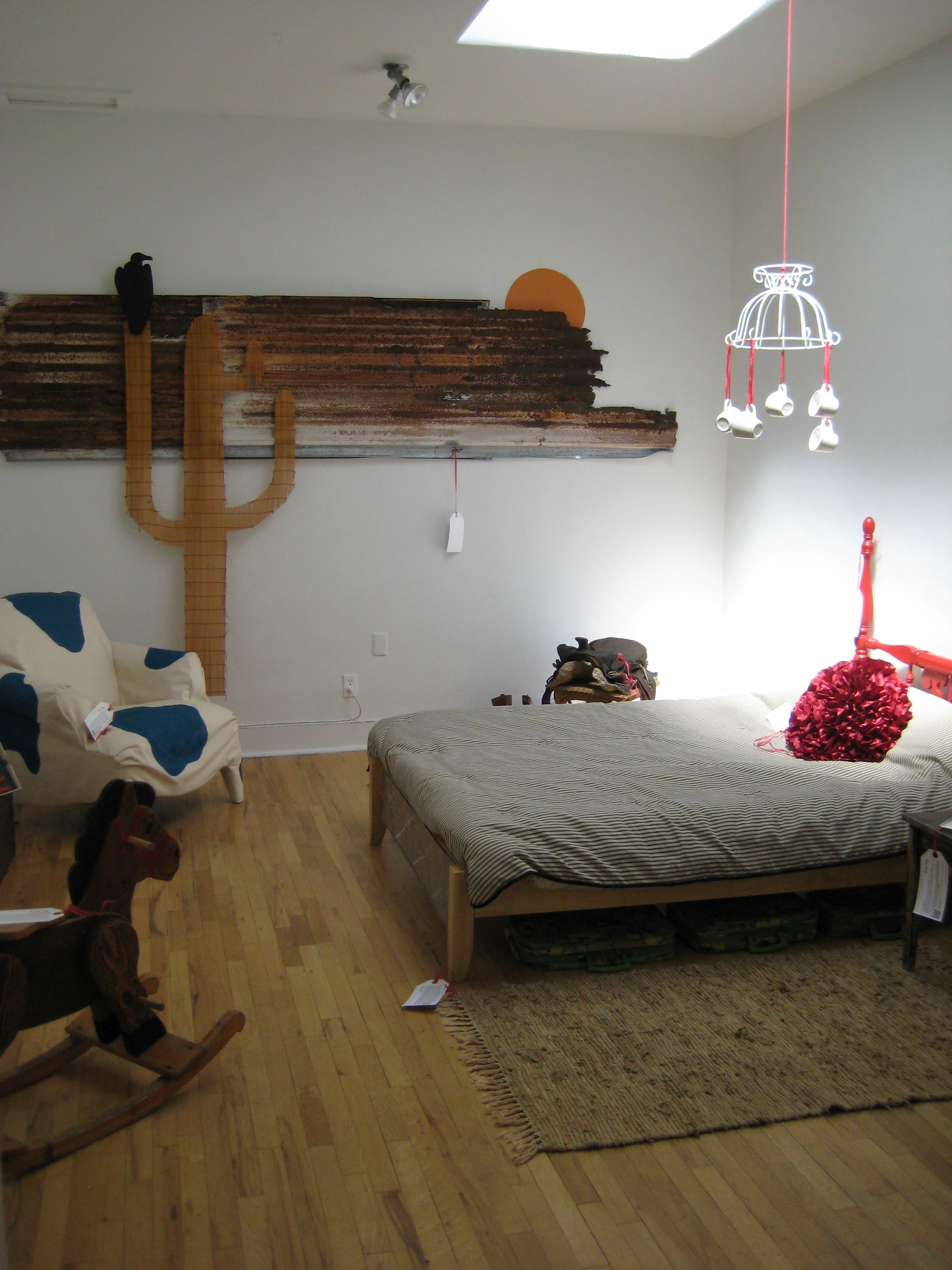
Consumption Installation
I recently collaborated with my partner, Nicole Morris, on a new piece called: “Consumption: an installation exploring waste”. This dynamic project put trash into the heart of downtown Santa Fe, NM by mingling it with the art scene right off the Plaza!
One summer afternoon in 2011, Nicole and I were driving amidst beautiful brown and green mesas blanketed by amazing azure skies while I was telling her about a new call for artists that I had come across earlier that day. The invitation put out by New Mexico Arts encouraged artists to venture beyond their normal body of work and take risks by creating a space-specific installation, which really peaked my interest. We threw around a few ideas and, as the sun began to set mixing its golden light with the deepening blue, a collaboration was born.
We responded to the call with many other applicants and we were honored to be one of the chosen! Nicole and I designed a project that had two outcomes: create an installation so beautiful and pleasing that one could hardly believe it was reused trash; and in the process of gathering the objects for the installation, provide a reuse study for the Santa Fe Solid Waste Management Agency. (To learn more about the project read the artists statement.) Our desires were to create a work of art, to solicit creative thinking and education, and to give back something to the lovely community that we feel blessed to be a part of.
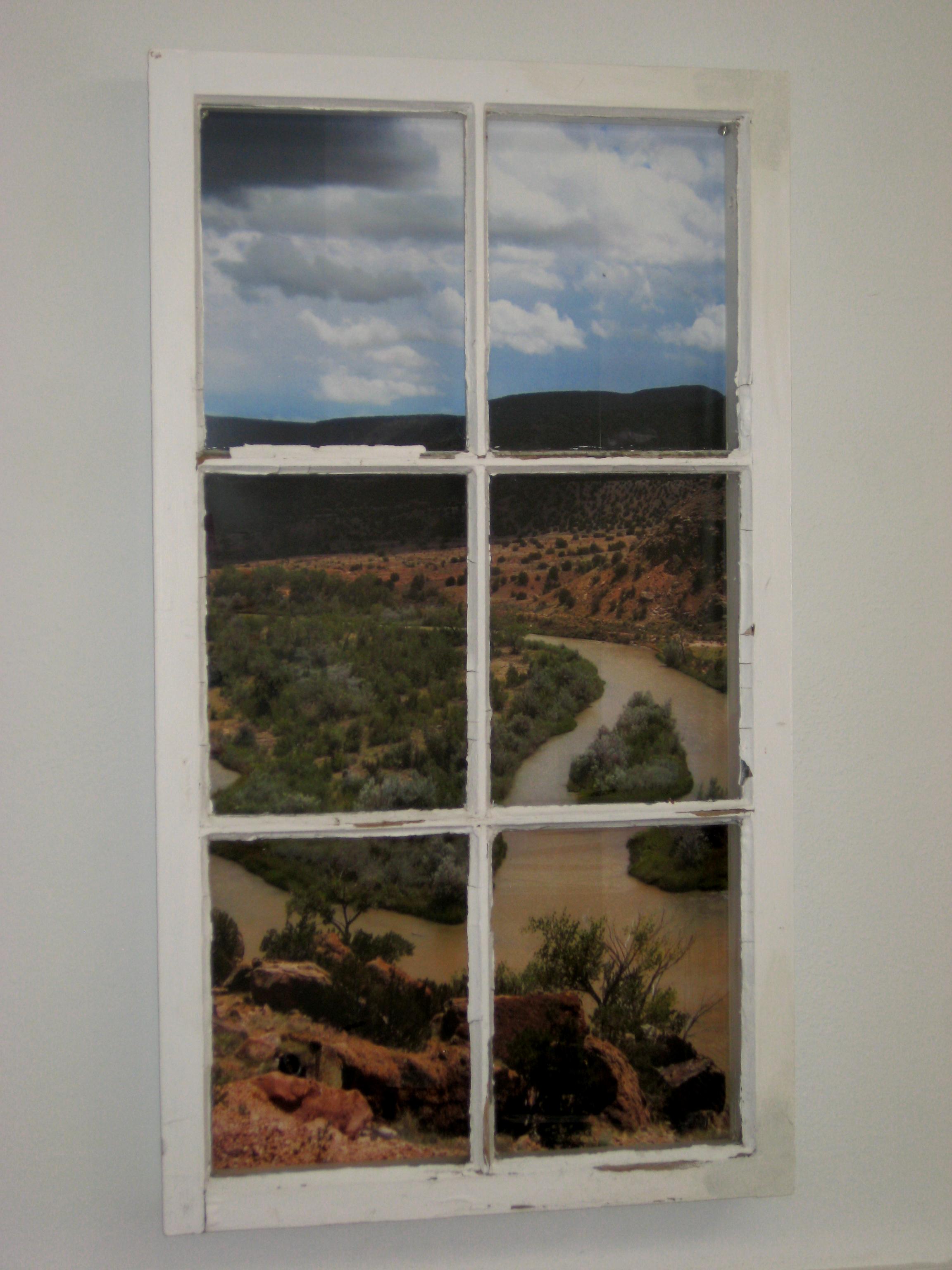
Nicole's photo of the Rio Chama framed by a discarded window
My interest in working with garbage is obvious to those of you that are familiar with my 20 year background in recycling and my Recycle Runway collection of couture fashion sculptures made from trash. Nicole had recently finished a course called Climate Masters, offered at that time by the State of New Mexico’s Environment Department, which fed her life-long commitment to environmental conservation. For the project, she also drew from her background in photography and design. It was a great partnership!
Our goal with this installation is to engage people in thinking about their relationship to the items we purchase, bring into our homes and casually throw away. Beyond that we hope viewers will consider the environmental impact with each step of this “cradle-to-grave” process.
Though many of the materials we needed to install the show came from the trash (cleaning agents, paint, even a shop-vac) we did have to buy some new supplies. It was really interesting to go shopping after having just been at the transfer station and seen similar items thrown away. It made us ask the question, “what gives items value?”
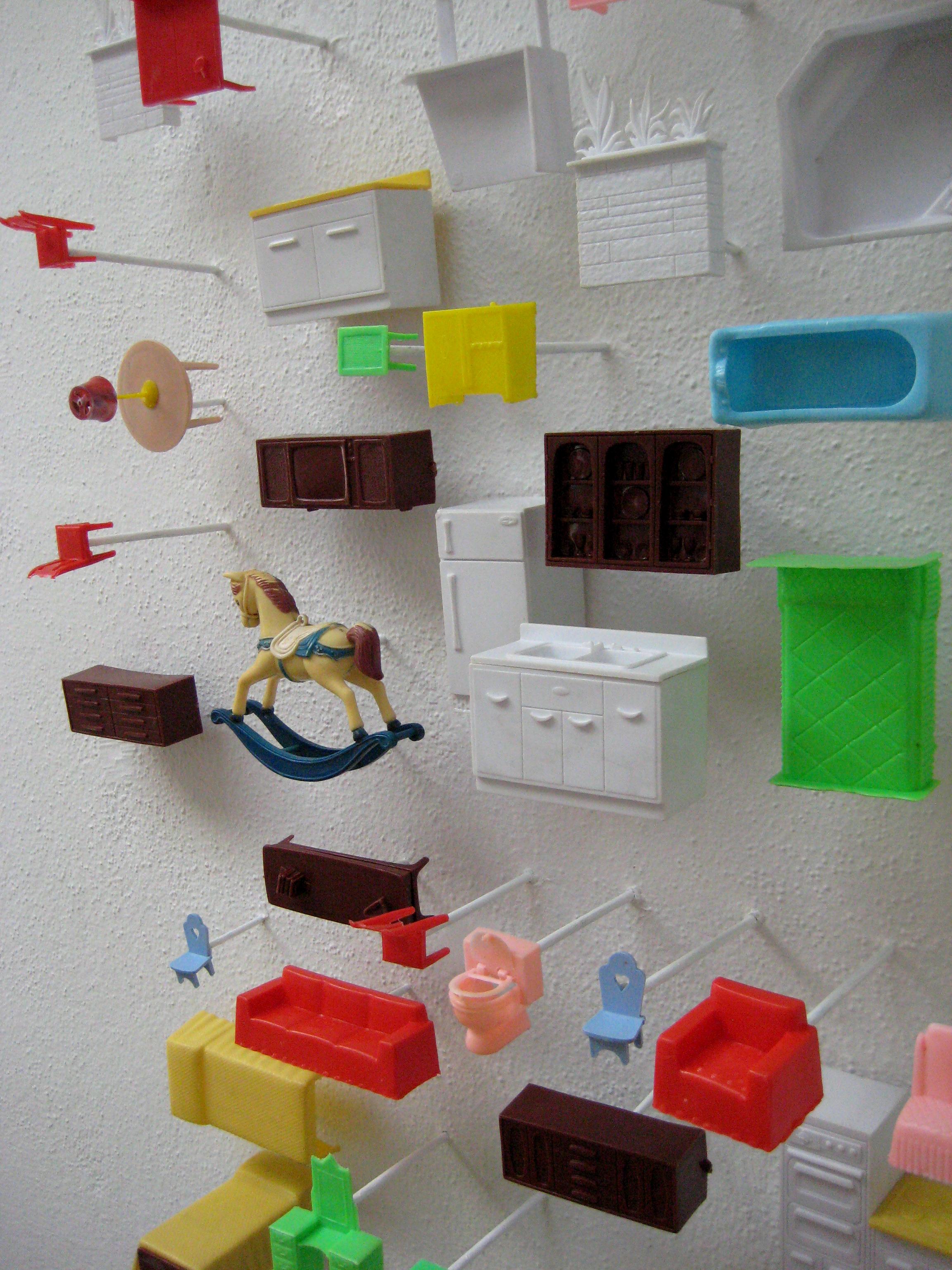
Discarded toys mounted on the wall
- Is an item valuable because it is presented as new in a store?
- Does something lose its value when we have grown tired of it, no longer need it, or find it has a scuff?
- Does an object have no value once it is in the trash – even though it could be still usable or even brand new?
- How does the value of an item change when we are in a hurry and the quickest option is to throw it away?
- Do the value of objects increase or decrease after the death of a loved one?
These questions of value are what inspired us to create the “Environmental Price Tags” that are attached to many of the objects in the show. The price tags were meant to assist the viewer to delve into even deeper considerations such as:
- Would the value we place on an item change if we knew it would take more than one million years to break down in the landfill, or that tons of chemicals polluted the air, water and soil in the process of making it?
- Or perhaps the value would diminish if we knew that when we unpacked it in our home it would “off-gas”, releasing harmful chemicals that would contribute to the toxic load in our families’ and in our own bodies.
Balancing these conceptual ideas with the aesthetics in the show was sometimes a tricky process; sometimes the concept would dictate certain choices. For example at one point we considered making the seven suitcases we found into a cohesive sculptural element by painting them all one color. But we decided not to because in the end it would have rendered them unusable after the show and ultimately, in the process of painting them, it would have released more volatile organic compounds into the air.
We were pleased to have these various issues covered in two stories about the show, one in the Santa Fe New Mexican’s Pasatiempo and the other on the front page of the Albuquerque Journal North’s Sunday edition.
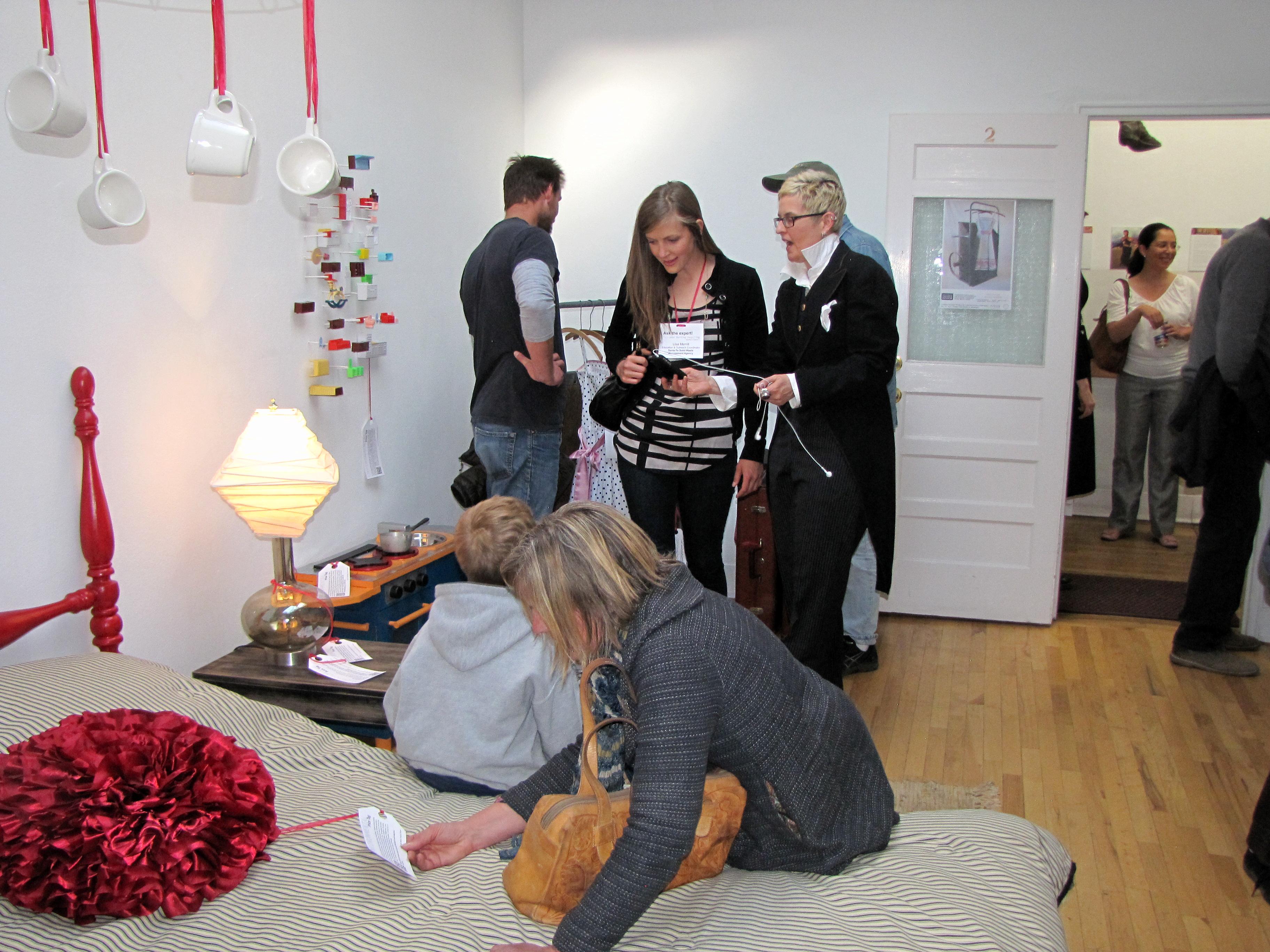
Opening night, someone reading an "Environmental Price Tag"
The opening for the installation was an important part of the project. Many of Santa Fe’s most knowledgeable people in waste reduction, sustainability and alternative energy were in attendance opening night. We asked those we knew if they would be willing to wear a name tag that said “Ask the Expert” and answer people’s questions on these topics. It was fun eavesdropping on some of these conversations!
The opening was also a waste free event. By providing a large waste can for recycling and a medium waste can for composting, at the end of the evening, they were full and the 5 inch tall garbage can was empty!
After the show comes down from the Centennial Project Space, we hope to reinstall it around the region to provide further educational opportunities. Several learning institutions in Santa Fe and White Rock have expressed an interest in hosting the installation!
If you live in Santa Fe and want to see the installation, it will be on display through Friday May 11, 2012 at the The New Mexico Arts Centennial Project Space located at 54 1/2 East San Francisco Street, Suite 2 on the Santa Fe Plaza above the Haagen-Dazs, Monday – Friday 10AM – 5 PM. Gallery number: 505.699.4914 (call first).
If you live out of town, you can still view more photos of the show and read the environmental price tags.
Lastly, we want to thank the following organizations and individuals for making this project possible.
- The Art in Public Places Program of the State of New Mexico, Department of Cultural Affairs for funding this project
- Randall Kippenbrock, Executive Director of Santa Fe Solid Waste Management Agency for facilitating this projects collaboration with the Agency
- Mike Smith, Lisa Merrill, Katherine Mortimer and the staff at BuRTT for helping to conduct the reuse studies
- Samantha Brody and Ariel Harrison for helping with painting, sanding and sewing
- Regina Wheeler, Jesse Just (New Mexico Recycling Coalition) for consulting on the project
- Eileen Braziel of Eileen Braziel Art Advisers for hosting the installation
- Brian Bylenok and Carol Dayton for loaning the air mattress
From Garbage to Gallery
Nicole Morris, left, and Nancy Judd collaborated on the project "Consumption".
April 8, 2012
By Kathaleen Roberts / Journal Staff Writer
Read article on-line.
Nancy Judd turns trash into treasure.
In 2008, the Santa Fe artist and environmental teacher pieced together a coat from Obama campaign signs that landed in the Smithsonian. Now she’s turning her transformative eye to interior design. On Friday, Judd and Santa Fe artist Nicole Morris will open “Consumption: An installation exploring waste,” Judd’s first work of recycled furniture and objects, at the New Mexico Arts Centennial Project Space. The exhibit is being funded by a grant from Art in Public Places of New Mexico Arts.
Walk up the steep staircase next to the Haagen Dazs store on the Plaza, and you’ll discover a cowboy children’s room with a hint of Japanese style. At first glance, it may look like a chic designer showroom. But deeper layers hide beneath its sleek surface.
If you go:
WHAT: “Consumption: An installation exploring waste” by Nancy Judd and Nicole Morris
WHEN: Reception 5-7 p.m. Friday, April 13 to May 4
WHERE: New Mexico Arts Centennial Project Space, 54 1/2 E. San Francisco St., Suite 2 CONTACT: 699-4914
Judd culled everything in the room from the trash. For nine months, the artists and the Santa Fe Solid Waste Management Agency staff have been conducting a reuse study documenting the amounts and types of waste Santa Feans dump into the garbage.
During the study, the artists were allowed to pull items for the installation, with the goal of amassing information for a reuse center. National studies have shown that reuse is one of the best ways to both conserve resources and reduce trash.
The idea germinated from a New Mexico Environment Department-sponsored class last spring. In return for free tuition, Morris agreed to volunteer for 30 hours.
“I was looking for a project,” she said. “Nancy started talking about this public art thing she was interested in.”
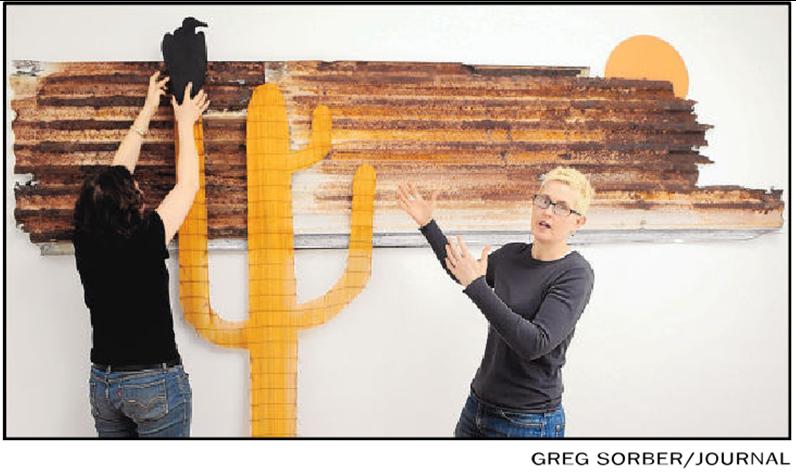
Artists Nicole Morris, right, and Nancy Judd create a south-western wall piece from rusted corrugated metal, a painted sun, a cactus made from window blinds and a canvas vulture.
Judd was eager to switch from dresses to design. The two artists pieced together a wall-sized saguaro cactus from recycled venetian blinds. Morris visualized the mesa scene decorating the bedroom’s wall. A rusted piece of corrugated steel forms hills and hollows. A “vulture” crafted from old canvas perches on a cactus branch.
Even their Shop-Vac was a garbage rescue.
“It works, except we were missing a hose,” Judd said. “We found out we could buy a hose.
“There’s a chair that I’m reupholstering,” she added. “I’ve been draping the chair as I would a dress frame with some old canvas.
Environmental price tags dangling from each exhibit object describe the time it would take it to decompose and the “off gases” that would leach into the environment in the process.
Santa Fe’s dump abounded with discarded children’s items.
“There’s a little kitchenette,” Judd continued. “Some things needed cleaning. Some need a little more work.”
An old rocking horse required cleaning and oiling. A pair of scuffed brown cowboy boots completed the vignette.
“It’s going to have this sort of Southwest cowboy theme, but done in a very clean, Japanese way,” Judd said. “It’s not like howling coyotes.”
To complete the corner kitchen, she added a counter top from found aluminum siding. She tipped an old wheelbarrow vertically to form a child’s mini-closet. To clean the rose-bordered girl’s dress it shelters, Judd washed the garment and hung it in the sun for some solar bleaching.
Insects had discovered some of the items well before Judd and Morris found them. To fumigate without using chemicals, they placed the objects in plastic bags and left them in the sun for three weeks to exterminate any multi-footed guests.
The two artists discovered a cache of more than 100 overstocked children’s books inside two construction trailers. Everyone who comes to the installation will get a free book.
Santa Fe Solid Waste education and outreach coordinator Lisa Merrill took on the task of escorting the two artists to the Buckman Road Recycling and Transfer Station dressed in protective wear and goggles. The trio stopped and approached people trucking in their waste for permission to scavenge it for re-usable objects.
“If they saw anything they wanted, I jumped down and got it before it got smashed,” Merrill said. “It’s just a shock how many people throw away perfectly good items. One man –– you could tell he had just cleaned out his mother’s house –– brought a beautiful crystal punch bowl.”
Merrill said she did not know what would come of the study because there was no room for a reuse center at the transfer station. She encouraged residents to donate usable items in good condition to a thrift store, battered women’s shelter or another charity.
Judd is known primarily for her dresses made from recycled materials. She made a “jellyfish dress” pieced from plastic bags, a flounced flamenco dress from fanned pieces of junk mail, a cowboy skirt and vest woven from phone book pages, and a flapper dress sparkling with teardrop-shaped “sequins” sliced from aluminum cans.
The onetime coordinator for the city of Santa Fe’s recycling program, Judd also initiated her own company, Recycle Runway, and helped launch Santa Fe’s annual Trash Fashion contest and Recycle Art Market. She began creating recycled garments to promote these events.
Today, she gives workshops on recycling and other environmental issues throughout Santa Fe’s schools and youth organizations. Her Recycle Runway traveling exhibit has been showcased at airports around the country, opening at the Albuquerque Sunport in 2007. Travelers can see 21 of her dresses at the Atlanta airport.
Judd’s passion for recycling started with an art school Coke machine.
“I watched the garbage can next to it fill up with cans,” she said. “Though I wasn’t a big environmentalist, I thought it was wrong.”
She started an independent study in recycling and solid waste and a career was born.
Eco-Flamenco
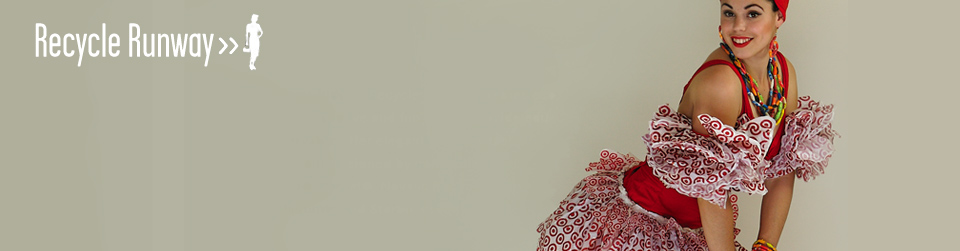
5,000 people helped create this passionate dress!
Cereal boxes painted with recycled paint have been transformed into cascades of ruffles that contain over 5,000 eco-pledges—commitments of actions that people will take to help the environment. The ruffles cover a dress made from parachute scraps. This dramatic dress took 650 hours to create and was completed in 2011.
___________________________________________________________________________________
Which one of the following was NOT an eco-pledge sewn to this dress?
- I will shop locally.
- I will eat organic food.
- I will live in a tree and eat bananas.
- I will use my car less.
- I will reuse and recycle everything I can.
Answer: 3.
We don’t have to live like monkeys to live lighter on the earth! Every moment we make simple decisions that affect the planet. What can you do in your life to help the environment?
ReDress: Upcycled Style
Eighteen of Nancy Judd’s enchanting couture fashion sculptures made from trash traveled to museums and art centers around the United States from 2013-2017. Watch this interview with Nancy talking about the ReDress exhibition.
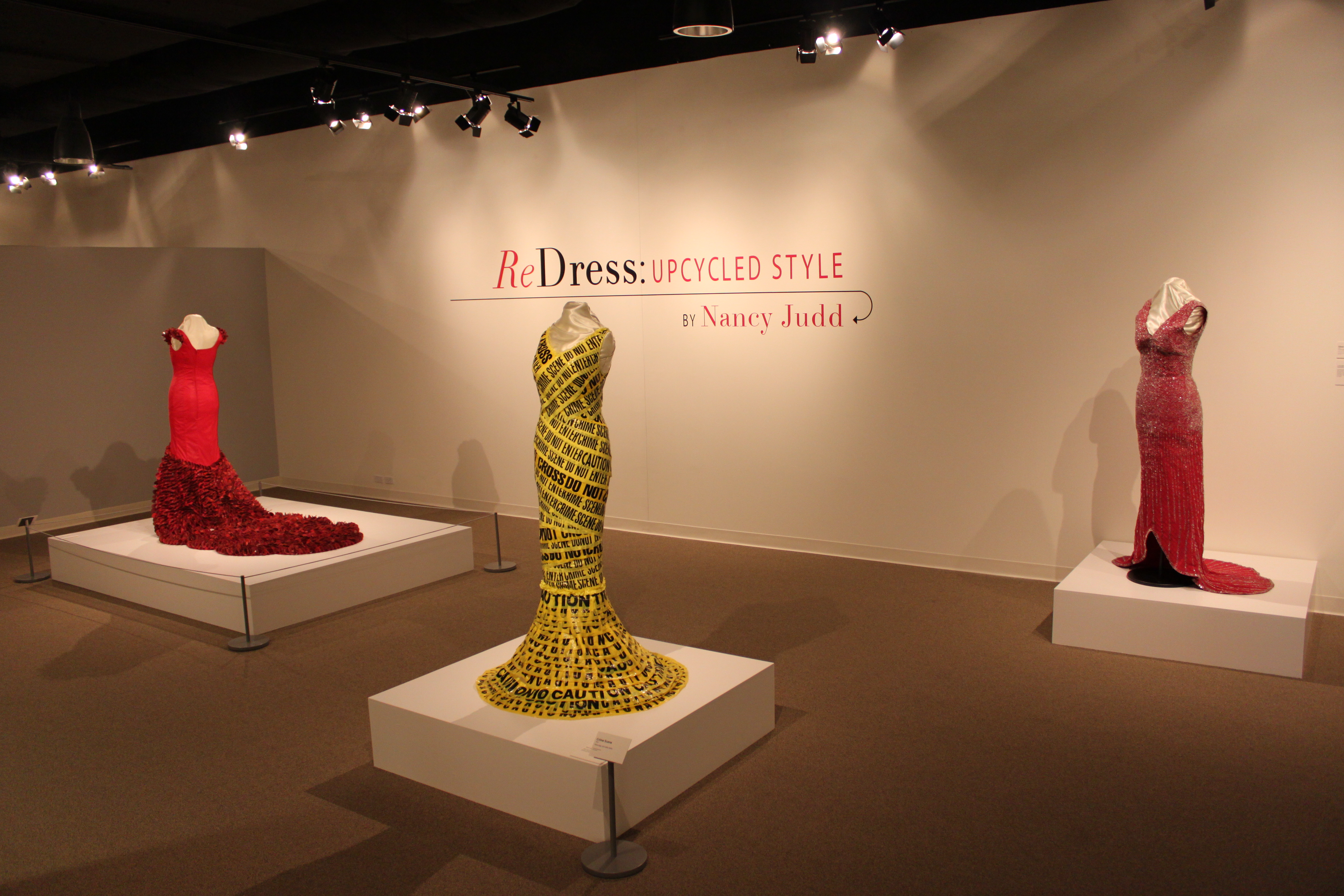
Ruth Funk Center for Textile Arts, 2013
“The ReDress exhibit has been a gem to have within our walls and has sparked conversation and imagination among visitors, volunteers, staff and the campus. Your message is delivered in such a positive way that it motivates and excites individuals to want to become more aware of the impact their daily life has on the planet.”
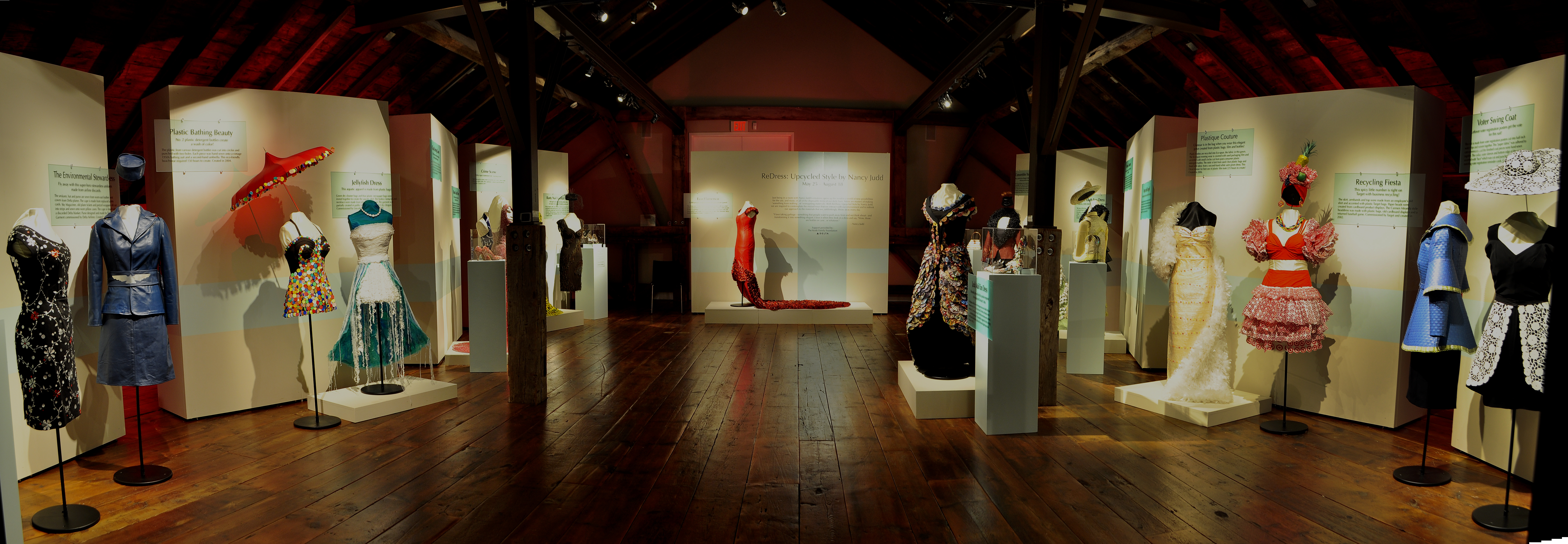
Bascom Center for Visual Arts
“Everyone in Highland is talking about your exhibition – lots of good buzz about the Bascom.”
“We are absolutely thrilled to have this show and the response from visitors is nothing shy of amazing.”
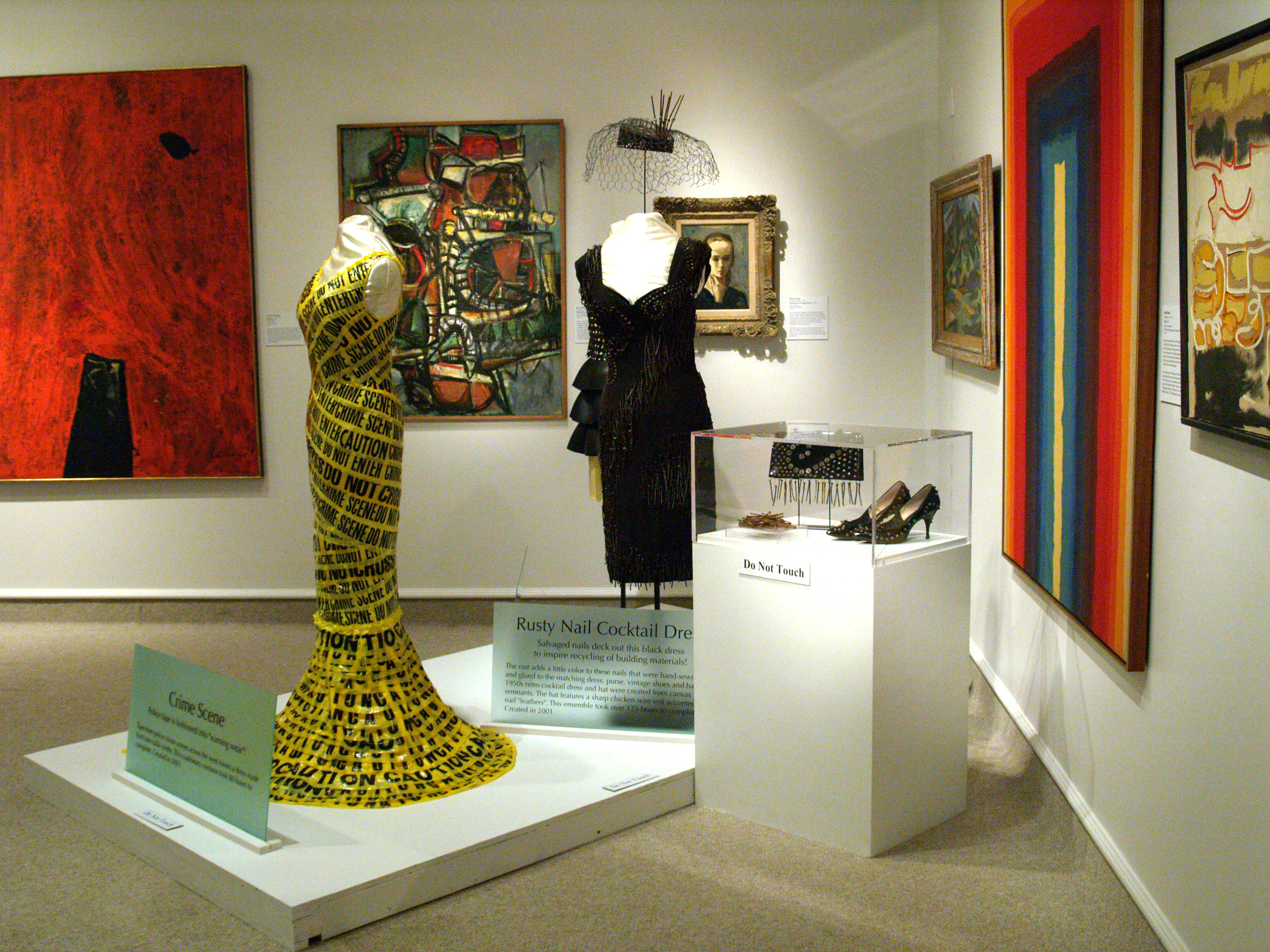
The Reading Public Museum
“ReDress:Upcycled Style by Nancy Judd is more than just an exhibit. It’s an idea transformed into something people will remember, something that will make an impression on them. Judd takes discarded waste and turns it into something beautiful. Trash becomes a dress, shoes a purse or a hat that can be displayed to show people how they can help the environment and upcycle.”
Article from a student review of the exhibition.
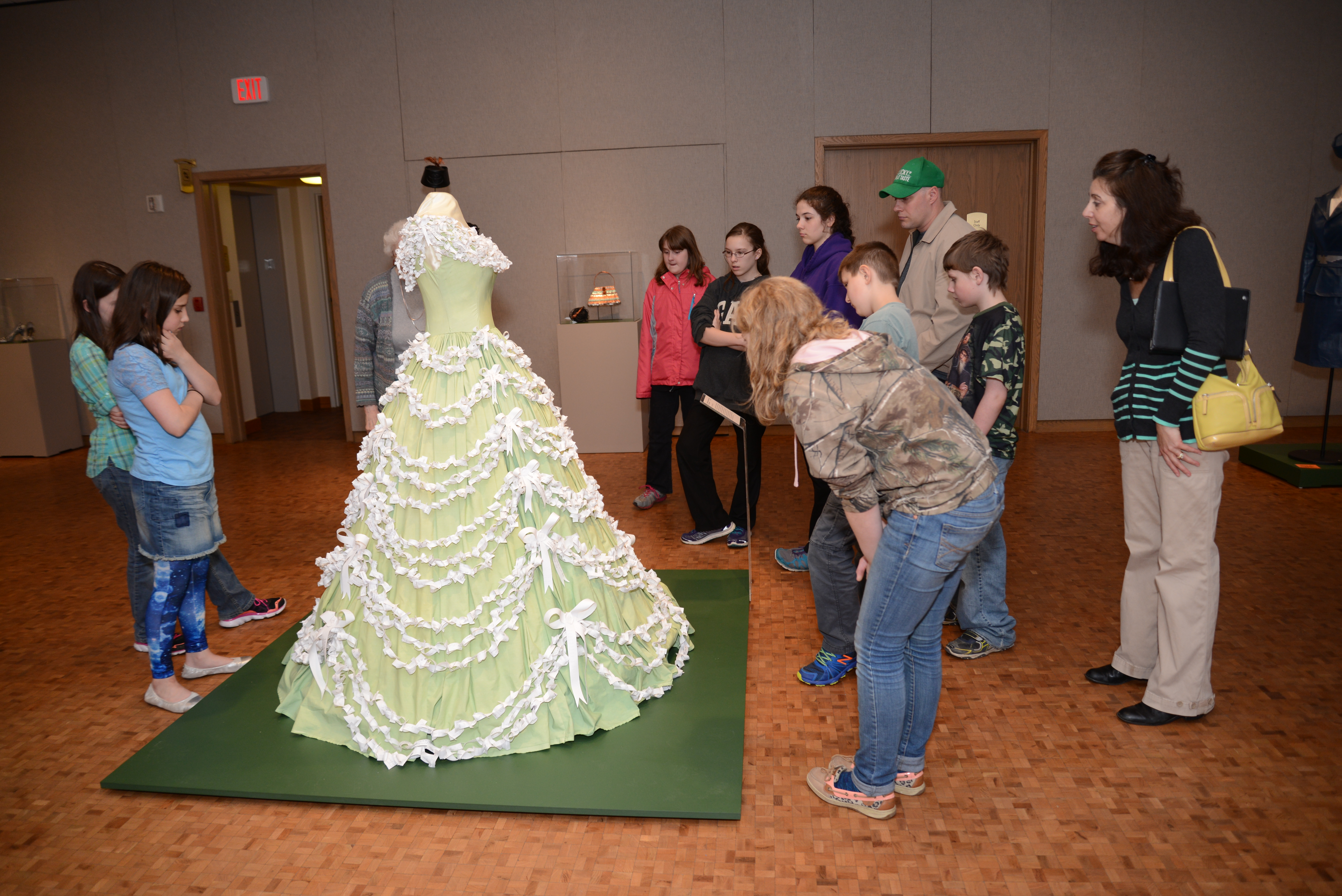
Woodson Art Museum
“Nancy led a gallery walk on the final afternoon of her artist residency, May 1-4. On the first sunny afternoon after a long Wisconsin winter, more than 30 visitors flocked to the Museum for this program. Nancy ascertained the makeup of the group and tailored her comments to ensure she provided fresh content, different from her previous residency programs so that it wouldn’t be repetitive for those who attended previously. Her frank, open comments about her artwork and acceptance of commissions were well received and appreciated and likely encouraged visitors to pursue their career path with a realistic mix of passion and pragmatism.”
Exhibition Schedule:
- The Ruth Funk Center for Textile Arts in Melbourne, Florida – Winter 2013
- Bascom: Center for Visual Arts in Highlands, North Carolina – Spring 2013
- Reading Museum in Reading, Pennsylvania – Fall 2013
- Woodson Art Museum in Wausau, Wisconsin – Spring 2014
- Stamford Museum in Stamford, Connecticut – Spring 2015
- Artesia Historical Museum and Art Center in Artesia, New Mexico – Winter 2016/Spring 2017
- Farmington Museum in Farmington, New Mexico – Winter 2017/Spring 2018
- Fort Collins Museum of Art in Fort Collins, Colorado – Summer 2017
See a video of ReDress at the Ruth Funk Center.
