Eco Trash Couture
To View Project Details


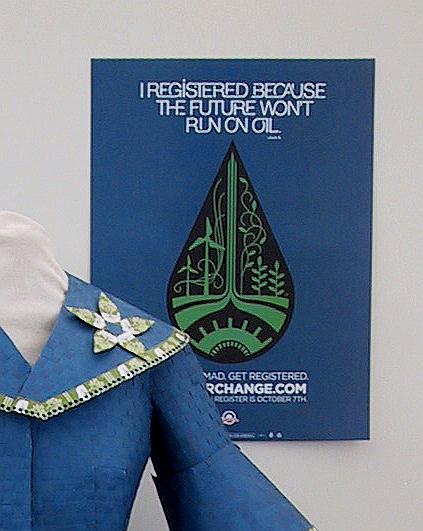
To begin… THANK YOU to everyone for all your support of my work over the years and most recently around my exhibition in the Atlanta International Airport, I will send photos and details about that later.
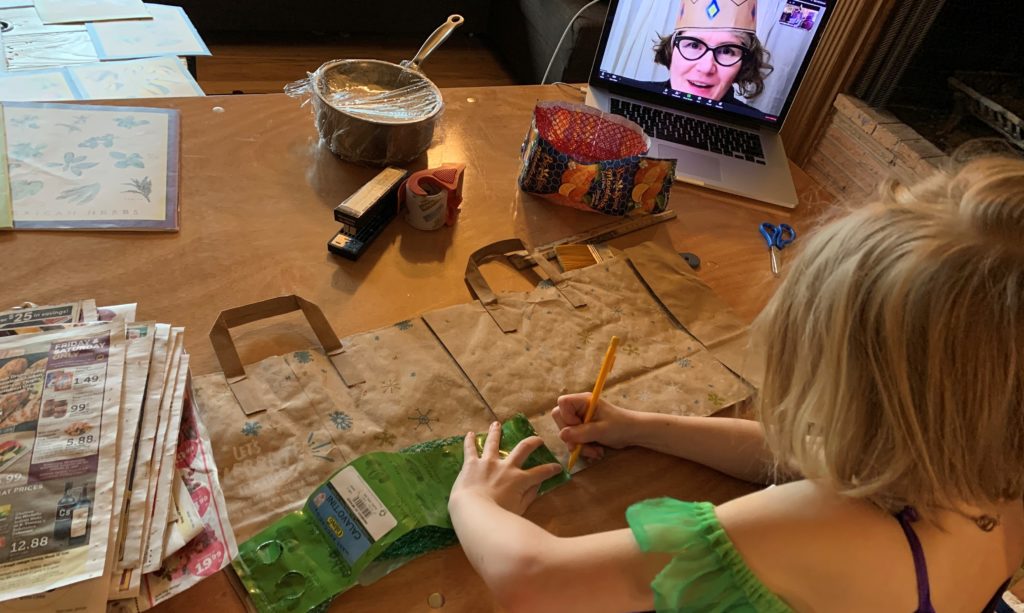
Meanwhile in response to COVID-19 virus circumstances, I have been pivoting my work to help children. Using my recycled art practice and teaching artist experience I have created virtual interactive upCycled art classes for children, youth and adults everywhere!
One of the gifts of these interactive online classes is that I get to develop relationships and spend quality time with children that I was not able to do when I was working with classes of 25-30 students. I so cherish this sweet time I get to share with my students!
I provide child-centered, immersive and interdisciplinary lessons that help children build skills, have fun and in the process create their own UpCylced Maker Kit to use for future projects. Using my arts integration training, I include in every session mindfulness exercises and movement breaks that can help kids learn to manage stressful situations and talk about their Covid-19 related experiences (CDC recommendations).
Each project is aligned with National Common Core Standards, Next Generation Science Standards, and National Core Arts Standards and during the sessions I help children develop life skills that can assist them to face challenges, for example to:
- Persevere through challenges and brainstorm solutions
- Speculate and hypothesize outcomes
- Work independently
- Connect to their feelings and their community
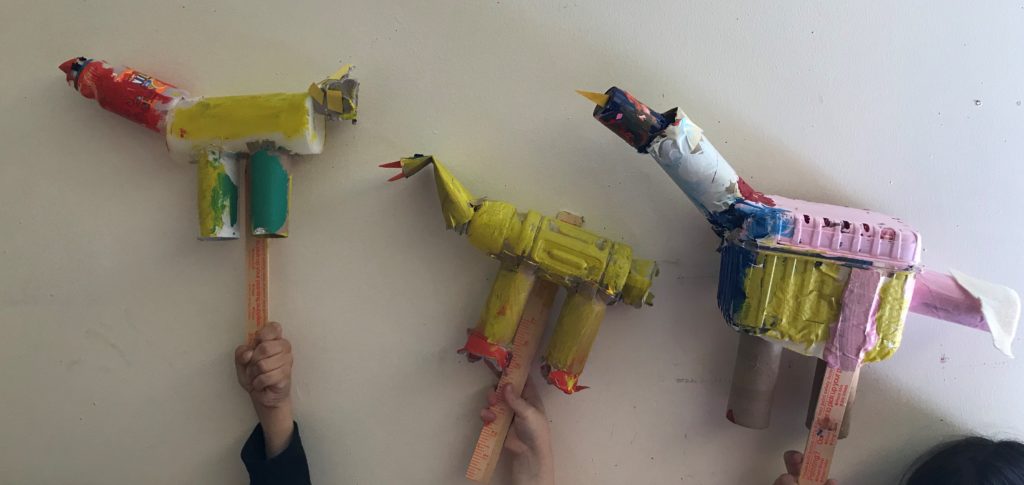
UPCYCYCLED ART PROJECTS
Most of the projects below can be adapted for kids 5 to 100 years old!
For the first session, choose one of the hour-long projects listed in the first section. The projects listed in the second section take between 1-5 hours, some can be started with Nancy and finished later and others worked on over several sessions. Click on the project descriptions below to learn more about each project and here is a sample session schedule.
First Meeting Projects
Quirky Crowns (made from paper bags and magazines)
Collage Cards (made from cereal boxes and magazines)
Paper Flowers 101 (made from paper bags)
Subsequent Project Options (to date)
Decoupage Jars (made from magazines and glass jars)
Paper Flowers 102 (made from paper bags and magazines)
Marvelous Masks (made from cereal boxes)
T-Shirt Transformations: hats, animal toys, capes, shirts, bags, etc. (made from old T-shirts)
Upcycled Fashions (made from misc items)
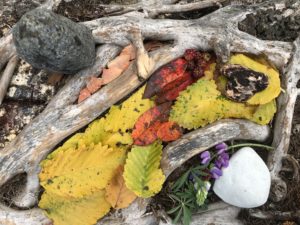
Nature Art (made from organic items found in the yard)
Fabulous Puppets (made from misc recycled items)
Imagined Worlds (made from shoe boxes and magazines)
Whimsical Insects (made from misc recycled items)
Any-kinda-HAT-you-can-imagine! (made from newspaper and misc recycled items)
Magazine Beads (made from magazines)
HOW IT WORKS
Step 1
Contact me to schedule a session at Nancy@RecycleRunway.com.
We will start with an easy project that any age can accomplish with a feeling of success! If they continue, children can choose future projects based on interests and materials on hand.
Step 2
Gather the materials and tools listed in the project descriptions above. Over time we will work on developing your own UpCycled Maker Kit!
Step 3
At the scheduled time have your materials and tools ready and a table for your child to work on in a quiet space without TV or other distractions (if possible).
How to connect?
I use Zoom, but can also use Skype or FaceTime depending on what devices and apps families have available.
Contact me at 505-577-9712 or nancy@RecycleRunway.com for more information, to schedule a session, or buy a gift certificate!
I hope that you, your family and friends stay safe and healthy in the weeks to come.
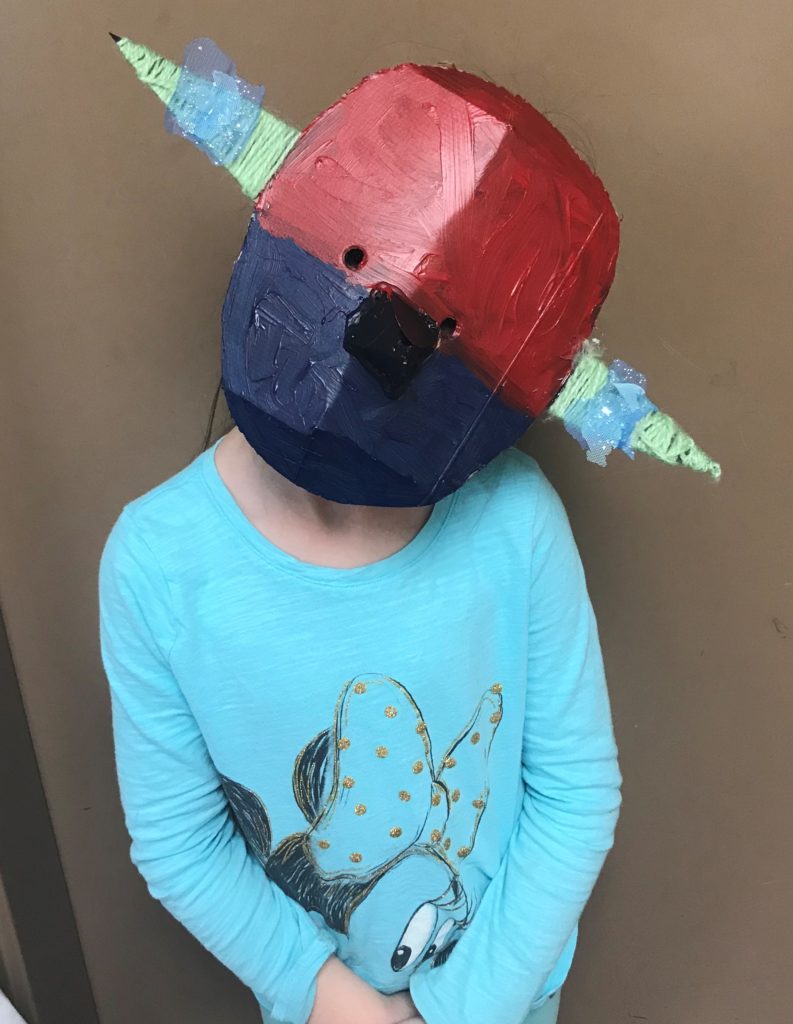
 When people ask me what I do, I tell them I am an artist and an environmental advocate. I also tell them that I am a Teaching Artist. And it has never been truer than this year as I am spening so much time diving into the classroom. I just finished an artist residency at one school, I am in the middle of another, I am preparing for a Skype presentation with a classroom in Ireland, and I am planning half a dozen other workshops and camps for this spring and summer!
Though I have been in classrooms and working with children for over 25 years, in the last 2 years I have been training to be a Teaching Artist with an organization in Portland called the Right Brain Initiative. How is a Teaching Artist different than an Art Teacher, you might be wondering? As Teaching Artists we are trained to provide an Arts Integration experience to students. The John F. Kennedy Center for the Performing Arts in Washington, D.C., one of the leading organizations that has researched and taught Arts Integration, defines it as “an approach to teaching in which students construct and demonstrate understanding through an art form. Students engage in a creative process which connects an art form and another subject and meets evolving objectives.” Or in my words, we develop creative experiences to help students understand academic subjects such as math, science, social studies, history, reading, or writing.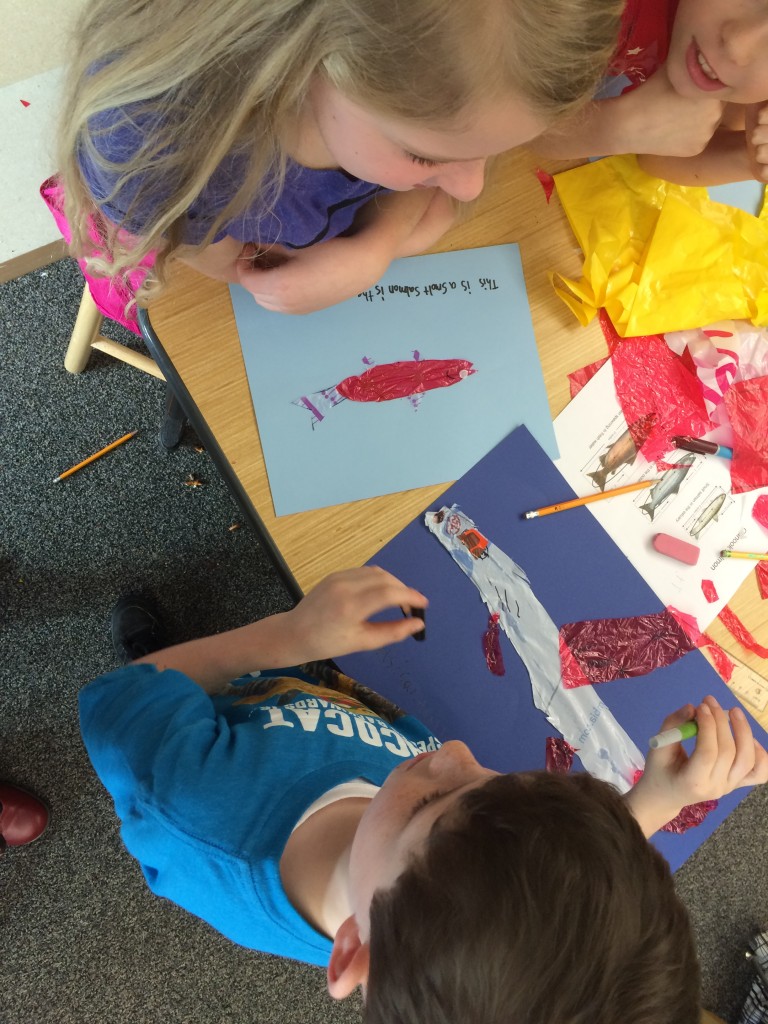
My first Right Brain Initiative residency last year was with two 3rd grade classrooms at Quatama Elementary School west of Portland Oregon. The students had just studied the life-cycle of salmon and were working on fractions. I started my time with them by having small groups use a creative movement activity to act-out each stage in a salmon’s life-cycle from little eggs, to swimming out to sea, to coming back and laying eggs. Next we used plastic, something that fish mistake for food when littered in waterways and oceans, to create a collage of a Salmon. We used fractions to determine where on the body the fins should go. You can see in the photo below that the students were also asked to write specifically what stage of life their Salmon was in, and what it was doing. Thus theater, visual, and literary arts were used to “construct and demonstrate understanding” of what they were learning about salmon.
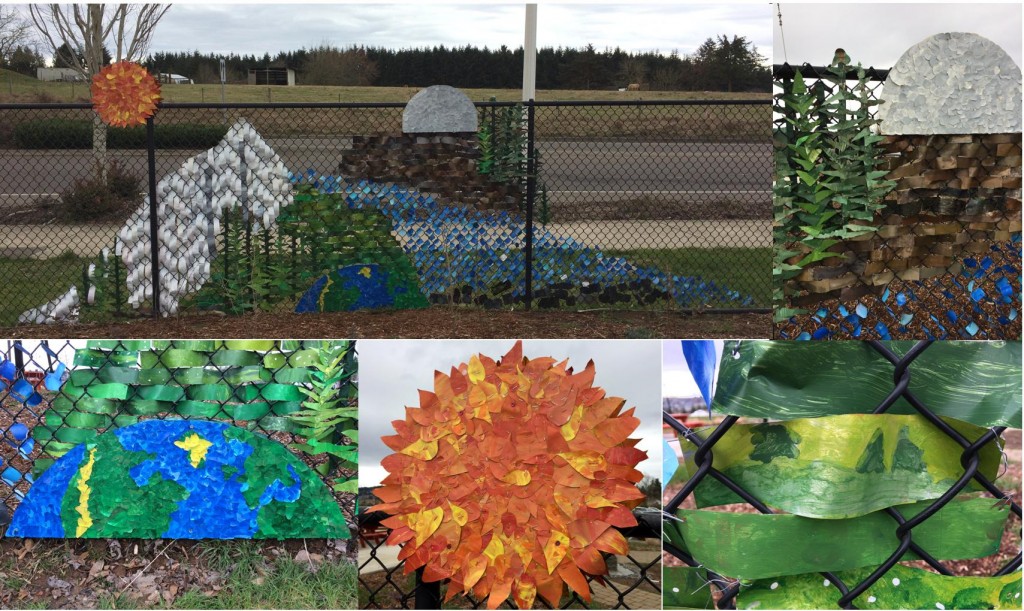
I recently finished a MUCH LARGER residency at Verne Duncan Elementary school just south of Portland. Here I worked with all of the 3rd, 4th and 5th grade classes (11 class rooms) and I visited each class 4 times, for a total of 44 sessions! When the school initially contacted me they asked if I could create a mural with their students on a chain-link fence using upcycled materials. Knowing that I usually create “trashions”, they were not sure I would be interested but since I am always up for a new challenge, I said I would be happy to step outside my usually art form and try something new.
I then had a meeting with the principal and the 11 teachers whose classes I’d be working with, where we co-created the content of the mural and residency. The theme was a natural habitat in the North West that included geological and weather/climate features, in addition to a river, plants, and planets. Each classroom contributed an element of the mural related to specifically what they were studying.
On my first day, besides showing photos of my work and talking about my career as an artist, as might be expected, I also shared my challenges as a student with the learning disability, dyslexia. I often try to tell my story of overcoming my learning disability because, in addition to giving hope to students that face similar challenges, it supports general concepts that most schools are trying to teach such as perseverance and “growth mind-set”. Plus, I think the lessons I learned from my dyslexia have contributed to my ability to face the challenges of being an entrepreneur and have actually enhanced my creativity! If this is true, I want to share this inspiration with them!
During the residency I took the students through the process of creating the mural. I decided to use painted aluminum cans which became an opportunity to bring science into the session. The general scientific inquiry process I went through to decide to use aluminum rather than plastic went something like this:
- Question – Which will hold paint and stand up to the elements better, aluminum or plastic?
- Experiment – Cut pieces of an aluminum can and from a plastic detergent bottle; paint them with an outdoor acrylic paint; bury them in the snow for a couple of days; and then submerge them in water for 24 hours.
- Observe/Analyze – The paint scratched off the plastic, but not the aluminum.
- Conclusions – The aluminum will hold paint better, and over time will not become brittle and break down as plastic does. (I decided to use the conclusion I arrived at to also teach about plastic pollution. As an aside I asked, “Did you know that plastic never decomposes? It just breaks down into tiny little pieces that pollute the soil and water– so all the plastic that has ever been made still exists!) I certainly did not want this mural becoming a source of litter and pollution!
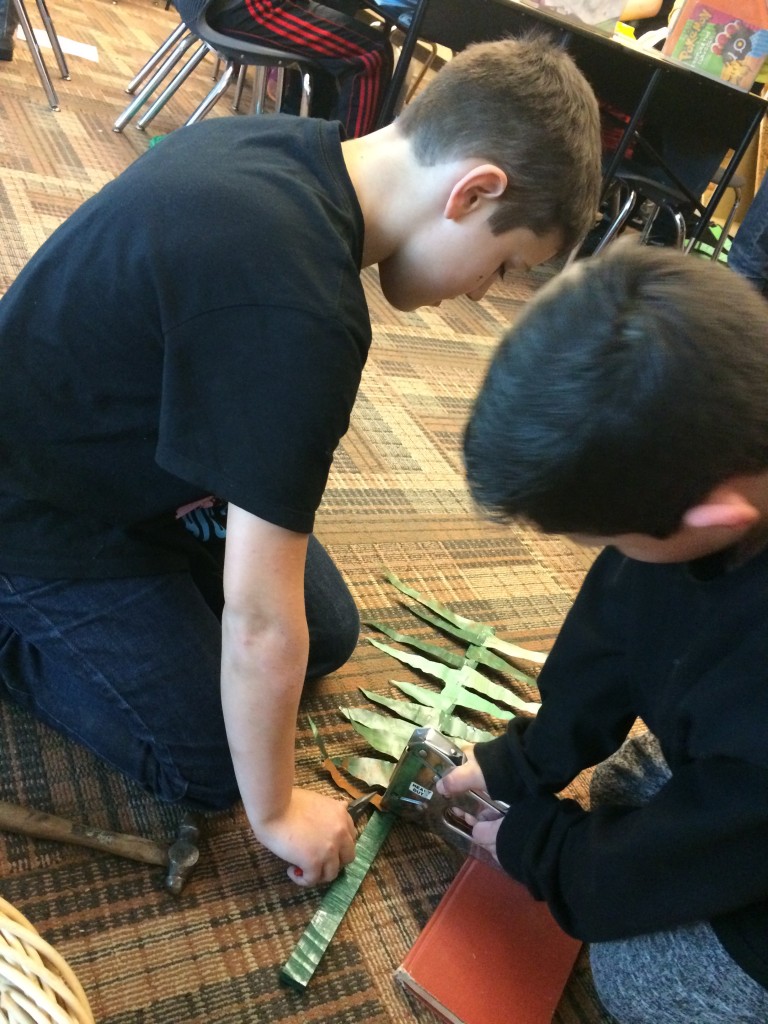
A dedicated parent (Krisen, who’s children were not even part of my residency) cut the tops and bottoms off around soda 500 cans! The students sanded the strips of aluminum, painted them and using normal scissors cut them into different shapes. At this point some of the classes poked holes in the corners and ventured out into the rain (and snow!) to attach the pieces onto the fence. The other lucky students got to stay warm inside and staple their painted aluminum pieces onto pieces of wood that were transformed into trees, the earth, the sun and the moon which would later be attached to the fence.
In an Arts Integration Residency we start with a “big idea.” The Big Idea the teachers and I crafted was: “The earth and everything that lives on it (plants, animals, and humans) are INTERDEPENDENT on each other.” The big idea is then woven throughout the sessions. To bring this theme into focus, I started my sessions exploring this quote by Chief Seattle, the chief of the Duwamish and Suquamish tribes who lived around the Puget Sound area:
This we know: the earth does not belong to man, man belongs to the earth.
Man did not weave the web of life, he is merely a strand in it.
Whatever he does to the web, he does to himself.
During each session we explored one line from the quote in-depth. On the last day I told the students a story about Chief Seattle that many people do not know. Even though the City was named after him, Chief Seattle was never allowed to live in the city limits. This was an opportunity to discuss the concept of discrimination, and link it to words the kids are familiar with like “bullying”. We also connected this to the idea of social INTERDEPENDENCE.
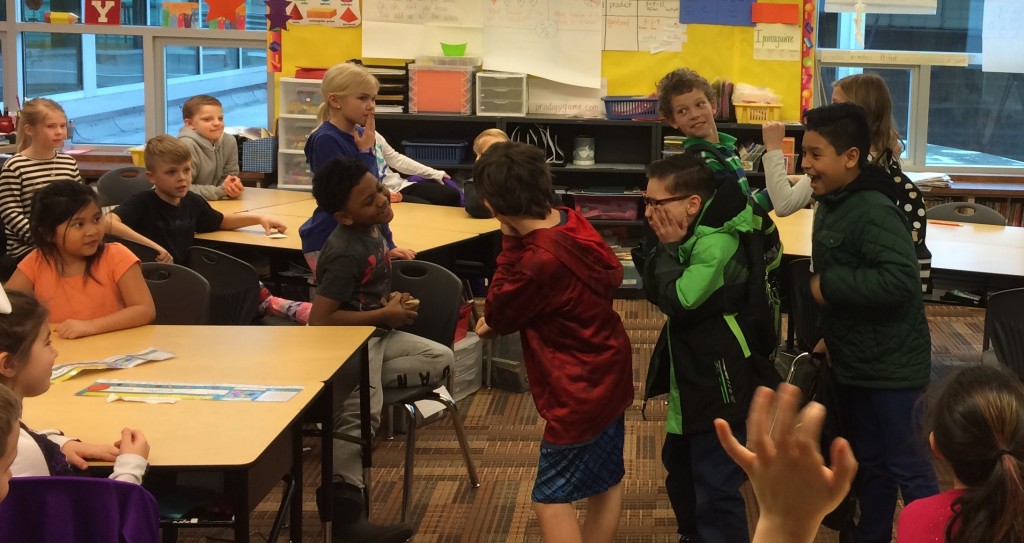 For me discussing the big idea was actually more important than the mural itself. In fact, instead of spending any of the last session working on the mural, we spent the entire time reflecting on how the mural and the Chief Seattle quote connected to the idea of INTERDEPENDENCE between us and our earth as well as amongst people and creatures. Another teaching artist tool that I employed is called “Tableaus,” where the students act-out scenes, in this case with environmental and interdependent themes, and freeze action in the middle of them. As a teaching tool, Tableaus help the students put into context the actions that they are acting out as well as the actions of their fellow students, hopefully coming away with a deeper understanding of the themes. The following are examples of the themes we explored through Tableau:
- Show how the trees in the mural are dependent upon the sun and river.
- Show ways of caring for the earth by acting out conservation actions like turning off the water and lights, or recycling and not littering.
- Show students helping each other.
- Show students demonstrating about an issue they care about such as equality or clean water.
- Show students writing and calling their leaders about issues important to them.
After each Tableau, the other students that were watching got to guess what theme was being represented and the students in the tableau would explain how their scenario connected to the Big Idea of INTERDEPENDENCE.
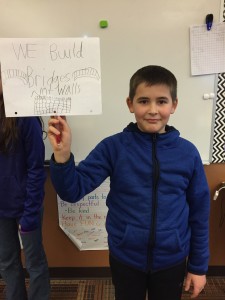 In the last part of my session with the students, I took a bit of a risk and tied these ideas to the politics of the day. Specifically discussing the different forms of discrimination we see our federal government taking against Muslims and immigrants, and the power that is being taken from the Environmental Protection Agency to protect our air, water, soil and climate. Like a broken record, I kept returning to the idea that: “If we take care of the earth, the earth will take care of us, and if we take care of each other then we will be taken care of too.” I talked to the students about the power they have to model caring for the planet, and other people. I also told them that they can be powerful young activists standing up for the issues that they believe in.
I was not sure how the school and the teachers would feel about my brining these current issues into the classroom. However, I am deeply concerned about how the new administration is impacting the planet and my fellow human beings and, because these issues are so related to the idea of INTERDEPENDENCE, I felt like I needed to make these environmental and social justice connections. The feedback I received from the teachers afterwards was positive and they said that they appreciated that I brought up what is happening politically because they felt like they could not. Also they liked that I focused on facts, not my personal opinions.
I really enjoyed all aspects of this residency, and will miss the students, teachers and staff at Verne Duncan, it was an honor to be part of their community for a couple of months!
My current residency at Hollydale Elementary school just east of Portland is focusing on making “trashion costumes” and connecting this to the Big Idea of cycles. Specifically, we are comparing the sustainable cycles we see in nature with the unsustainable cycles of consumerism specifically the fashion industry.
If you are a teacher, school administrator, or parent please know that I would love to visit your children’s school too! As mentioned I even give Skype presentations to classrooms across the country and world! Contact me at Nancy@RecycleRunway.com if you would like more information.
The third in a series of blog posts about the true costs of the clothing we wear.
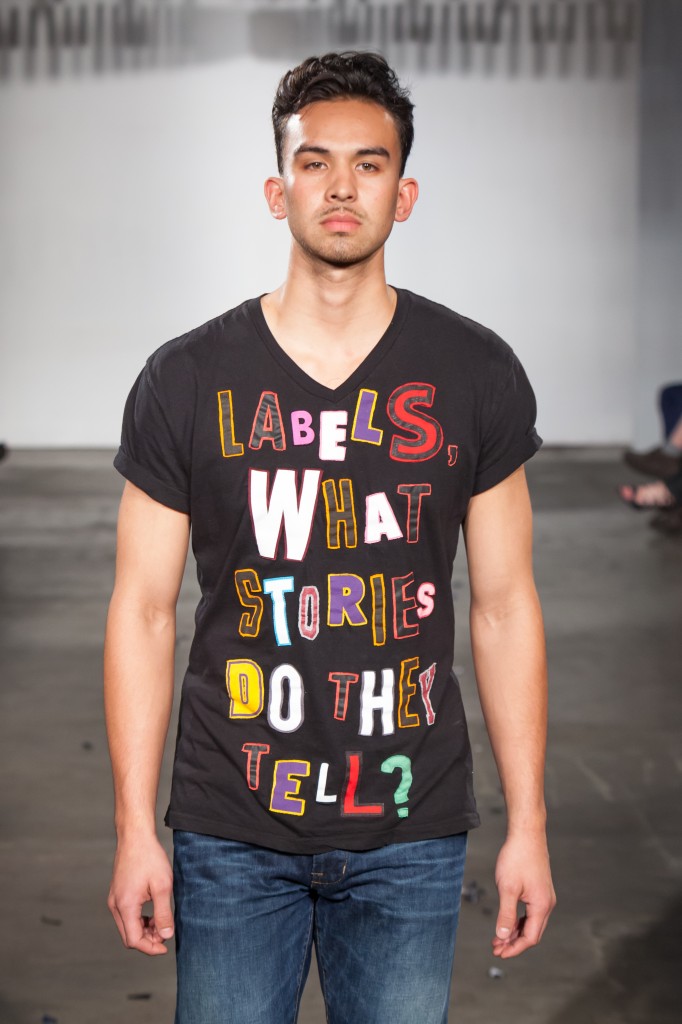
A T-shirt from my ECO FASHION WEEK collection.
In my first post, I explained that through preparing new work for ECO FASHION WEEK, I took a deep dive into the environmental and social impacts of our clothing. In the second post we explored the world of fast fashion. Below I will use the journey of a simple T-shirt to underscore how the clothing industry is the second most polluting industry in the world after oil.
Besides packing a landfill, other reasons the fashion industry is so polluting become clear when you think about the cradle-to-grave journey of a simple T-shirt. As we shall see, there are loads of instances where toxicity is released into the environment, populations of other countries are exploited and human dignity is compromised.
Most T-shirts are made of a blend of cotton and polyester.
- Cotton uses more pesticides and fertilizers than most crops and this impacts the water, soil, air, AND people who grow and pick the cotton. Some of the largest cotton fields in the world in Texas and India have significantly higher than normal rates of brain tumors and children born with physical and mental challenges.1
- Polyester is made from petroleum and the pollution from the extraction, refinement, transportation, and use of petroleum defines the first most polluting industry in the world. From oil spills, to water contamination, to air and soil toxification, to increased methane release we see the effects of pollution in everything the oil industry touches. Additionally, creating fabric from petroleum is very energy and water intensive, from the extraction of the crude oil to the weaving of the materials from polymers.2 And the fabric particles (think, the lint in your dryer) never completely break down and instead build up in the environment. These are showing up in municipal waste water treatment plants and waterways everywhere, often referred to as contaminants of emerging concern or microplastics.
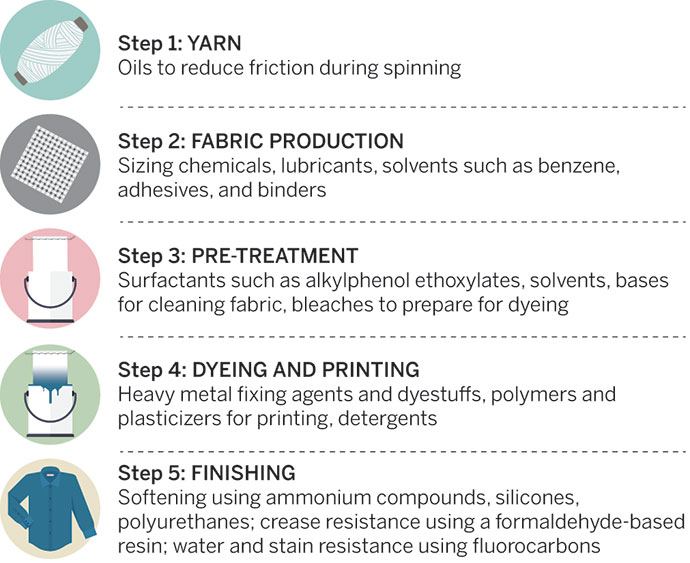
Graphic of chemicals used in each step of clothing manufacturing, from Chemical & Engineering News.3
Next our fabric needs to be bleached and dyed. Dyes and dye effluent contain highly toxic materials like ammonia, heavy metals, and alkali salts such as caustic soda, caustic potash, and lye. Many of the chemicals that make dye are carcinogenic and regulated by the EPA due to their production of toxic waste. This is another VERY polluting process that uses and pollutes tremendous amounts of water impacting people’s water sources across the globe. Tirupur, India, a city with the population with over 444,000 people, is known for its dyeing and bleaching industry. Water pollution has gotten so bad there that neither citizens, nor local farmers can use it.4 And here’s a figure for water usage in the dyeing process; in order to produce enough dyed fabric for one ordinary sofa, you need 500 gallons of water.5
Our T-shirt now needs to be cut and sewn. Clothing production in the United States has fallen dramatically over the years as companies have found people across the globe willing to work for much less money, in often unfair and unsafe conditions. According to a public broadcasting report “The Lowdown,” produced by KQED of Northern California, we went from 95% of American garments made in the USA during the 1960’s to 2% made in the USA as of 2013.6 Hundreds of people have been killed in fires and unsafe working conditions so that we can have the satisfaction of buying inexpensive clothes and getting “good deals.” Bangladesh saw one of its factories, Rana Plaza, collapse during April 2013, where over 1,100 workers were killed. Prior to that in 2012 over 100 employees were killed in a fire at the Tazreen factory, also in Bangladesh. One of the reasons that foreign manufacturers are able to make our clothing so cheaply is their lack of regulation in many portions of the process. Many of these manufacturers employ children, and do not worry about the sanitation nor even safety of their workplaces. And they can be found engaging in both forced repression of unions as well as simple wage theft.
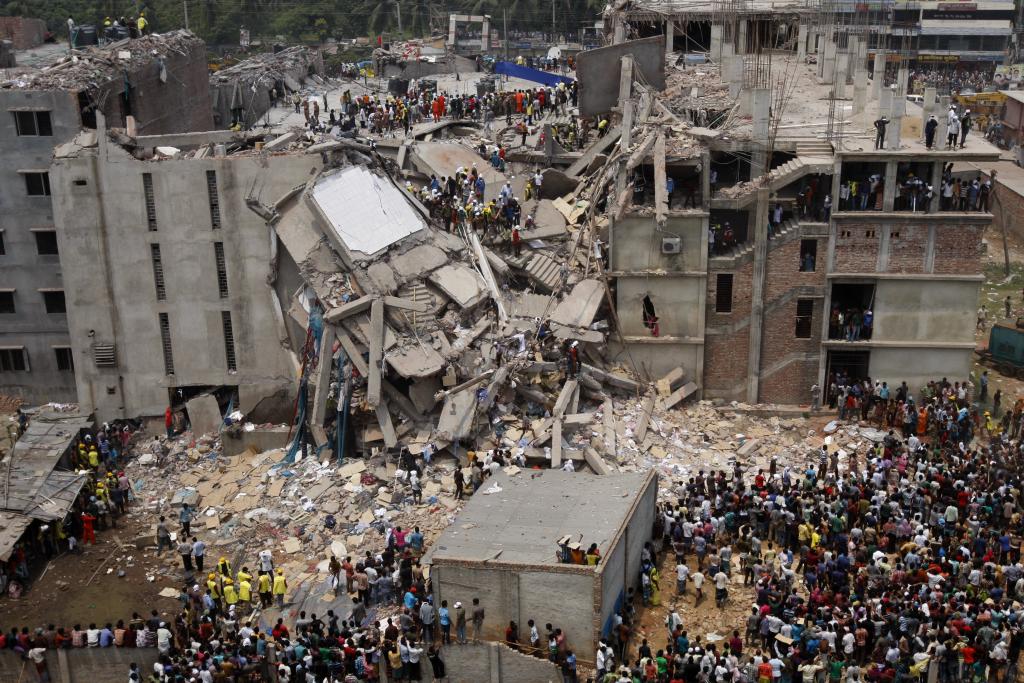
Photo by Jaber Al Nahian, Dhaka Savar Building Collapse (CC BY-SA 2.0), https://www.flickr.com/photos/rijans/8731789941
Lastly, the entire business of clothing and textile manufacturing uses an enormous amount of energy and fuel. This process of growing/mining; processing/weaving; bleaching/dying; sewing; selling/buying; and wearing our clothing rarely happens in one place or region. Each stage requires transportation. Though global supply chains have the promise of efficiency to meet manufacturer and vendor deadlines without adding extra cost, they are transported by shipping containers on rail, truck, and ships using the worst of today’s polluting fossil fuels. Increases in transport by ships that consume fuel by tons per hour, coupled with their use of lower grade bunker fuel have increased the negative health effects to coastal and inland populations.
Beyond all this, here is a brief list of startling facts:
- Making polyester uses 70 million gallons of oil each year.
- To manufacture rayon and other fibers from cellulose, we harvest over 70 million trees a year.
- 24% and 11% of insecticides and pesticides global manufacturing, respectively, is used to produce the world’s cotton.
- Textiles use ¼ of the world’s chemicals.7
- It takes 3,886 MJ (megajoules) of energy to produce enough nylon fabric to cover a couch (about 25 yards).8
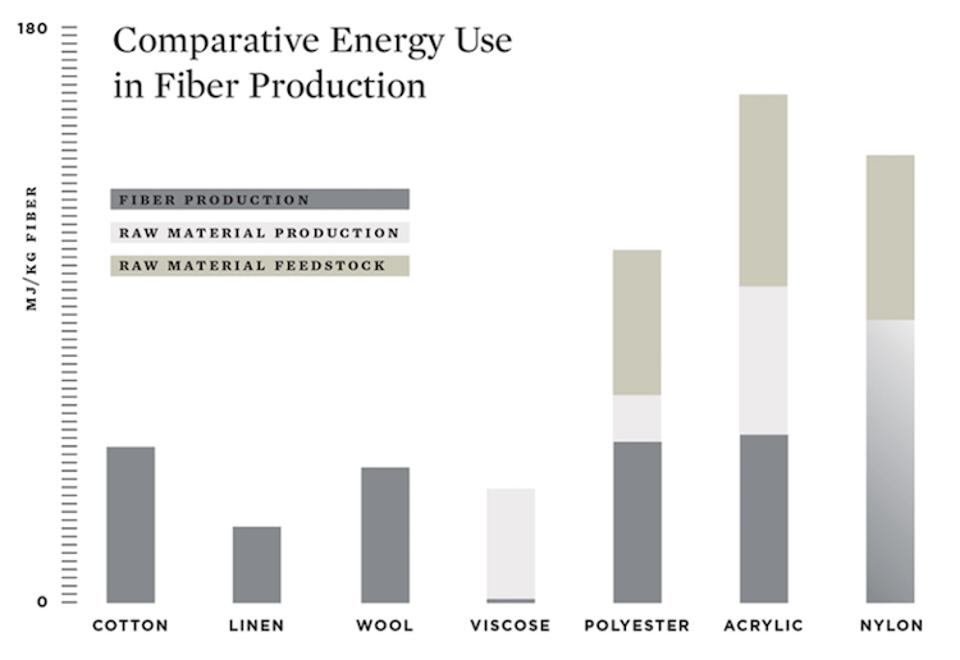
Graphic “Comparative Energy Use in Fiber Production,” from Forbes. 9
This is the quick story of a simple T-Shirt, imagine the process for more complicated items like shoes, rain coats, dresses with sequins, etc. Even clothing purchased from more “reputable” brands and stores are mostly created from the same problematic materials and in overseas factories that require a great deal of transportation. NOW, perhaps you can see why the clothing industry is the second most polluting industry in the world!
In my next blog post, I will talk about how all this information informed the collection and performance piece I created for ECO FASHION WEEK, and in my last blog post we will explore what we can do as consumers to reduce the negative impacts of the clothing we purchase and wear.
1 Morgan, Andrew. The True Cost | A Documentary Film. bullfrogfilms, 2015. SDH Captioned. http://truecostmovie.com/
2 Grossman, Patty, and Van Dusen, Leigh Anne. “Estimating the Carbon Footprint of a Fabric.” WordPress. O ECOTEXTILES. N.p., 19 Jan. 2011. Web. 21 Dec. 2016. https://oecotextiles.wordpress.com/2011/01/19/estimating-the-carbon-footprint-of-a-fabric/
3 Scott, Alex. “Cutting Out Textile Pollution.” Chemical & Engineering News 19 Oct. 2015. Web. 17 Jan. 2017. http://cen.acs.org/articles/93/i41/Cutting-Textile-Pollution.html
4 Rajshekhar, M. “Can the Courts Save India’s Rivers from Pollution? Tirupur Shows the Answer Is No.” News. Scroll.in. N.p., 30 Aug. 2016. Web. 21 Dec. 2016. http://scroll.in/article/812470/can-the-courts-save-indias-rivers-from-pollution-tirupur-shows-the-answer-is-no
5 Grossman, Patty, and Leigh Anne Van Dusen. “Textiles and Water Use.” WordPress. O ECOTEXTILES. N.p., 24 Feb. 2010. Web. 21 Dec. 2016. https://oecotextiles.wordpress.com/2010/02/24/textiles-and-water-use/
6 Vatz, Stephanie. “Why America Stopped Making Its Own Clothes.” Public Broadcasting. The Lowdown. N.p., 24 May 2013. Web. 18 Jan. 2017. http://ww2.kqed.org/lowdown/2013/05/24/madeinamerica/
7 Conca, James. “Making Climate Change Fashionable – The Garment Industry Takes On Global Warming.” Publication. Forbes. N.p., 3 Dec. 2015. Web. 19 Jan. 2017. http://www.forbes.com/sites/jamesconca/2015/12/03/making-climate-change-fashionable-the-garment-industry-takes-on-global-warming/#2c2c25a9778a
8 Grossman, Patty, and Leigh Anne Van Dusen. “What Is the Energy Profile of the Textile Industry?” WordPress. O ECOTEXTILES. N.p., 16 June 2009. Web. 19 Jan. 2017. https://oecotextiles.wordpress.com/2009/06/16/what-is-the-energy-profile-of-the-textile-industry/
9 Conca, James. “Making Climate Change Fashionable – The Garment Industry Takes On Global Warming.” Publication. Forbes. N.p., 3 Dec. 2015. Web. 19 Jan. 2017. http://www.forbes.com/sites/jamesconca/2015/12/03/making-climate-change-fashionable-the-garment-industry-takes-on-global-warming/#2c2c25a9778a
This series was co-researched and co-written with Nicole Morris.
Photo Credits: Runway photo by Peter Jensen.
PDX Weather Advisory, 2016
Celebrating Sustainability (and rainy weather) at the Portland Airport!
The Port of Portland which runs the Portland International Airport commissioned me to create this ensemble. Each part of the rain gear outfit (a nod to Portland’s notoriously wet climate) represents one of the Port’s five sustainability programs, and is made from waste materials upcycled from each of those programs.
You can learn more about what each component is made of and the process of creating the piece in this blog post.
The Trash Man’s Suit, 2016
The Trash Suit was commissioned by Rob Greenfield during an “eco-stunt”, where he wore his trash for 30 days! It is made of clear plastic film that was sewn onto a pair of military pants and a coat supported by an old back pack frame. See photos of the suit filling up over the month in Rob’s “Trash Me Time Line”.
Read more about my experience making the suit and working with Rob in this blog post.
Watch a video Rob’s team made about my process creating the Trash Suit.
Pacifica, 2016
A Celebration of the Seashore!
This sculpture was created to celebrate the 50 year anniversary of Cascade Head Preserve on the Oregon Coast. It is made of natural items found along the seashore such as shells, driftwood, rocks, salmon teeth, fins and vertebrae that are strung onto wire and secured to a metal skirt made from upcycled baking sheets. The bodice is made from moss, lichens and bark sewn to burlap with old fishing line.
Pacifica was commissioned by the Nature Conservancy in Oregon.
You can read details about the creation of Pacifica in this blog post.
Bella, 2016
A Bride on a Mission!
This sculpture is made from discarded plastic Tyvek® (used in sterilization pouches and bags for the medical industry) that was cut into strips and sewn to the dress. The flowers were made primarily by people attending medical industry conferences across the US in 2016. Bella’s goal is to bring awareness to the recyclablity of Tyvek®, and inspire the creation of recycling programs for this plastic film.
Commissioned by Beacon Converters in 2016.
Read this blog post to learn more about the creation and mission of Bella.
The first in a series of blog posts about the true costs of the clothing we wear
 Ask me to make a dress from a pile of trash and the inspiration flows! Ask me to make one from “normal” fabric and…it’s not quite that easy. Thus, it was an unusual challenge when I was invited to participate in a fashion week event last month in Seattle. Fashion? Couture maybe, but I have a dubious relation with fashion. However, this event was no normal fashion week. This was ECO FASHION WEEK (#EFW), the world’s largest sustainable fashion event happening, in 2016 for the first time, in Seattle Washington! Originally launched in Vancouver, BC, Canada in 2010, they sought to break into the international market by bringing the event to the US. Held over four days with two jam packed evenings, the event was filled with runway shows, a meet and greet, and a full day of presentations called the Collective Conversation. Meant to explore the environmental and social issues related to the fashion industry, I was invited to both participate as a panelist in the Collective Conversation and to share new work on the runway. The pace was thrilling and exhausting!
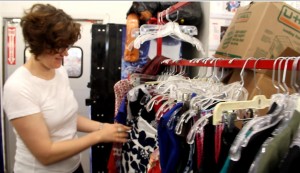 For the runway portion of EFW, I was one of 10 designers and stylists that participated in the Runway ReImagined: Project 8.1. So there I was in Value Village at 6 o’clock in the morning, standing toe to toe with the other clothing sorters except I was pulling clothing for fabric and labels, not for resale (hence my foray into creating a garment made solely from repurposed “normal” fabric). Individually, each of the 10 designers used 8.1 pounds of recycled clothing to create a small collection of garments. But collectively, we created couture weighing a total of 81 lbs. What is the significance of 81lbs, you may ask? It’s the staggering weight of textiles that the average North American discards annually! Hard to imagine isn’t it?
The EPA estimates that 3.8 billion pounds of post-consumer textile waste goes into the landfill every year.1 Luckily most of these textiles we discard — even if they’re worn, torn, or stained — can be recycled! You can even recycle a single shoe! Items simply need to be clean and dry. There are lots of thrift stores happy to take your textiles, such as one of the main sponsors of the 8.1 challenge and Eco-Fashion Week: Value Village (aka Savers, Inc.). The clothing recycling market can reuse and recycle 95% of the enormous amount of apparel that we purchase and discard every year. About 45% of discarded clothes are usable clothing, however, because of the huge glut of clothing in the world only a small percent is resold in secondhand clothing stores. The rest is sent to developing countries for reuse. The other 50% of discarded clothes are turned into a variety of new products where 30% become wiping cloths (used in repair shops, construction, stores, and maintenance or custodial departments) and 20%, when processed back into fibers, are turned into paper, yarn, insulation and carpet padding.2 Unfortunately, of the 81lbs of clothes we throw away every year, the clothing recycling market is only capturing 15%. The rest goes into landfill.
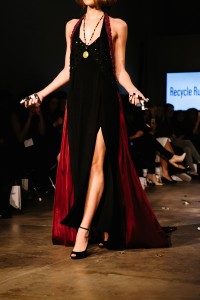
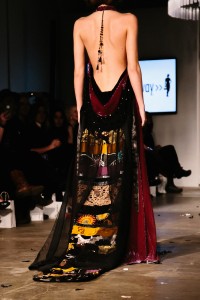 However, the disposal of textiles is only one problem with the fashion industry. Let us pause here as our minds conger up images of slim models with hair blowing in the wind, garments unimaginably sleek, revealing sensuality, or audacious juxtaposition usually affordable only through extravagant expense. My first piece in the collection (shown in the images to the left) I created for ECO FASHION WEEK was meant to represent this notion of fashion and the opulence of conspicuous consumption. But let these realms stay in the pages of Vogue, Elle, W, and GQ.
The thing is, when I talk about the fashion industry I am also referring to the sneakers worn by 8-year-old boys, T-shirts worn by the guy next door, and the bathrobe worn by your grandma. All our attire including coats, shoes, hats, and accessories are part of this mammoth industry. Which by the way, is the SECOND most polluting industry in the world after oil–YES, the second!
This blog post starts a series about fashion and its critical role in the exploitation of resource use and in climate change. In the series, we will explore 81lbs of waste, pollution and mistreatment from fast fashion, the exportation and globalization of toxicity, and what steps we can take individually and collectively to combat our decreasing value of clothing. I will return to more about my ECO FASHION WEEK collection and performance piece in this series, but first I am going to share with you some of the information I learned in my research preparing for the project.
I thought this series a very fitting way to begin the New Year as we open ourselves to resistance against the old ways of thinking that no longer serve us. Continue reading the next post in the series here.
1 Digitek, Potomac. “SMART: Consumers & Green Advocates.” Professional Trade Association. SMART: Secondary Materials and Recycled Textiles Association. N.p., 12 Aug. 2015. Web. 19 Dec. 2016. http://www.smartasn.org/consumers/index.cfm#
2 SMART: Secondary Materials and Recycled Textiles. The Lifecycle of Rags. N.p., 2015. Web. 19 Dec. 2016. http://www.smartasn.org/consumers/lifecycleofrags.pdf
This series was co-researched and co-written with Nicole Morris.
Photo Credits: All photos by Nicole Morris, except runway photos by Alfonso Arnold.
The video above was recently released by the Huffington Post about the work I do. It is part of an excellent series they are doing called RECLAIM: REDUCING THE WORLD OF WASTE . In this series, they cover positive stories across the globe ranging from smog vacuums in China; to Rob Greenfield’s story of wearing his trash for a month; to a story called, “You Make Reckless Decisions When You Shop After Work.”
The Huffington Post piece focused on my use of fashion as a means to engage people in conversations about what is happening to our planet. As I prepare to dive into the world of fashion at Eco Fashion Week in Seattle this week, this is a perfect focus.
At EFW, I’ll be participating in two ways but I’m going to talk about the second event first. On Friday November 4th I will be part of a panel, during Session 2, in a day-long event called the “Collective Conversation” which explores how to make our clothing more sustainable. I will discuss this in further detail later this month in a blog post covering what I learn this week. For now I want to share with you one staggering piece of information I discovered recently:
FASHION IS THE SECOND MOST POLLUTING INDUSTRY AFTER OIL & GAS!
At first this seemed unlikely to me, especially considering industries such as nuclear energy and weapons. But as I thought about it more I realized that each of the 7 billion people on this planet wear cloths and many have copious amounts of them! The price of fashion is huge when we consider the varied activities that take place around clothing, for example:
- the pesticides used to grow cotton;
- the petroleum products used to make nylon and polyester;
- the staggering amounts of water that are both used and polluted in the garment industry (it takes over 700 gallons of water to make ONE T-SHIRT!);
- the overwhelming energy requirements to power the massive facilities where our clothes are dyed, bleached, woven, cut, and sewn;
- the energy used on washing and drying clothes;
- all of the packaging used to protect the materials and finished garments as they move from one place to another before they end up in our closets;
- the fuel used and pollution created to transport clothes across the world and back again;
- the waste created while we wear clothes and later dispose of them (the average American throws away 81 lbs of textiles a year!)
- And then of course there are the often unfair and unsafe working conditions for the millions of people in the garment industry.
When you consider the many and far reaching arms of the fashion industry, you can begin to understand why it holds this regrettable distinction!
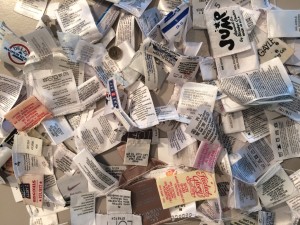
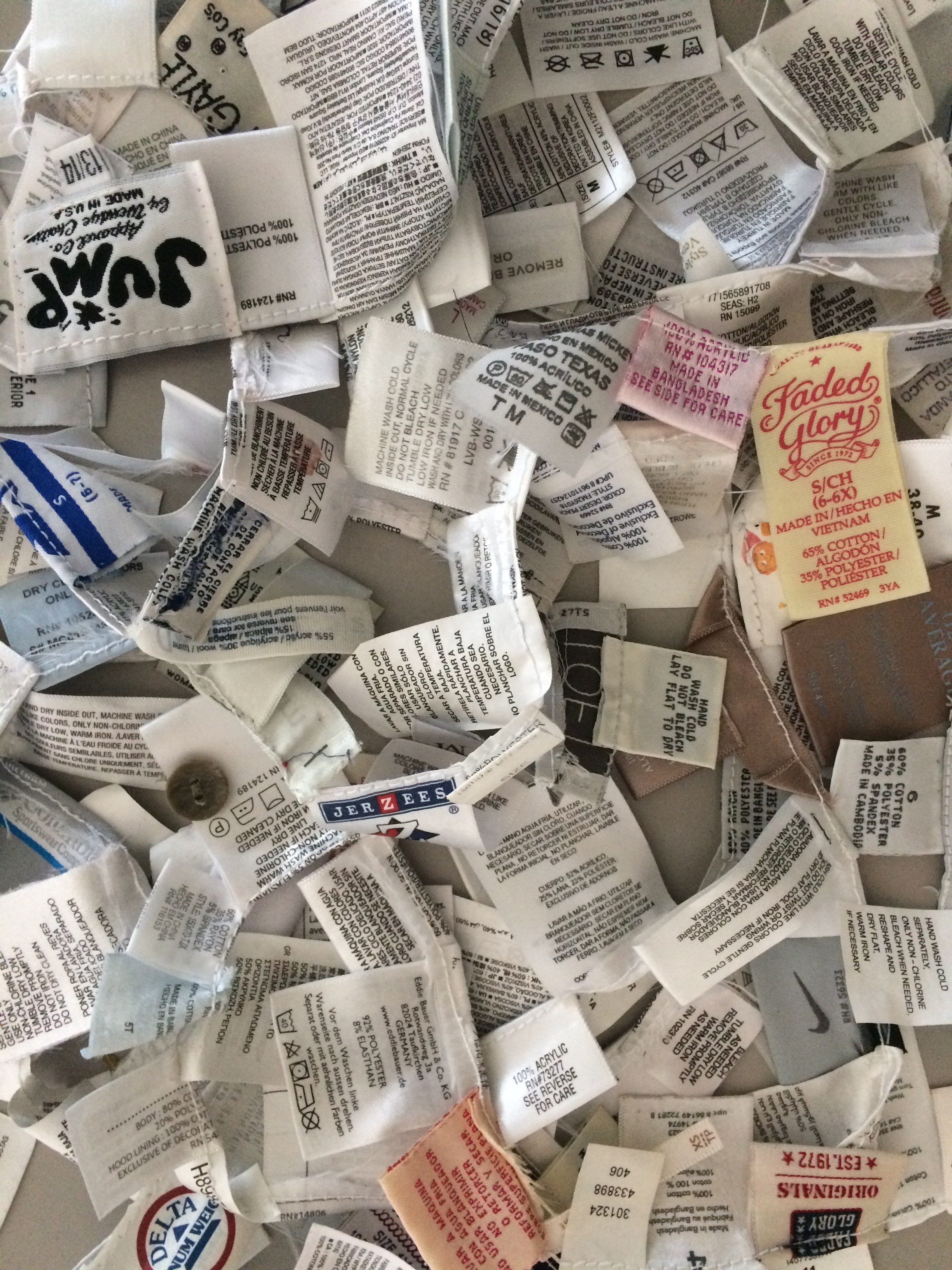
The first event I will present in is a segment called RUNWAY REIMAGINED on Wednesday November 3rd where I will be unveiling a visual exploration of the price of fashion on the runway. (If you live in Seattle, please come! Details can be found here: ) For the show, I have created three garments that raise questions about the labels in our clothing and the stories they tell us about the environmental and social costs of what we wear. I consider this work to be performance art, using the fashion stage as my “canvas”. It’s new territory for me and I’m very excited!
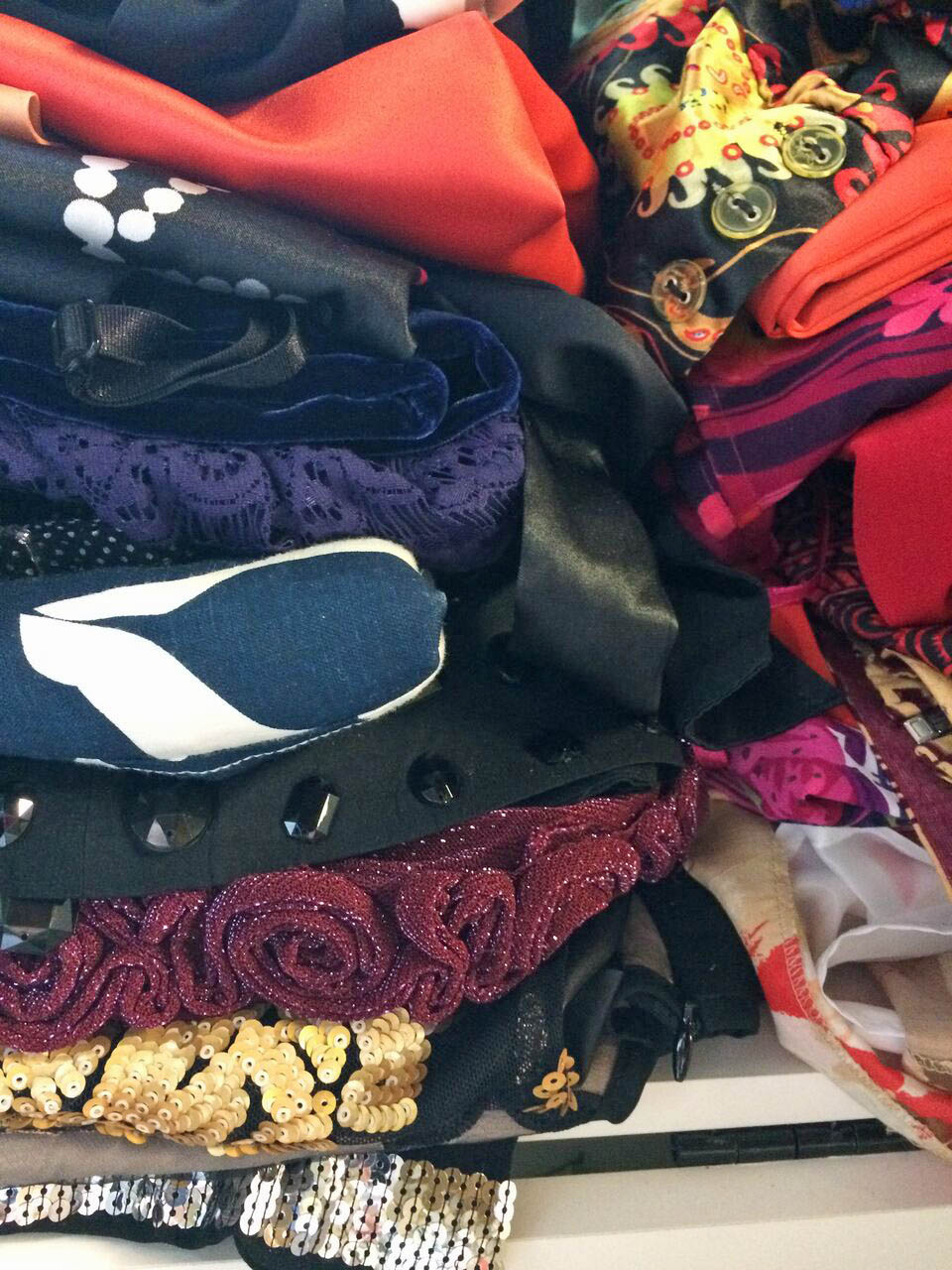
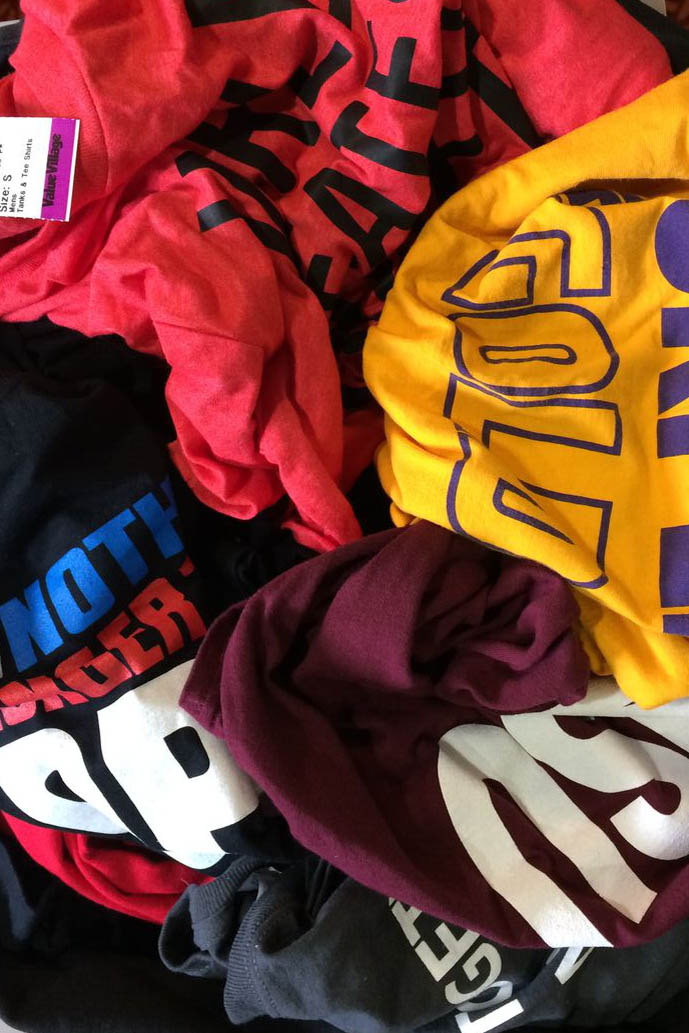
Below are photos of the materials I am working with for this collection. After the garments are unveiled at Eco Fashion Week, I will send out photos and video of the full garments and collection. Stay tuned!
 |
 |
 |
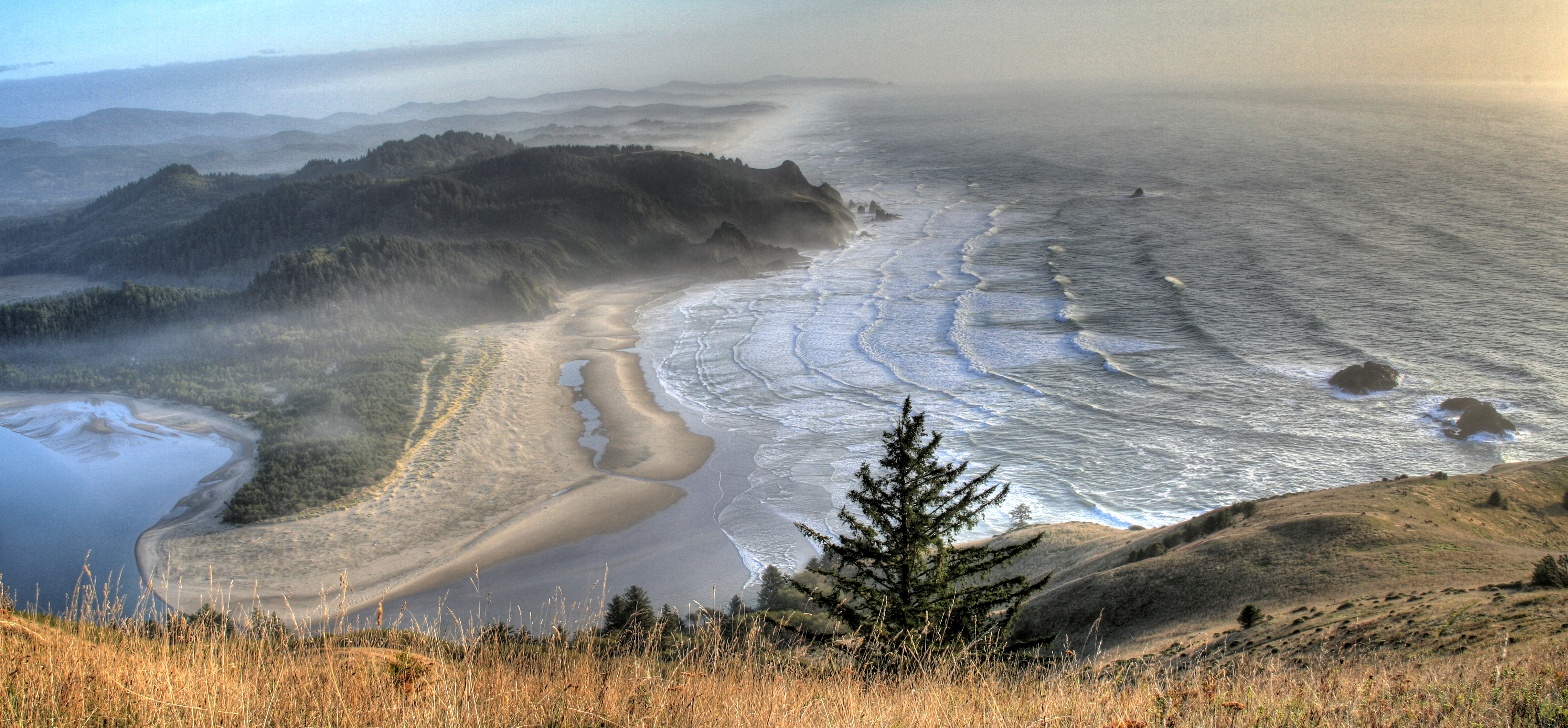
Cascade Head Preserve and the Salmon River Estuary
I love most that first breathe when I step out of the car after a two-hour drive from Portland, OR and inhale the rich smells of Cascade Head. It’s a mixture of the salty ocean with the loamy earth. It is specific to this area where the sea meets the land at the mouth of the Salmon River Estuary. As a child I was allowed to roam this River and the nearby forests at my leisure, spending hundreds of hours quietly watching: noticing the green moss, the green ferns, the green leaves, the green pine trees—infinite shades of green teaming with life. Burying my nose in a mossy tree limb made me feel alive and connected to the natural world. It still does!
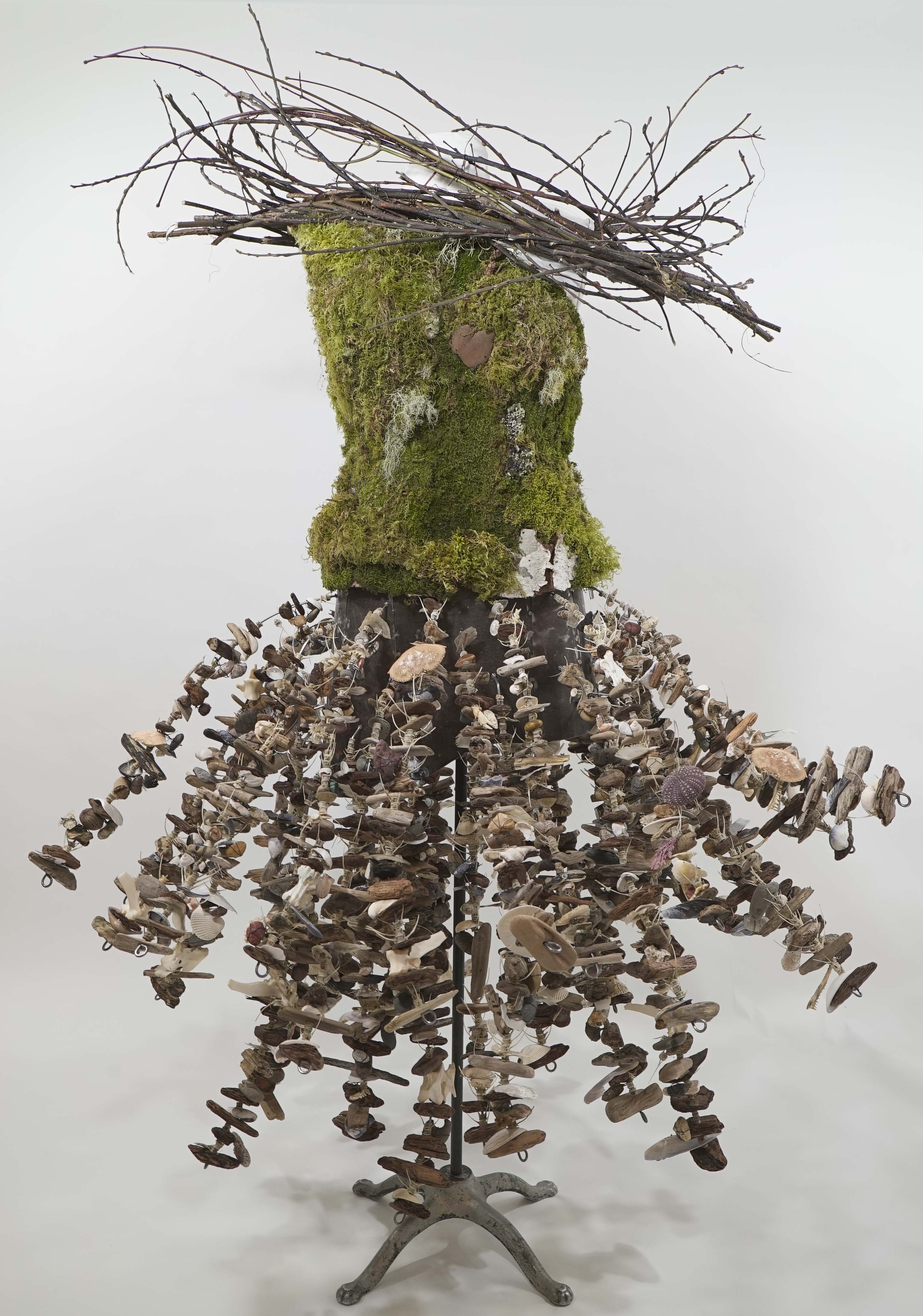
Pacifica
Pacifica is the most personal sculpture I have created thus far. It tells the story of my history, my inspirations, my family, and one of the most powerful forces on earth: the ocean. This sculpture was commissioned by The Nature Conservancy in Oregon (TNC) which is celebrating the 50-year anniversary of Cascade Head, one of their prized preserves and a place central to my being. I first came to this magical area as a child in the 1970s when my parents purchased a small piece of property below the majestic Cascade Head which is on the Oregon coast just north of Lincoln City. They settled on a steep triangle of land thick with elderberry bushes and sword ferns over-looking the Salmon River Estuary. Here my Mom and step-father John (who is a painter, sculpture and builder) designed and built our family a beautiful home. John took over 20 years to construct every inch himself down to each drawer and banister. It is truly the gift of a lifetime as my siblings, nieces, nephews, our spouses, friends, and I have returned again and again for over 40 years!
The creation of Pacifica began at Cascade Head on a rainy February day when I hiked with TNC’s Debbie Pickering, Mitch Maxson and Julia Amato, along with cinematographer Brady Holden, up to the Head and walked along the Estuary to collect materials. Debbie, TNC’s Oregon Coast Ecologist, shared information with us about the ecology of the area that was completely new to me despite my years of walking these paths. For example she taught us how to distinguish different conifer trees from one another, and which plants are edible and used for medicinal purposes.
Brady Holden’s video about Pacifica won two awards at the McMinnville Short Film Festival in October.
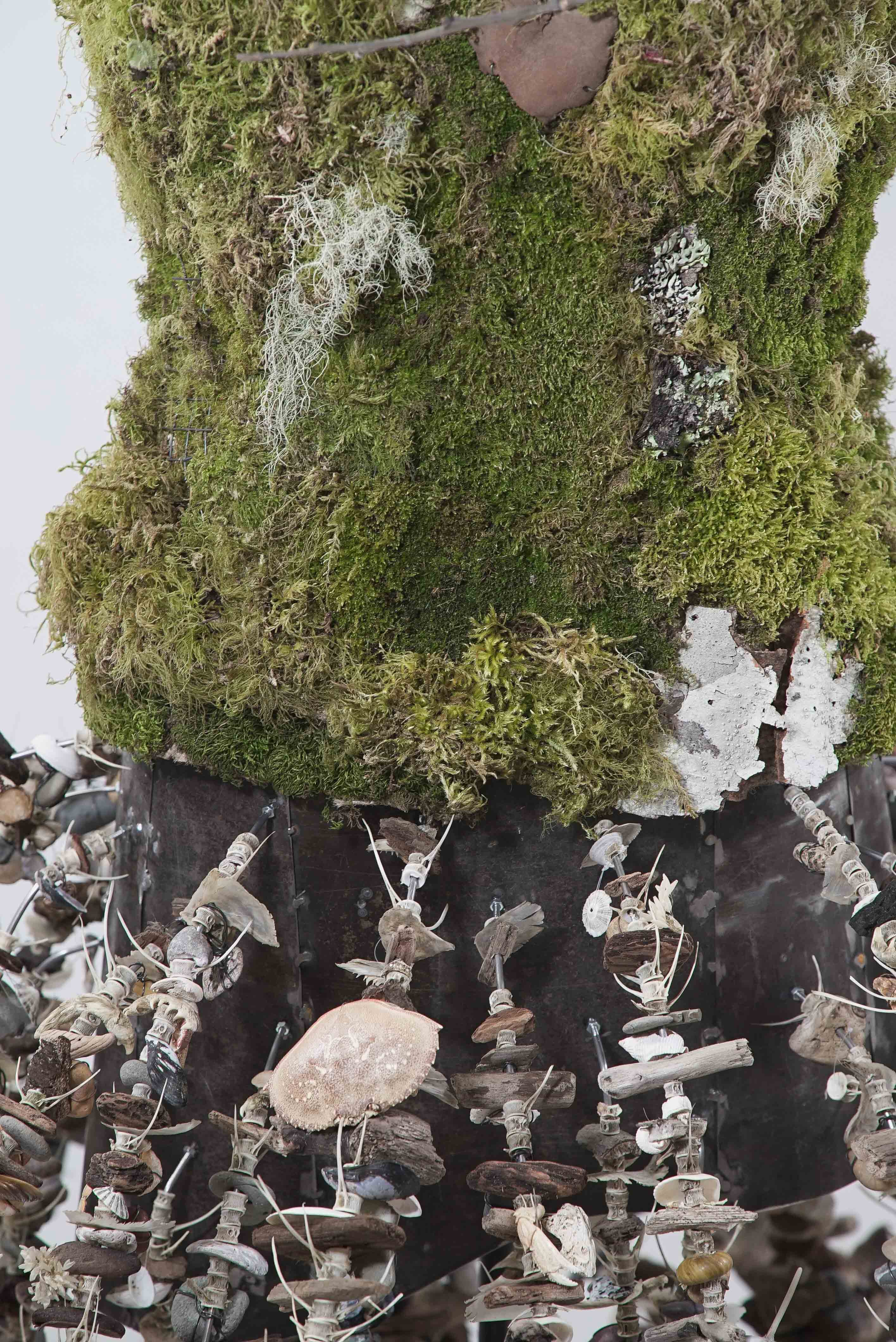
Detail of Pacifica
Unlike my other garments, Pacifica is made primarily of natural objects: shells, wood, rocks, bones and feathers are strung on wire and connected to an upcycled steel skirt; the living bodice is made from moss, branches and pine cones sewn to burlap with reclaimed fishing wire. Debbie determined which items we could include on the sculpture, for example we had to be careful not to collect anything with living barnacles attached to it so as not to inadvertently kill any little creatures in creating the piece. Additionally, Debbie and her husband Dave spent many hours along the sea shore gathering the majority of materials that make up the skirt… I am very appreciative of her special contribution to the creation of Pacifica!
For me, this sculpture is about the connection of the ocean to the land. As a child I was moved by the connections and transitions I witnessed at Cascade Head where the river meets the ocean, the ocean meets the land, and that incredible moment when you break out of the sheltered forest into the open grasslands of the Head. There before you stretches the Pacific Ocean out to our neighbors in Asia and, as you turn around, you can see miles of the Salmon River forever flowing, flowing, flowing. Below our house, sitting on a rock in the estuary I watched the waves crashing, splashing, misting, and foaming. Other times the ocean arrives in the estuary quietly, slowly raising the river as the tide flows in, curious seals floating by with big eyes watching me watch them. It was in these moments I discovered my connection with the earth which has guided me to the work I am privileged to do today, and to creating Pacifica. See more beautiful photos of Cascade Head here.
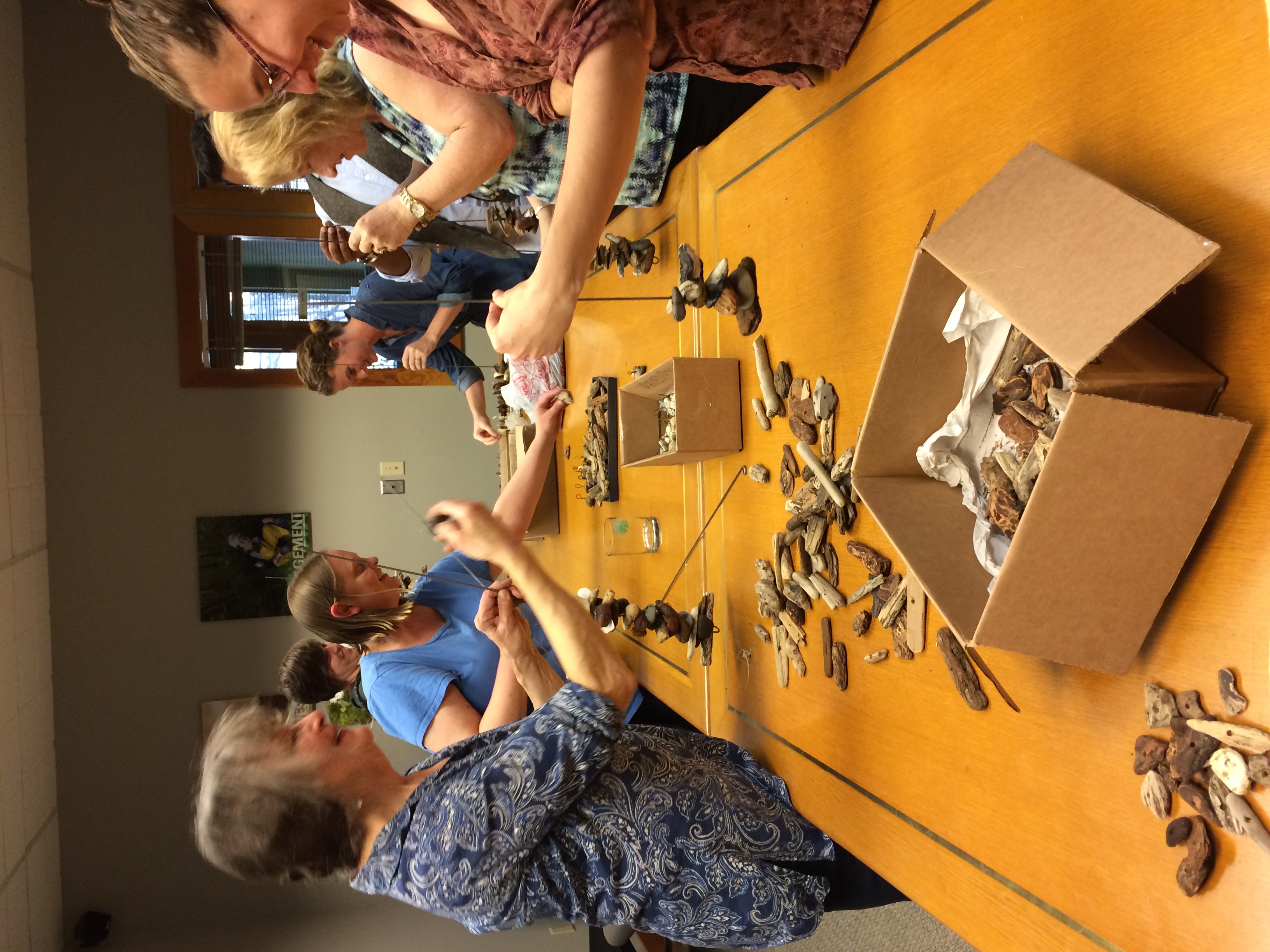
TNC staff and volunteers string the “sea-shore-shish-kabobs”.
I started working on Pacifica right after I finished an upcycled wedding dress called Bella. At the same time I was working on Pacifica I was starting another project called PDX Weather Advisory; both had to be completed at the same time in April. All that to say, there is no way I could have finished this sculpture (it took 270 hours) without the help of many volunteers! Over 20 people helped me in several work parties at the Oregon TNC headquarters and at SCRAP, a local reuse store in Portland. Volunteers prepared materials and helped to string the “sea-shore-shish-kabobs” made of drift wood, shells, rocks and fish bones that make up the skirt. Early in the project the OCEAN volunteered an invaluable gift to Pacifica: a huge pile of old Salmon bones was discovered by a TNC ecologist at another nearby estuary. The teeth, fins and especially vertebra became an essential part of the skirt. The little vertebra created space between the rocks, wood and shells which not only kept the wires from becoming too heavy, but they also helped to extend the materials (which we used ALL of) so that I had enough to complete the skirt. This also created a more open and airy visual feel to the skirt.
Pacifica has been on display this summer at the Bridgeport Shopping Center outside of Portland, TNC’s Julia Amato created a beautiful display located in a shop window on the way to the movie theater. In October Pacifica will be showcased at FashioNXT, a celebrated fashion week in Portland, OR. It will travel back down to Salmon River Estuary at the end of October for the 50 year celebration of Cascade Head Preserve, and then in 2017/2018 Pacifica will join the rest of my work in a solo exhibition in the Atlanta Airport for one year.
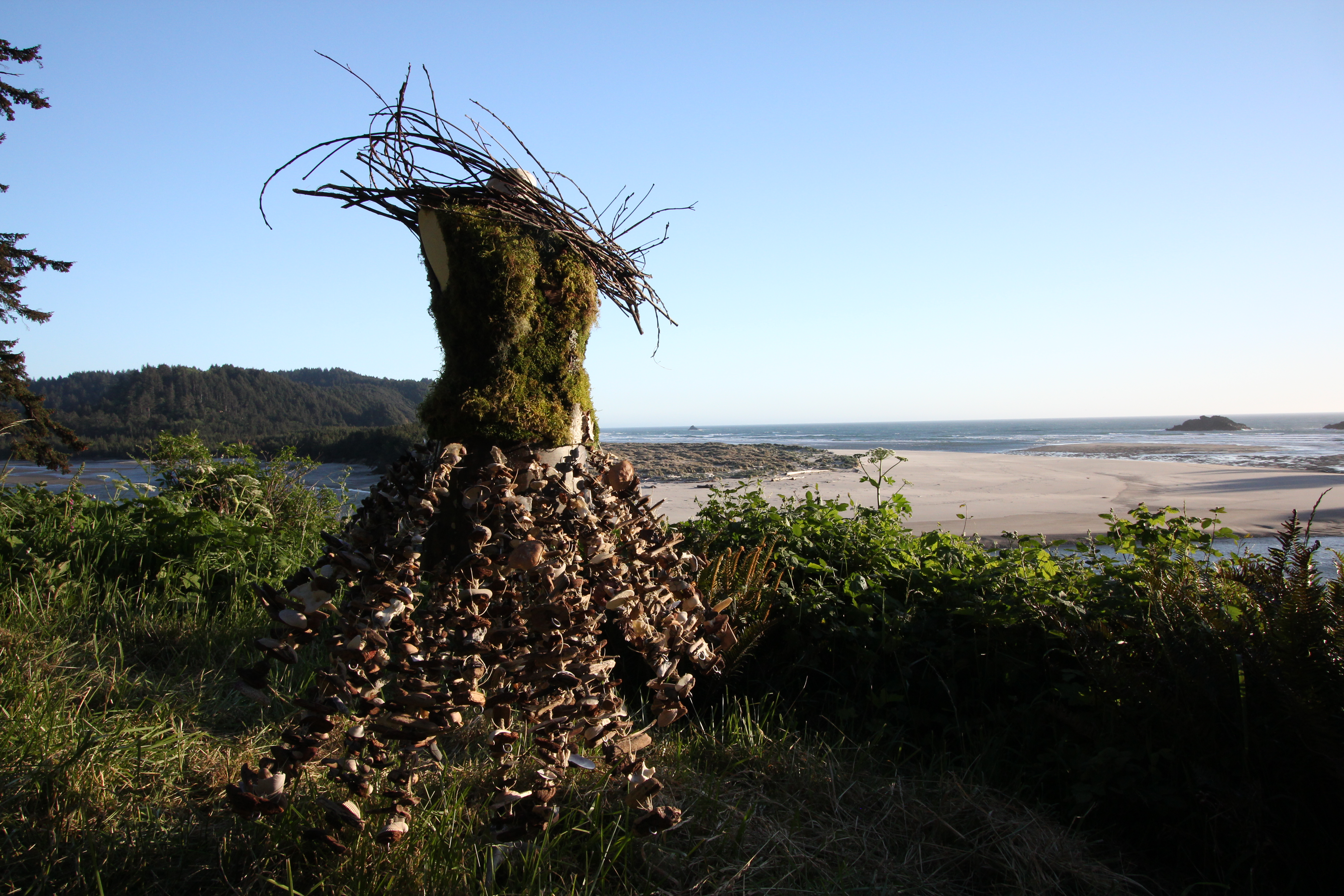
Pacifica above the Salmon River Estuary
For me Pacifica represents the wisdom of ancient forests regenerating themselves for billions of years. As leaves, shrubs, grasses and trees die and fall to the ground they become food and shelter for other life to grow; at Cascade Head I learned that in nature there is no such thing as waste. Pacifica also captures that sense of discovery the ocean offers as it delivers little gifts along the seashore every day. The sea is so comfortably consistent; for decades and centuries, for most of the life of this planet, the rhythm of the waves has been present like the heartbeat of the earth– the heartbeat of Pacifica.
A special heartfelt thank you to all the staff of The Nature Conservancy for each of your special contributions to this project: Julie Fitzgerald, Debbie Pickering, Julia Amato, Mitch Maxson, Deanna Brown, Christine Kessler, Kate O’Neill, Joe Buttafuoco, Teri Stoeber, Megan Fairbanks, Meredith Stewart, Nav Dayanand, Kim Lepre, Molly Dougherty
Additionally, I deeply appreciate the following individuals and organizations for your time, various contributions and encouragement:

Kevin welding the skirt
Nicole Morris-Judd
Brady Holden
Dave Pickering
Kevin Takalo
Palo Alto Software
Bridgeport Plaza – Mallorie Goody
SCRAP – Elizabeth Start and Lisa LeDouxAshley Smithers
Carol Knutson
Marilyn Ellis
Helena Tesselar
Myleen Richardson
Norma Gregor
Amarette Gregor
Jayne Vetter
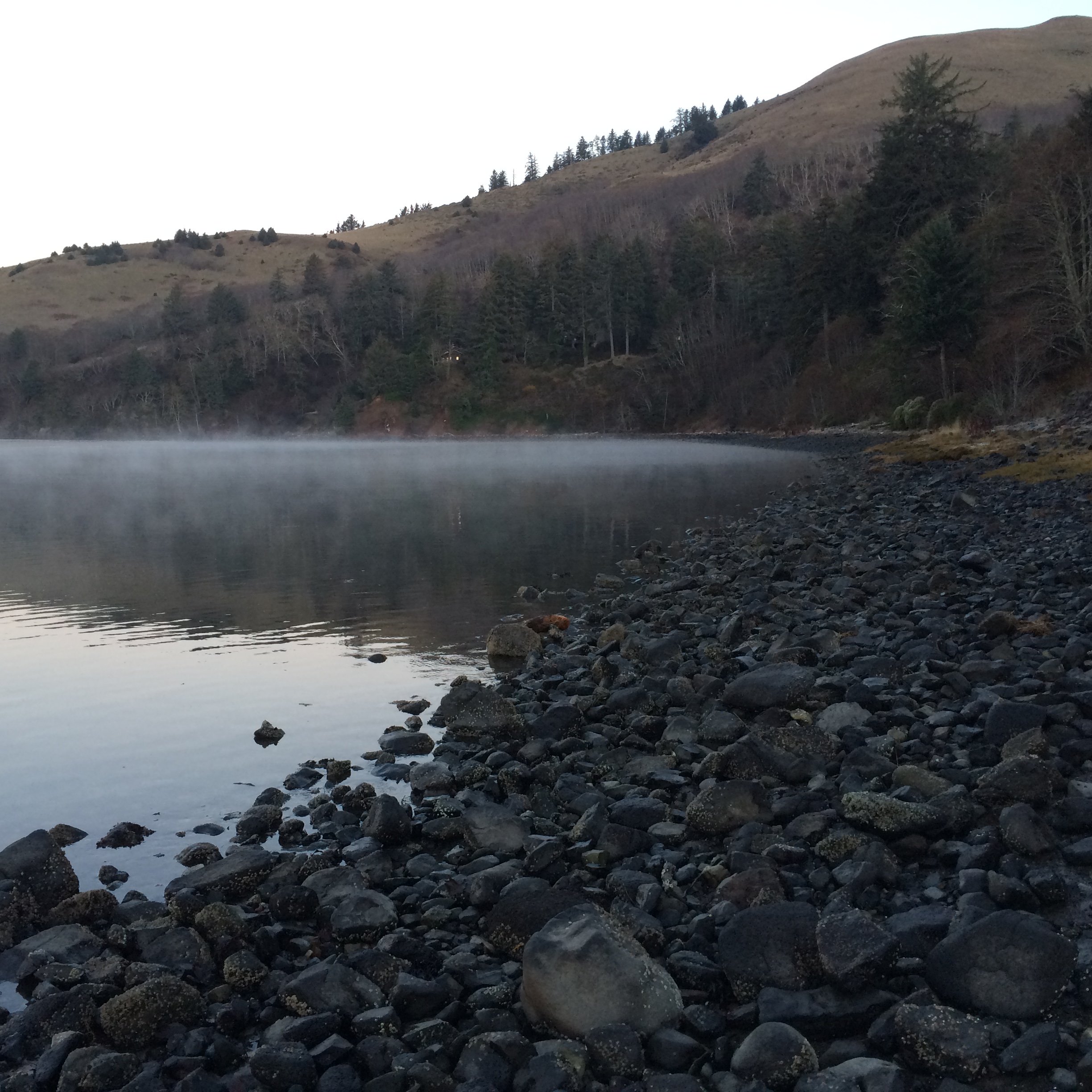
Morning view of Cascade Head from the Salmon River
Claire Darling
Gillian Nance
Cynthia Cada
Pat Reisinger
Harold Broughton
Lexie Ladd
Russel Parks
Julia White
Tiff Valentine
Tami Wheeler
Rose Lawrence
Ben Lawrence
Dave my neighbor
…and anyone else I forgot to mention!!

Gillian brushing Salmon teeth at SCRAP
Photo Credits: All photos by Nancy Judd except:
“Cascade Head and the Salmon River Estuary”: Jack Doyle
“Pacifica” and “Detail of Pacifica”: Brady Holden
“Pacifica above the Salmon River Estuary”: Nicole Morris-Judd

