

Eco Trash Couture
To View Project Details


WFMZ-TV NEWS
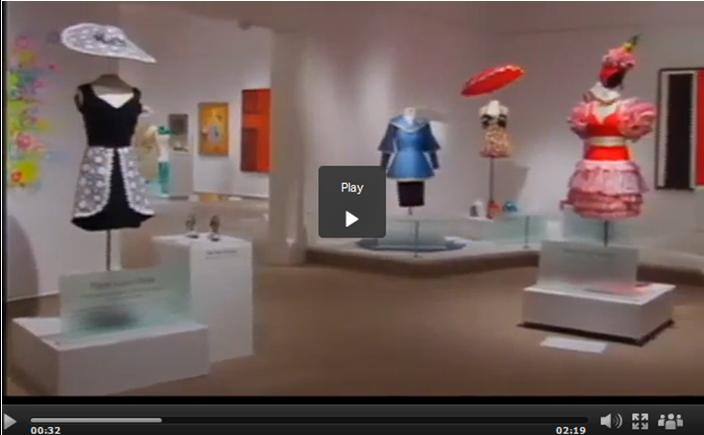
September 25, 2013 news story about the ReDress Upcycled Style Exhibition in the Reading Public Museum.
Upcycled superhero is here to teach you about sink aerators
 June, 4, 2013
By Enrique Limón
Read the article and see photos on line.
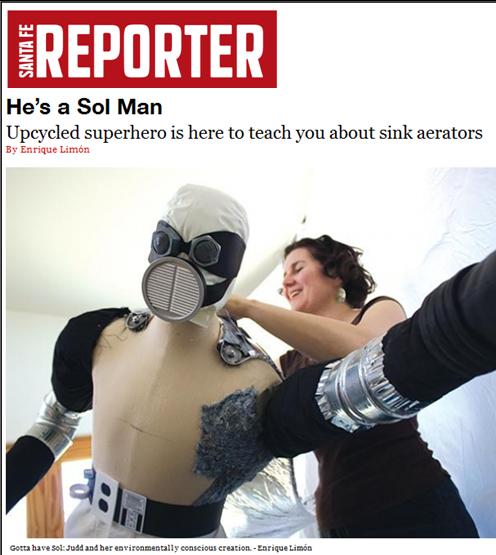
It’s a bird…it’s a LEED-certified plane…it’s Sol Man, Santa Fe’s own conservationist superhero!
“This is the Man in progress,” artist and environmental educator Nancy Judd says, leading the way to her studio where the work-in-progress lies, striking a classic flying-through-midair pose.
“This is the first time I’ve done anything specifically in energy conservation,” Judd, the head of Recycle Runway and co-founder of Recycle Santa Fe Art Market, says. “I make couture fashion sculptures from trash, and I use them to raise awareness about environmental issues.”
The city’s former recycling coordinator achieves this by setting up installations in high foot-traffic locations like shopping malls, airports and museums.
Sol Man is no exception, being that he’ll be unveiled this Wednesday at 4 pm at the Santa Fe Place Mall.
Utensils galore line Judd’s worktable, including pliers, heavy-duty gloves (“his cape still has sharp edges,” she warns), and a chart of the “ideal-proportion male.”
“For me, as an artist, this has been a really challenging process,” Judd says, working on Sol’s head. His torso is a discarded dress form rescued from a dumpster; his legs and arms were once conduit, covered with pipe insulation; and his bulging “muscles” are made from downcycled home insulation.
Other elements in the figure include rubber gasket scraps, yard signs from past political campaigns and ventilation ducts.
“My stuff is usually very feminine,” Judd confesses, “so making this guy—who is everything but—has been a challenge.”
Like every fabled crusader before him, Sol Man has a chimerical backstory.
It starts in an Ortiz Middle School science classroom. “The kids learned about where energy comes from, different energy sources, problems with different energy sources and about energy conservation,” the artist says.
During the students’ three-week immersion, Judd says they were assigned energy-conservation projects at home.
“PNM, our local electric company, provided them one of these energy-efficiency kits,” she says, opening up a small box containing compact fluorescent light bulbs, a low-flow shower head, a fridge thermometer and other green household implements—several of which now rest on the Man’s belt.
During that time, Judd also went into the sixth-graders’ art class—where, collectively, Sol Man’s look was born.
“I worked with them and said, ‘We’re gonna create an energy-efficient superhero. What would he look like?’”
The result was a slew of drawn submissions, with names like “Shiny Woman,” “Super Energy Conserver” and “Corserva-Woman”—who boasts a “built-in nightlight.”
“I took some of their ideas and created this guy,” Judd says.
Approaching the same students, this time at their Consumer Science class, Sol Man’s different elements—like the 300 mini faux solar panels that adorn his cape—came to be.
After his stint at the mall, Sol Man will tour statewide to continue his mission of raising energy awareness.
“In the long run, I want people to conserve energy,” Judd says of her efforts, realized in part through a fellowship awarded by Toyota and the National Audubon Society. “I want to raise awareness about our environmental impact as individuals—and energy is one of those places where we have a huge impact.”
She’s aware the message is trite, but insists, “energy is a huge, huge problem because it’s one of our main sources of CO2, which is one of the leading causes of climate change.”
Judd hopes her initiative sets a [low-emission] spark across the local art community and motivates others in her position to marry their creativity with bigger causes.
“One of the connections that I make about the work that I do is that, in the coming years, as we face climate change, we’re gonna have to use incredible creativity,” she says.
“Whether that’s the creativity of an artist to educate, or the creativity of an engineer to help solve problems, an inventor or even a politician on how to get laws passed—all of that is really about creative problem solving,” Judd continues. “And the bigger the problem, the more creativity we’re gonna need.”
Ortiz students test bulbs, make ‘trash fashion’ to learn about conserving
 April 3, 2013
By Robert Nott
Read the article and see photos on line.
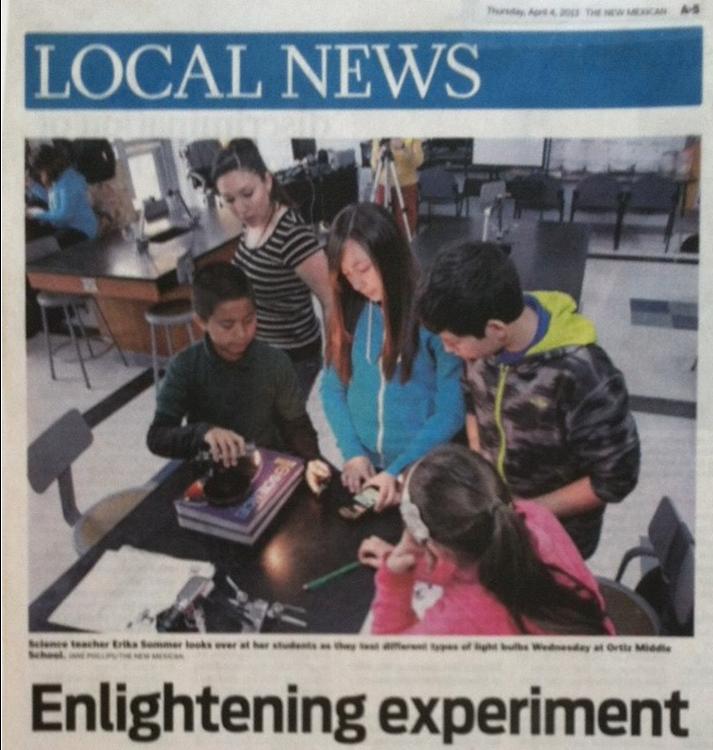
In an effort to draw attention to energy conservation efforts, Ortiz Middle School students engaged in a battle of the light bulbs in science class Wednesday, while building an “Energizer” superhero costume.
Their efforts were part of a collaboration between Santa Fe Public Schools, Recycle Runway artist Nancy Judd, Public Service Company of New Mexico and the Santa Fe Community College. The program, funded by a Toyota Together Green Grant and the National Audubon Society, was manpowered by about 125 sixth-graders at Ortiz.
The project is evenly divided between an experiment into how energy is created and conserved in Erika Sommer’s science class and an art-and-design “trash fashion” project in teacher Myoko Costello’s home-economics class.
Judd, an environmental activist and artist who runs Recycle Runway (creating “couture attire” from recycled items), said the project’s goal is to instill a sense of energy conservatism in the kids, with the hope that they will take what they learned home and incorporate their lessons into their home life. Lisa Randall, the school district’s energy conservation coordinator, said it provides “a home-school connection to energy conservation” that one doesn’t usually find in lesson plans.
Sommer’s class was engaged in an experiment to compare whether a 40-watt incandescent light bulb or a compact fluorescent light bulb (CFL) generates more light — and which one uses the most energy.
The students had to measure the amps, the lumens (a measure of the amount of light a bulb produces) and the watts of each bulb via a not-too-complicated setup involving a bulb board, a light meter and an interactive computer screen.
At one table in the class, several students, including Daryl Herrera, compared the effects of the two bulbs and came to the conclusion that the CFL bulb used less than half the energy of an incandescent bulb. (Most studies indicate that CFL bulbs use 75 percent less energy and last 10 times longer than an incandescent bulb.) Herrera said he found the experiment useful, “So we know which bulbs we should use at home.”
Following the class, the kids were asked how many believed the project would make them want to conserve energy at home. Almost all raised their hands. Asked how many would suggest to their parents that the latter use CFL bulbs, almost all raised their hands again. And when asked how many of them have parents who actually listen to them — well, only about a third raised their hands.
Down the hallway, Judd organized the art students into teams to build the parts needed for the Energizer costume, which is due to be completed by the end of April. Afterward, the costume — currently sans a superhero to wear it — will tour the schools and perhaps other sites within the city.
To ensure it really is an energy-efficient costume, Judd utilized everything from HVAC duct vents (for the arms), a high-efficiency heater flue, PCP pipe, window insulation and discarded 2008 Obama campaign signs. Why Obama? “That’s mostly what can be found in Santa Fe,” Judd replied.
One of the art students, Rudi Martinez, busied herself making small solar panels to line the Energizer costume’s 60-inch by 45-inch cape. “We need to learn how to save energy rather than waste energy,” she said as she worked.
Ryan Baca, who was on hand to represent PNM, which provided all the kids with home energy kits (including CFL bulbs), seconded that thought. She said kids today have a greater awareness about environmental needs and conservation efforts and that this joint project gives them “a good, solid foundation in what energy conservation means to their community, their school and their home.”
Next week, Santa Fe school buildings will be placed in a “sleep mode” for spring break. Lights and computers will be shut off and heating kept to a minimum.
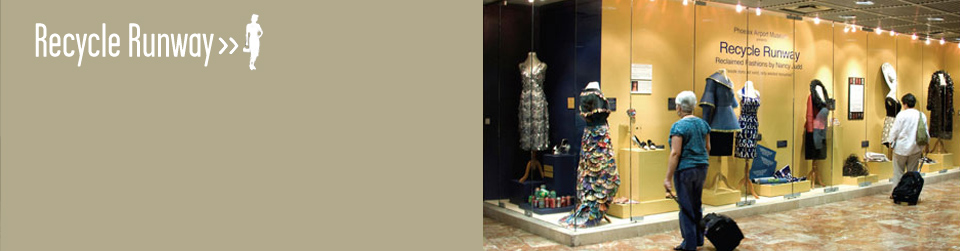
Recycle Runway in Airports
Airports provide Recycle Runway an opportunity to reach millions of international travelers often with time to spare. Airports include public art in their buildings to reduce the stress associated with airline travel, and Recycle Runway provides an engaging and educational experience to passengers while they wait for their plane.
Nancy is excited to announce that due to the popularity of her first exhibition in the Atlanta Airport, they have invited her back to install a 2nd show of all new work in 2017!
Following are the airports participating with Recycle Runway:
- 2nd Exhibition, Hartsfield-Jackson Atlanta International Airport, Fall 2019
- Hartsfield-Jackson Atlanta International Airport, Feb 2011- Mar 2012
- Phoenix International Airport, Feb 2010-Sept 2010
- Pittsburgh International Airport, Aug 2008-Aug 2009
- Albuquerque Sky Harbor International Airport, Oct 2007-Jan 2008
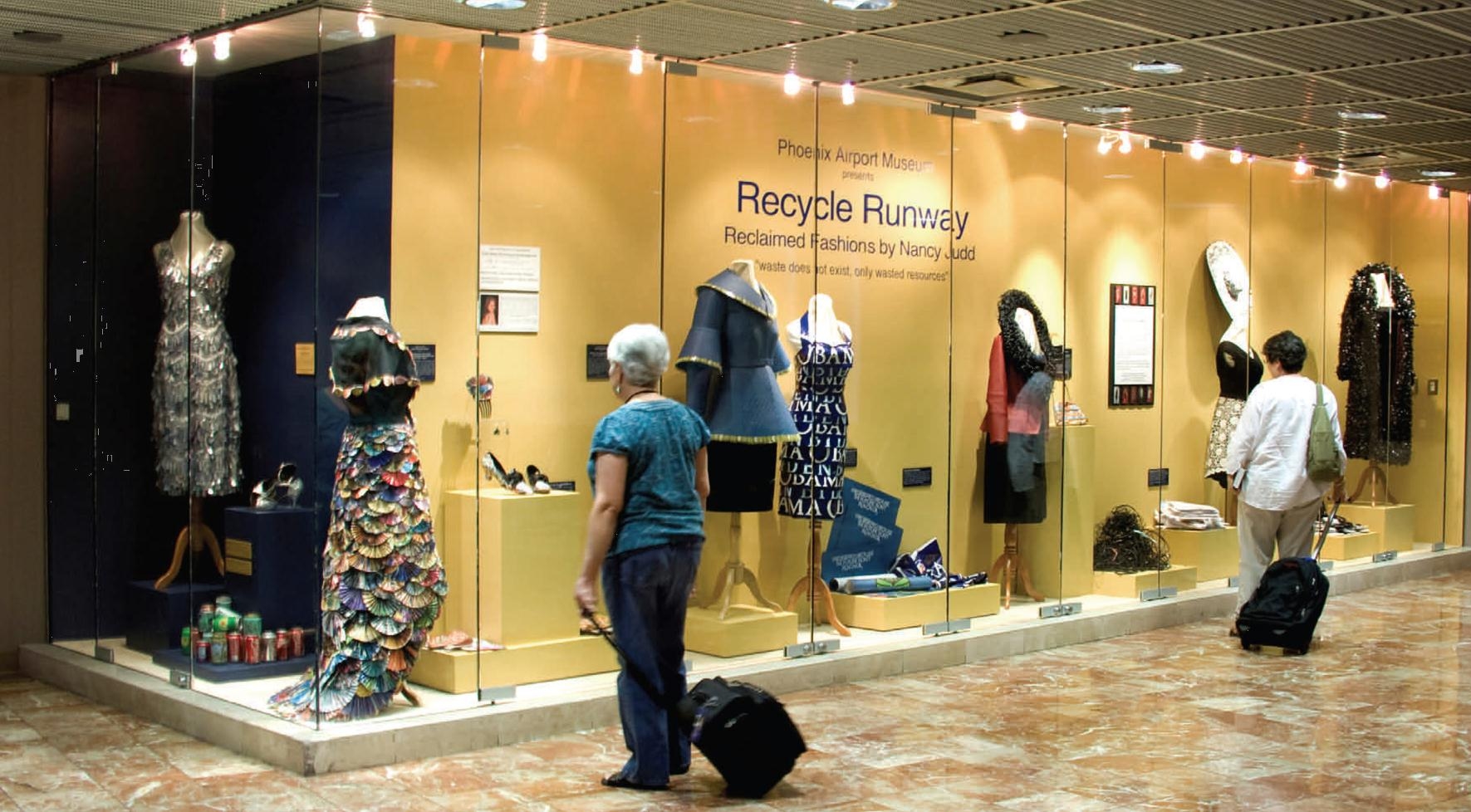
Recycle Runway in the Phoenix International Airport
Praise about the Recycle Runway Exhibition:
“Nancy Judd’s Recycle Runway installation was one of our most popular exhibitions.”
David Vogt, Hartsfield-Jackson Atlanta International Airport, Airport Art Program Manager
