Eco Trash Couture
To View Project Details


PDX Weather Advisory, 2016
Celebrating Sustainability (and rainy weather) at the Portland Airport!
The Port of Portland which runs the Portland International Airport commissioned me to create this ensemble. Each part of the rain gear outfit (a nod to Portland’s notoriously wet climate) represents one of the Port’s five sustainability programs, and is made from waste materials upcycled from each of those programs.
You can learn more about what each component is made of and the process of creating the piece in this blog post.
The Trash Man’s Suit, 2016
The Trash Suit was commissioned by Rob Greenfield during an “eco-stunt”, where he wore his trash for 30 days! It is made of clear plastic film that was sewn onto a pair of military pants and a coat supported by an old back pack frame. See photos of the suit filling up over the month in Rob’s “Trash Me Time Line”.
Read more about my experience making the suit and working with Rob in this blog post.
Watch a video Rob’s team made about my process creating the Trash Suit.
Pacifica, 2016
A Celebration of the Seashore!
This sculpture was created to celebrate the 50 year anniversary of Cascade Head Preserve on the Oregon Coast. It is made of natural items found along the seashore such as shells, driftwood, rocks, salmon teeth, fins and vertebrae that are strung onto wire and secured to a metal skirt made from upcycled baking sheets. The bodice is made from moss, lichens and bark sewn to burlap with old fishing line.
Pacifica was commissioned by the Nature Conservancy in Oregon.
You can read details about the creation of Pacifica in this blog post.
PDX Weather Advisory, AKA April
One of my very favorite words is from Nepal: रङ्गी-चङ्गी; written in letters, raṅgii-caṅgii; and pronounced, rungy-chungy. This fabulous word (which does not have an English equivalent in my opinion) means crazy, multi-colored, splendid, fancy, exciting and fun! It was the design inspiration for one of my newest sculptures, PDX Weather Advisory, created for the Port of Portland which runs the Portland International Airport.
This raṅgii-caṅgii adventure began after listening to a presentation about the PDX Airport’s waste minimization efforts at a meeting about reuse of commercial waste streams. As I listened to Kaileigh Westermann, a Waste Minimization Project Lead from the Port of Portland, I was astounded to learn that the Port has implemented a five-year plan to achieve 90 percent or greater landfill diversion rates at its facilities. Let me repeat that: 90% landfill diversion– that is a TRULY impressive goal! To achieve this, they have an extensive on-site recycling program and provide technical assistance to airport tenants and airlines to reduce waste and recycle a wide variety of materials. Their composting program (unusual for an airport to have!) has diverted over 1,300 tons of food waste from the landfill and they also have a food donation program that has donated 130,000 lbs of food, or 85,000 meals, since its inception in 2013. I also learned that the Port has FOUR other equally impressive sustainability programs!
Next it was my turn to give a presentation to the group about my work. After the meeting, Kaileigh asked if I could help the Port tell the story of their sustainability programs in a creative, eye-catching way for Earth Day. “YES, I’m your gal!” I proclaimed enthusiastically and a dynamic collaboration began. We met many times over the next several months, fleshing out details such as:
April on display at the PDX Airport
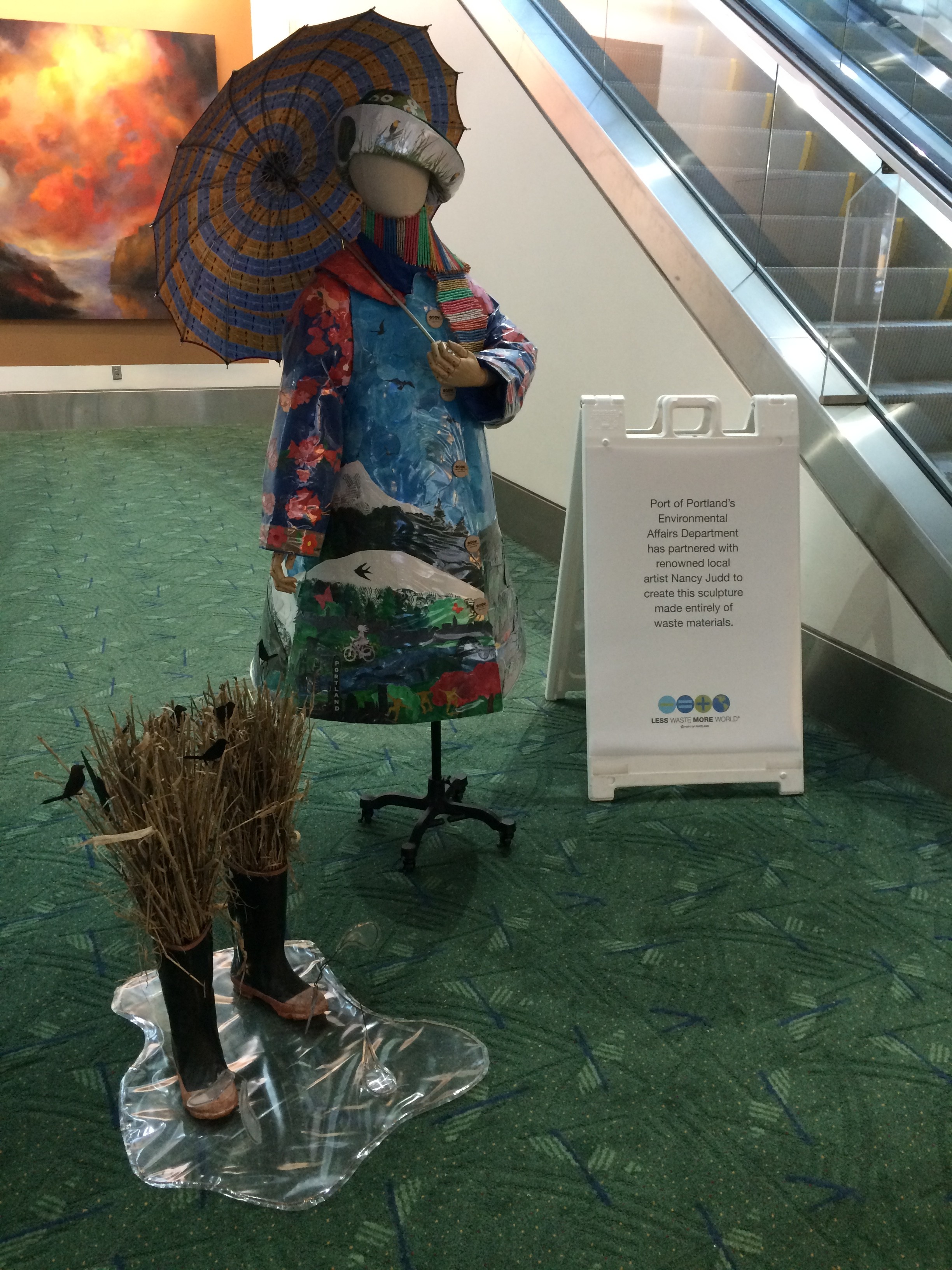
- The overall design concept- we settled on a rain gear outfit with five parts (umbrella, hat, scarf, coat and boots) that would each represent one of the Port’s five sustainability programs, and reference Portland’s notoriously wet climate.
- The message – we met with representatives from each of the five sustainability programs (air, water, energy, natural resources and waste minimization) to discuss what message they wanted to convey and the waste materials they generate that I could use in the garment to tell their story.
The day that Kaileigh delivered the materials, she looked at the mix-matched pile of coffee cups, electrical wire, old magazines, invasive dried grass, and parking garage tickets with an overwhelmed expression on her face and said:
“I’m glad you’re the one making this thing, not me!”
“Yes, well that is my specialty!” I said with a confident smile, but internally feeling as befuddled as she looked.
And the uncertainty continued for a week until I said to my partner: “I’m kind of drawing a blank here. How am I going to make a cohesive design with FIVE different elements from such diverse materials?” In a flash of inspiration Nicole said: “Maybe you should lean into the miscellany of the materials and create something that is multi-colored, multi-patterned and multi-textured so that what ties it together is the craziness of each element!” In that moment my favorite word popped into my head and the ideas started to flow! “YES, it will be raṅgii-caṅgii– a crazy, multi-colored, splendid, fancy, exciting and fun extravaganza!”
Thus off we went down the winding path of creating PDX Weather Advisory, AKA April. We choose the name as it has several pertinent meanings:
- The word “weather” references the fact that it is rain gear, AND relates to climate change.
- The word “advisory” in conjunction with weather, refers to a weather term AND implies a warning… which is really the subtext of all my work.
- Her nickname is April though because PDX Weather Advisory does not exactly roll off the tongue, and she was finished in the month of April for Earth Day.
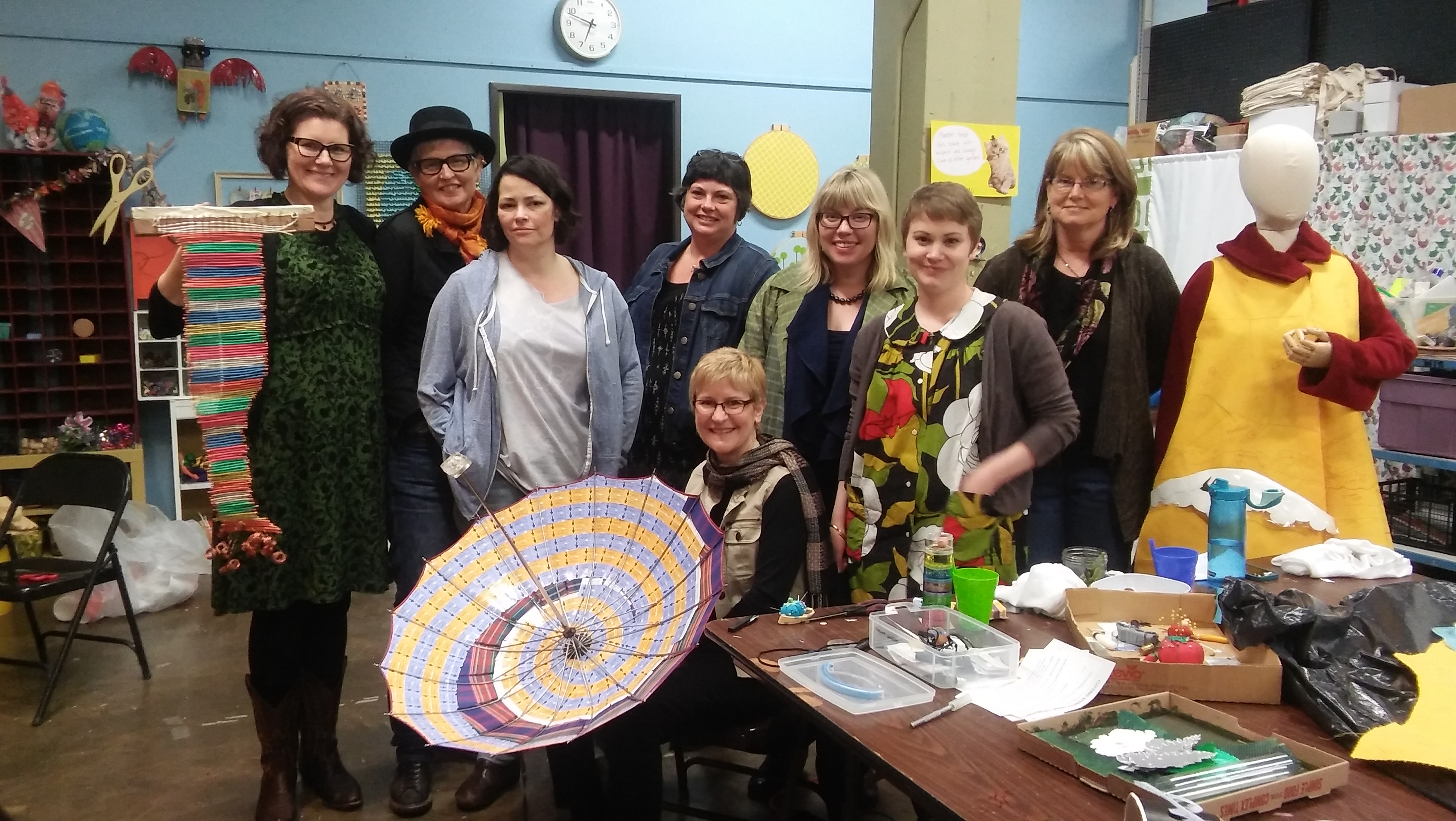
Yes, April needed to be completed by Earth Day. I stated after Valentine’s Day and it took 440 hours to make the sculpture, it was a pretty raṅgii-caṅgii ride! There is no way I could have done it without the help of more than 35 very generous volunteers: people ranging from Port employees, neighbors I had never met before, mothers of high school classmates, and old friends I had not seen in 30 years helped me finish April by Earth Day. We held work parties at the Port, in a local brew pub, at SCRAP (a local reuse center) and my studio. Thanks to each and every one of you– I see your contributions all over this sculpture and it is part of what makes it so special to me!
One of the volunteer work parties
So let me introduce you to April (AKA PDX Weather Advisory):
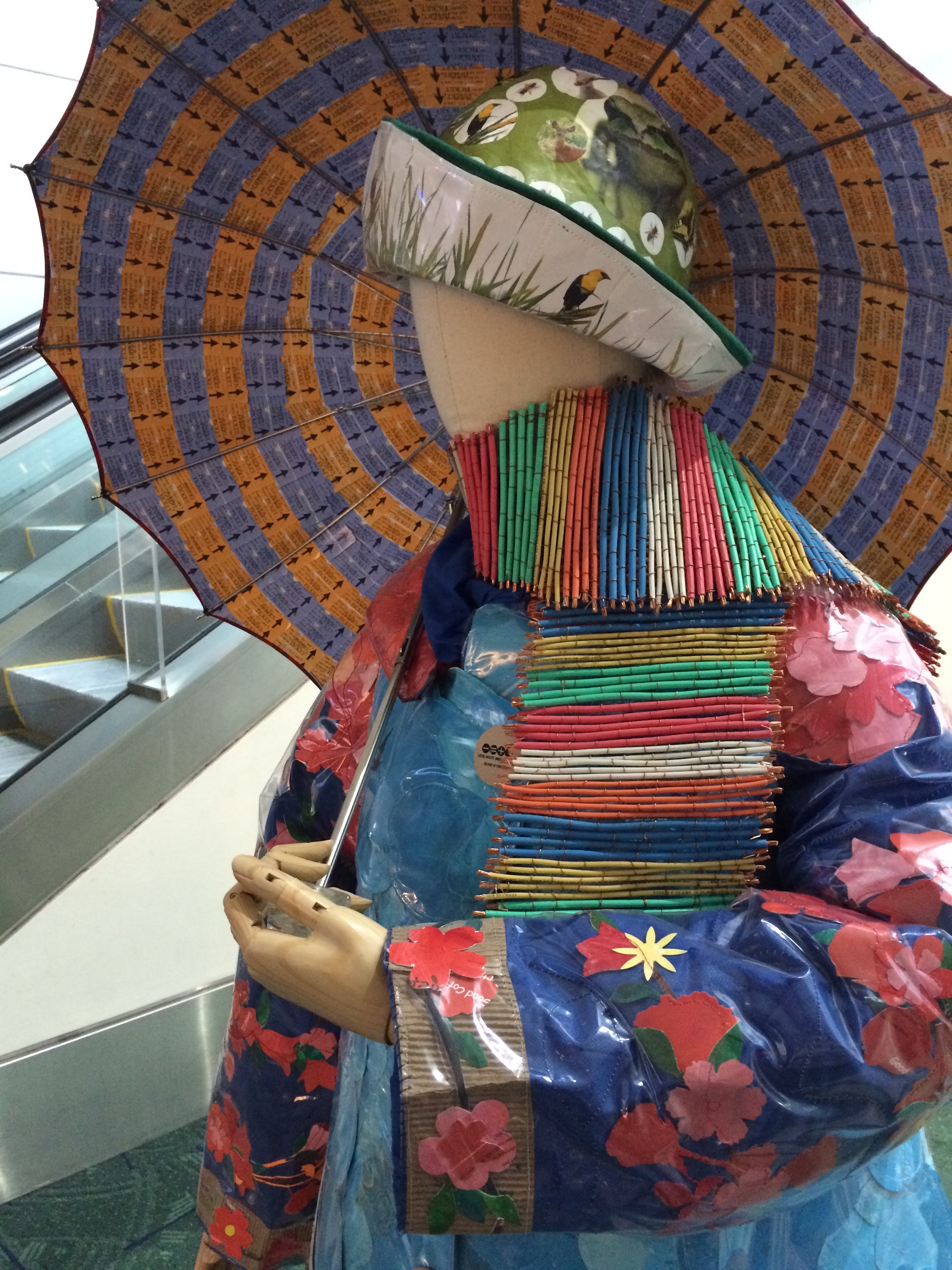
- RAINCOAT: Representing the Waste Minimization Program, disposable coffee cups cut into iconic Portland images are sewn to the coat and encourage travelers to reuse items such as coffee cups and water bottles.
- UMBRELLA: Representing the Air Quality Program, this umbrella is swirling with parking garage tickets, highlighting their program’s reduction in emissions from idling vehicles.
- HAT: Representing the Natural Resources Program, a hat-collage of insects and wildlife photos cut from old periodicals emphasizes the Port’s various protection programs and mitigation projects.
- SCARF: Representing the Energy Program, scrap electrical wire is woven into a scarf to highlight the clean energy and energy efficiency programs.
- BOOTS: Representing the Water Quality Program, these boots feature Reed Canarygrass, an invasive species that threatens wetlands. The Port works to manage this invasive species on mitigation lands, as well as many others, to support healthy watersheds and water quality.
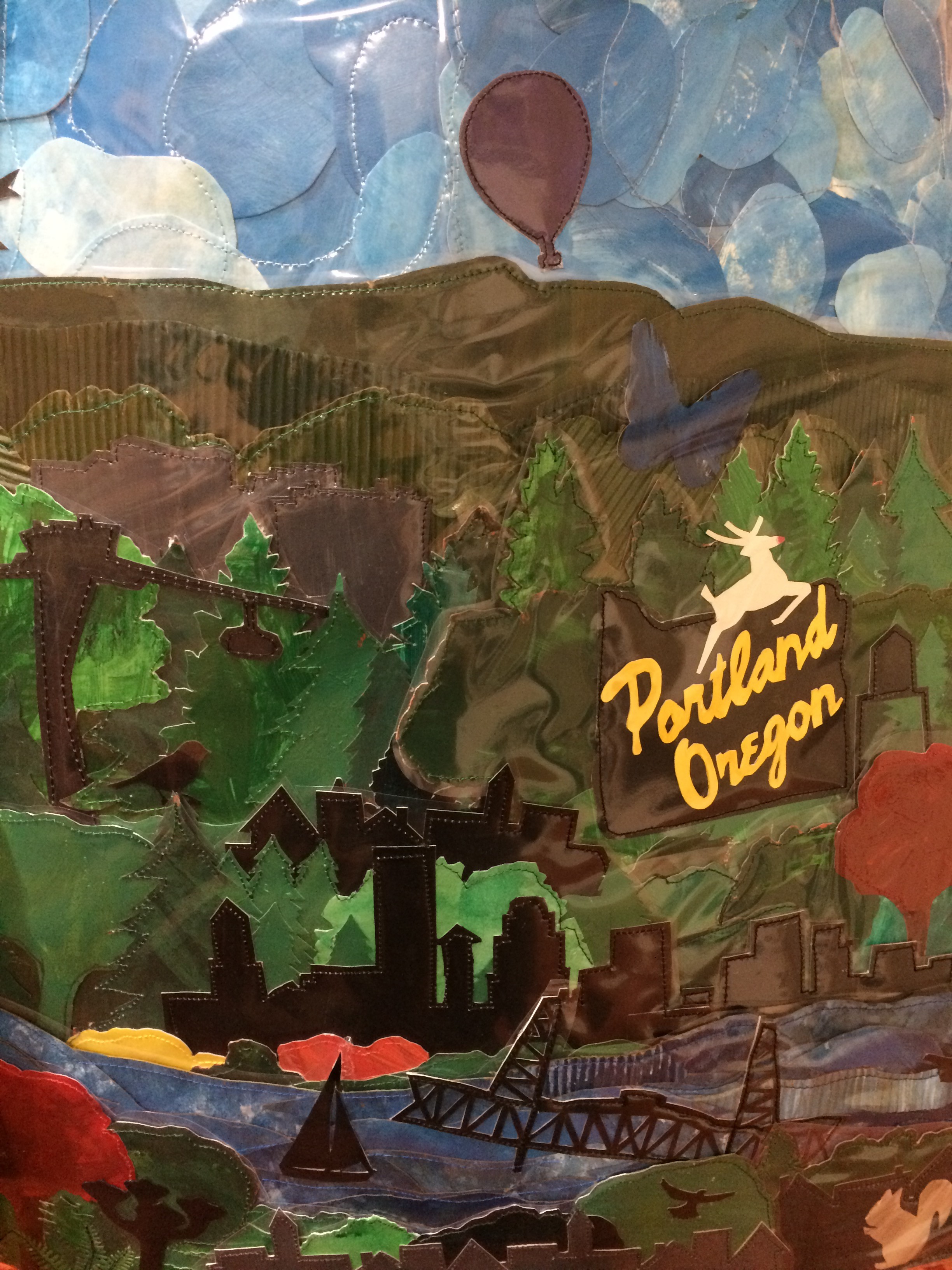
Detail of the coat, covered with scrap plastic film to provide protection from the rain!
One of the neat things for me about making the raincoat specifically was the connection to Portland in the collaged images. I was born and raised here, but left when I went to college. I returned two years ago and having been away almost 30 years it has been lovely rediscovering my home town. This coat was a surprising way to become reacquainted with the places I knew growing up and that are new to me as well. Cutting out the silhouettes of the Oregon Health and Science buildings called “Pill Hill”, collaging the bumps and shadows on Mt. Hood, and sewing down the Marcum bridge that my sister climbed before it opened in 1970. I found after making this coat that I had a new and surprising intimacy with the details of my beloved City.
When April was completed, she was on display in the Airport and now Port staff is taking her to various events around Portland to inform people about their sustainability programs. She will then become part of an exhibition of about six pieces I will have at Portland Fashion Week in September and then join 20 other of my new works in a major yearlong solo exhibit in the Atlanta Airport in 2017/2018!
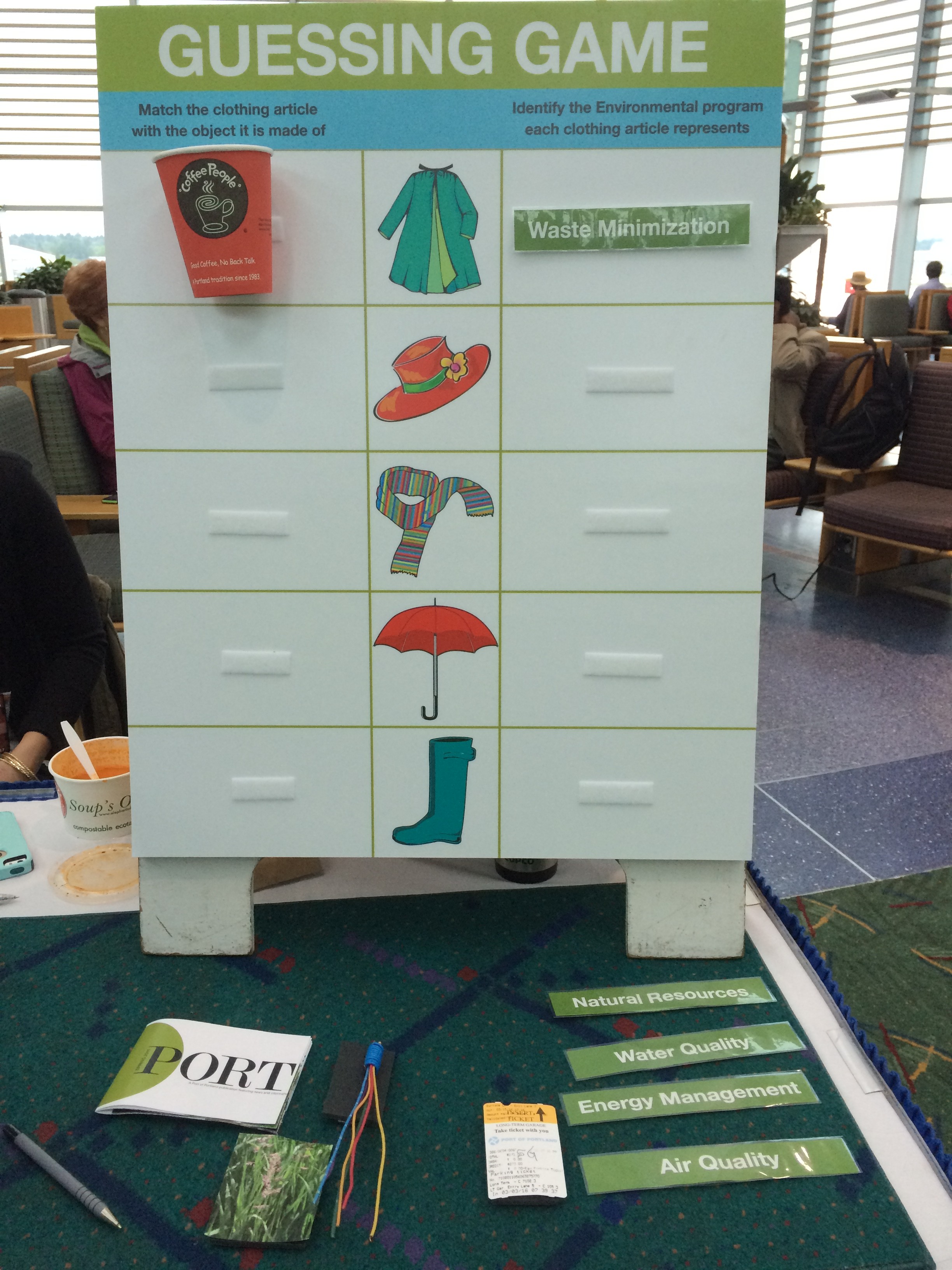
Interactive sculpture description
Kaileigh Westermann and the Port’s Corporate Communications, created a fabulous hands-on interactive display to accompany the sculpture. The board has three columns, the first has the materials (attached to Velcro) used to create April; the second has images of the coat, hat, boots, umbrella and scarf; and the third column has the name of each sustainability program on pieces of foam core. People can then match the material with the piece of clothing and the program it represents. It is a great way of engaging people in learning both about the sculpture as well as the airports sustainability programs. However, the story that PDX Weather Advisory tells is just the tip of the iceberg; the Port has many more inspiring sustainability programs! For example in their headquarters located at the Airport, their waste water is recycled through a “Living Machine” made of plants and underground gravel chambers!
Part of what made creating PDX Weather Advisory such a raṅgii-caṅgii experience, was that I had just finished (two days before) another sculpture called “Bella”, and was simultaneously working on a third piece, “Pacifica”, for the Nature Conservancy, also due at the same time. There was literally no way I could have completed these three sculptures in four months if it were not for ALL the people who volunteered their time to help!
I want to give a special thanks to Kaileigh for chauffeuring this project through all of the bureaucratic windy roads that needed to be navigated. To Erin, Grace and Lisa also from the Port for your many contributions, and to Stan Jones, Kaileigh’s boss who said “Go for it!” when she came to him with the initial idea. It was great to work with and get to know all of you, thank you for this wonderful opportunity!
Click here to watch TV coverage of PDX Weather Advisory!
This video shows the process of creating the sculpture “Pacifica” for The Nature Conservancy in Oregon. It will be part of Portland Fashion Week. “Pacifica” will join 20 other new sculptures by Nancy Judd for a year long solo exhibition in the Atlanta International Airport in 2017/2018.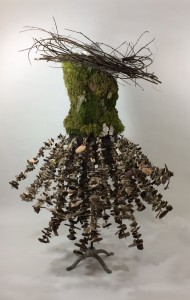
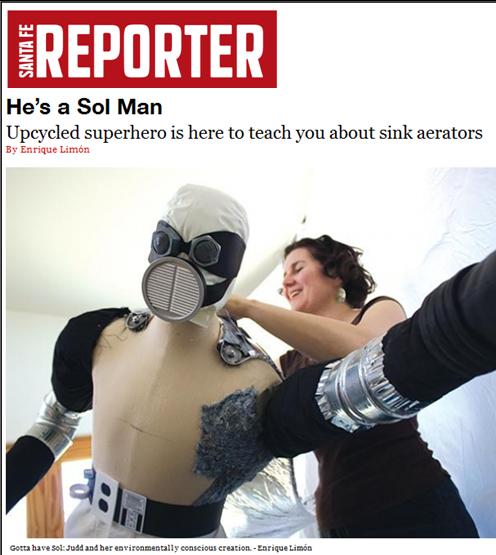
Upcycled superhero is here to teach you about sink aerators
 June, 4, 2013
By Enrique Limón
Read the article and see photos on line.
It’s a bird…it’s a LEED-certified plane…it’s Sol Man, Santa Fe’s own conservationist superhero!
“This is the Man in progress,” artist and environmental educator Nancy Judd says, leading the way to her studio where the work-in-progress lies, striking a classic flying-through-midair pose.
“This is the first time I’ve done anything specifically in energy conservation,” Judd, the head of Recycle Runway and co-founder of Recycle Santa Fe Art Market, says. “I make couture fashion sculptures from trash, and I use them to raise awareness about environmental issues.”
The city’s former recycling coordinator achieves this by setting up installations in high foot-traffic locations like shopping malls, airports and museums.
Sol Man is no exception, being that he’ll be unveiled this Wednesday at 4 pm at the Santa Fe Place Mall.
Utensils galore line Judd’s worktable, including pliers, heavy-duty gloves (“his cape still has sharp edges,” she warns), and a chart of the “ideal-proportion male.”
“For me, as an artist, this has been a really challenging process,” Judd says, working on Sol’s head. His torso is a discarded dress form rescued from a dumpster; his legs and arms were once conduit, covered with pipe insulation; and his bulging “muscles” are made from downcycled home insulation.
Other elements in the figure include rubber gasket scraps, yard signs from past political campaigns and ventilation ducts.
“My stuff is usually very feminine,” Judd confesses, “so making this guy—who is everything but—has been a challenge.”
Like every fabled crusader before him, Sol Man has a chimerical backstory.
It starts in an Ortiz Middle School science classroom. “The kids learned about where energy comes from, different energy sources, problems with different energy sources and about energy conservation,” the artist says.
During the students’ three-week immersion, Judd says they were assigned energy-conservation projects at home.
“PNM, our local electric company, provided them one of these energy-efficiency kits,” she says, opening up a small box containing compact fluorescent light bulbs, a low-flow shower head, a fridge thermometer and other green household implements—several of which now rest on the Man’s belt.
During that time, Judd also went into the sixth-graders’ art class—where, collectively, Sol Man’s look was born.
“I worked with them and said, ‘We’re gonna create an energy-efficient superhero. What would he look like?’”
The result was a slew of drawn submissions, with names like “Shiny Woman,” “Super Energy Conserver” and “Corserva-Woman”—who boasts a “built-in nightlight.”
“I took some of their ideas and created this guy,” Judd says.
Approaching the same students, this time at their Consumer Science class, Sol Man’s different elements—like the 300 mini faux solar panels that adorn his cape—came to be.
After his stint at the mall, Sol Man will tour statewide to continue his mission of raising energy awareness.
“In the long run, I want people to conserve energy,” Judd says of her efforts, realized in part through a fellowship awarded by Toyota and the National Audubon Society. “I want to raise awareness about our environmental impact as individuals—and energy is one of those places where we have a huge impact.”
She’s aware the message is trite, but insists, “energy is a huge, huge problem because it’s one of our main sources of CO2, which is one of the leading causes of climate change.”
Judd hopes her initiative sets a [low-emission] spark across the local art community and motivates others in her position to marry their creativity with bigger causes.
“One of the connections that I make about the work that I do is that, in the coming years, as we face climate change, we’re gonna have to use incredible creativity,” she says.
“Whether that’s the creativity of an artist to educate, or the creativity of an engineer to help solve problems, an inventor or even a politician on how to get laws passed—all of that is really about creative problem solving,” Judd continues. “And the bigger the problem, the more creativity we’re gonna need.”
Ortiz students test bulbs, make ‘trash fashion’ to learn about conserving
 April 3, 2013
By Robert Nott
Read the article and see photos on line.
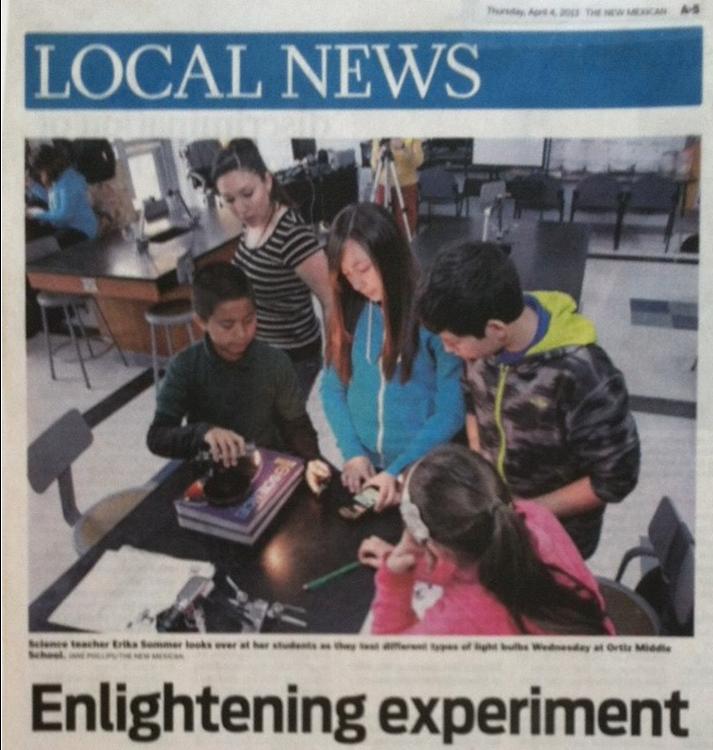
In an effort to draw attention to energy conservation efforts, Ortiz Middle School students engaged in a battle of the light bulbs in science class Wednesday, while building an “Energizer” superhero costume.
Their efforts were part of a collaboration between Santa Fe Public Schools, Recycle Runway artist Nancy Judd, Public Service Company of New Mexico and the Santa Fe Community College. The program, funded by a Toyota Together Green Grant and the National Audubon Society, was manpowered by about 125 sixth-graders at Ortiz.
The project is evenly divided between an experiment into how energy is created and conserved in Erika Sommer’s science class and an art-and-design “trash fashion” project in teacher Myoko Costello’s home-economics class.
Judd, an environmental activist and artist who runs Recycle Runway (creating “couture attire” from recycled items), said the project’s goal is to instill a sense of energy conservatism in the kids, with the hope that they will take what they learned home and incorporate their lessons into their home life. Lisa Randall, the school district’s energy conservation coordinator, said it provides “a home-school connection to energy conservation” that one doesn’t usually find in lesson plans.
Sommer’s class was engaged in an experiment to compare whether a 40-watt incandescent light bulb or a compact fluorescent light bulb (CFL) generates more light — and which one uses the most energy.
The students had to measure the amps, the lumens (a measure of the amount of light a bulb produces) and the watts of each bulb via a not-too-complicated setup involving a bulb board, a light meter and an interactive computer screen.
At one table in the class, several students, including Daryl Herrera, compared the effects of the two bulbs and came to the conclusion that the CFL bulb used less than half the energy of an incandescent bulb. (Most studies indicate that CFL bulbs use 75 percent less energy and last 10 times longer than an incandescent bulb.) Herrera said he found the experiment useful, “So we know which bulbs we should use at home.”
Following the class, the kids were asked how many believed the project would make them want to conserve energy at home. Almost all raised their hands. Asked how many would suggest to their parents that the latter use CFL bulbs, almost all raised their hands again. And when asked how many of them have parents who actually listen to them — well, only about a third raised their hands.
Down the hallway, Judd organized the art students into teams to build the parts needed for the Energizer costume, which is due to be completed by the end of April. Afterward, the costume — currently sans a superhero to wear it — will tour the schools and perhaps other sites within the city.
To ensure it really is an energy-efficient costume, Judd utilized everything from HVAC duct vents (for the arms), a high-efficiency heater flue, PCP pipe, window insulation and discarded 2008 Obama campaign signs. Why Obama? “That’s mostly what can be found in Santa Fe,” Judd replied.
One of the art students, Rudi Martinez, busied herself making small solar panels to line the Energizer costume’s 60-inch by 45-inch cape. “We need to learn how to save energy rather than waste energy,” she said as she worked.
Ryan Baca, who was on hand to represent PNM, which provided all the kids with home energy kits (including CFL bulbs), seconded that thought. She said kids today have a greater awareness about environmental needs and conservation efforts and that this joint project gives them “a good, solid foundation in what energy conservation means to their community, their school and their home.”
Next week, Santa Fe school buildings will be placed in a “sleep mode” for spring break. Lights and computers will be shut off and heating kept to a minimum.
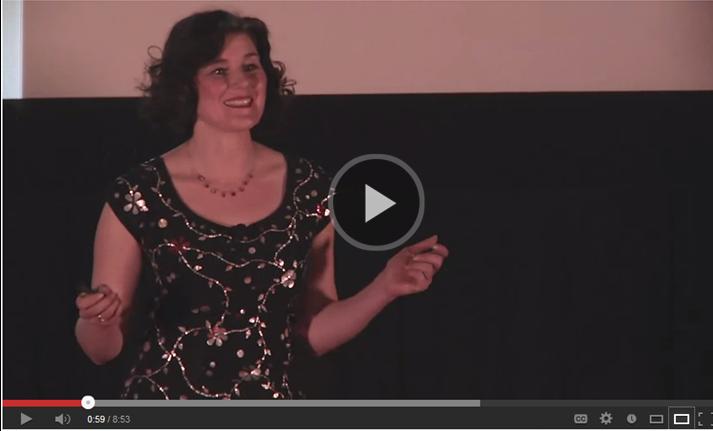
In November 2012 I gave my second TEDx talk at an event called TEDxAcequiaMadre in Santa Fe, NM. My first TEDx talk was in Albuquerque (TEDXABQ).
If you are not familiar with TED talks they are global conferences focused on “ideas worth spreading.” TED stands for Technology, Entertainment and Design, the beginning of their inspiring mission reads: “We believe passionately in the power of ideas to change attitudes, lives and ultimately, the world. So we’re building here a clearinghouse that offers free knowledge and inspiration from the world’s most inspired thinkers, and also a community of curious souls to engage with ideas and each other.” It is a great honor to be part of this community! TED talks can be viewed for free at www.TED.com. In 2009 local, self-organized conferences called TEDx events began internationally. As of the end of 2012, more than 16,000 talks have been given at more than 5,000 TEDx events in 1,200 cities in 133 countries.
Having given one TEDx talk already I did feel more prepared, but it still took a tremendous amount of time to write, reflect and practice. Since it is required that you memorize your talk, NO reading or notes, I spent 100s of hours practicing. Giving a TED talk is a commitment and experience unlike any other I have had!

Crime Scene and the Caution Dress
in the Atlanta Airport Exhibition, 2012
In my presentation I focused on a garment I created in 2012 called “Crime Scene” for my exhibition in the Atlanta Airport. The dress is part of a mini-collection made from police tape– the other dress, the “Caution Dress”, I made to wear for TEDxABQ. For my talk in Santa Fe I wore a dress commissioned by Coca-Cola in 2006 called Pop Can Couture made from aluminum cans cut into flowers, leaves and petals and sewn to a dress made from canvas scraps.
I titled my TEDxAcequiaMadre talk: “Undressing the Crime Scene– Addressing how to Slow Climate Change”. I feel like it is the first time that I have addressed the climate crisis this directly in any of my presentations.
I used the dress, Crime Scene, to explore how we have poisoned both the body of Mother Earth and our own bodies. As I share in the talk, when researching this presentation I fell into an armageddon panic about what we have done to the planet and the myriad of overwhelming problems that humanity is facing as a result. However, after a couple of weeks I managed to find my way back to the essence of what my work is about: creating a positive way to address these serious issues that does not instill guilt nor fear but instead inspires hope and action.
I would love to hear your reflections on my talk in the comment box below!
I de-installed my Recycle Runway exhibition in the Atlanta International Airport last month and sent it home to Santa Fe– it was sad to say goodbye to such a great venue!

Giving a tour of the exhibition to passengers and airport employees
I first met with the Atlanta’s Airport Art Program staff, David Vogt and Katherine Dirga, over 5 years ago for 15 minutes in-between flights. They generously agreed to meet at my gate for a quick introduction and look at my portfolio. When they informed me a couple of weeks later that they would like to exhibit my work, I was thrilled because they have curated such a wonderful permanent collection and rotating exhibitions. Also, knowing that ALT is the busiest airport in the WORLD; I was humbled by such an incredible opportunity to reach so many people with my message of environmental stewardship.
We installed the exhibition in May of 2011 (you can read about our midnight adventures in my blog post from May 10, 2011) and we took it down in the second week of July, 2012. Nineteen garments were initially installed in nine cases and an additional three were added to a tenth case that the Airport Art Program installed in January of 2012 in the entrance to the terminal between the escalator and the information desk. The airport estimates that during this time over 15 million passengers passed through Concourse E!
The exhibition was advertised with a 30 second video on the CNN TV monitors located throughout the entire airport. It was seen several times each day that it was aired. Click here to view the video.
The exhibition was generously sponsored by Coca-Cola, Delta Air Lines, Janome, and Novelis and my Green Partners: Earth911.com, the Georgia Chapter of the Sierra Club, the Georgia Recycling Coalition, Keep America Beautiful, Keep Georgia Beautiful, the Phoenix Airport Museum and the Turner Foundation.
I was overwhelmed by the number of print and electronic media outlets that covered the exhibition over the 14 months it was on display.
| Misc Press Outlets -USA Today Travel -CNN -Yahoo -NBC/ 11 Alive -Delta’s Sky Magazine -Clayton News Daily -Atlanta Day Book -Metromix Atlanta -Future News Network -Orbiz.com Blog Posts -Delta -Atlanta Airport -BlueGreen -Chimeras -Fashiongraphia -Stuck at the Airport -Talking with Tami FlickR -Atlanta International Airport -HaveIgotastory4u’ -FilipinoOnSkis |
Websites -TrendHunter -Chic Republiq -Examiner -Terminal U -Ecouterre -PolarTREC Magazines and Newsletters -Resource Recycling -Southern Seasons -New Mexico Recycling Coalition -Georgia Recycling Coalition -Glass Packaging Institute Pintrist -Click to view numerous “pins” of the exhibition. Other Social Media -FourSquare -Tumblr -Twitcsy -Twyla |
There were so many really heart-harming moments for me during this exhibition, here are a few samples:
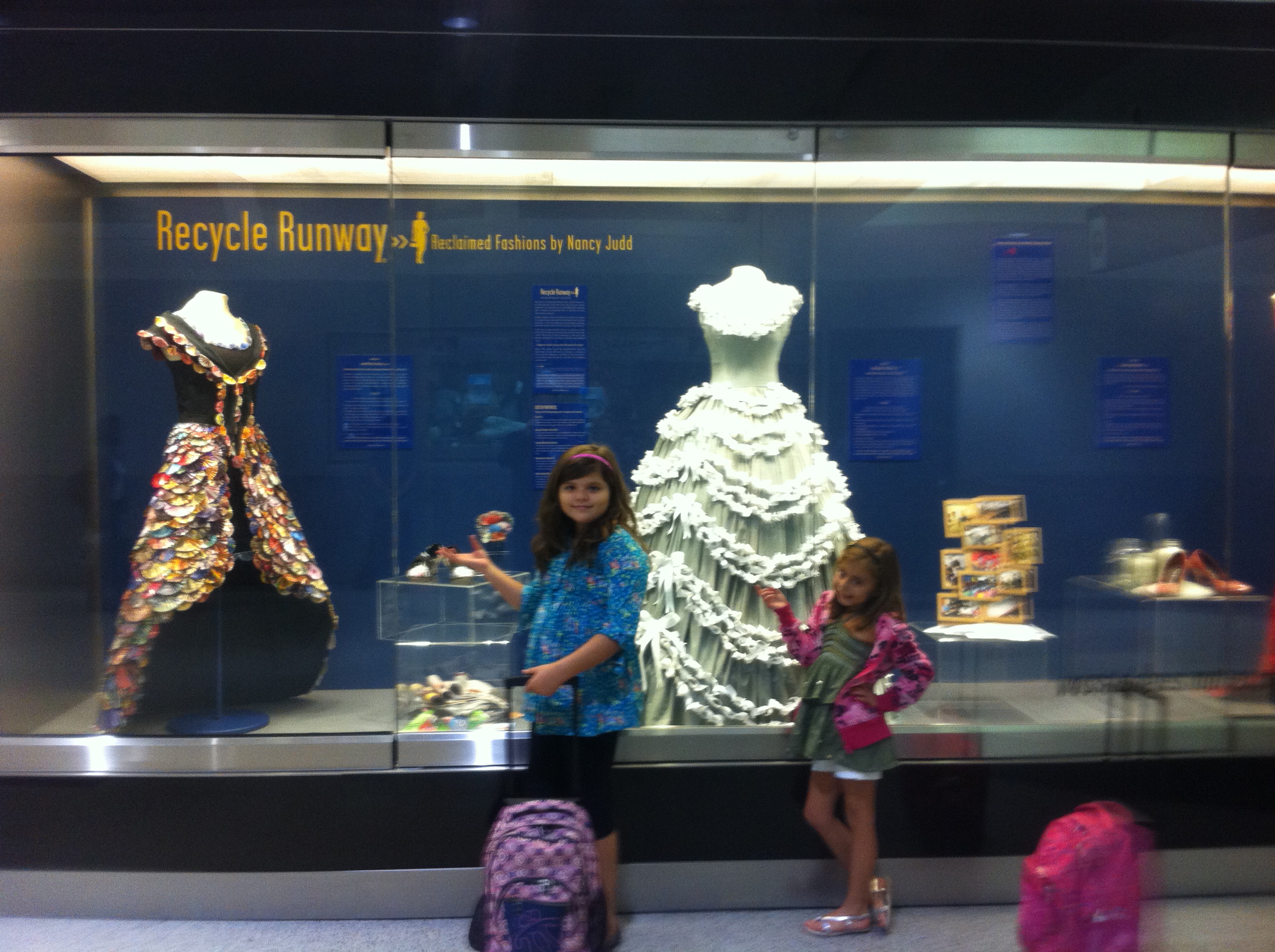
- I received several notes from friends who I have not see for over 20 years that came across my exhibition in the Airport and sent photos of their kids in front of favorite garments.
- An Army Sergeant that flew through Concourse E numerous times while the exhibition was on display wrote to me often. The installation motivated him to contacted the airport to find out how he could help to improve their recycling program.
- A Grecian hair-dresser saw the exhibition and was inspired to start a trash fashion show in Drama City, Greece, outside the National Bank of Greece.
- One of the airport employees, Mr. Jones, who buffs the floor at night in Concourse E told me this: “I will be sad to see this exhibition go, I watched a lot of passengers taking photos of it. In fact I took a photo of one of the dresses and showed it to my son. He got inspired and did a recycling project for his middle school class!”
THANK YOU to everyone that helped to make this exhibition a success!
˜ ˜ ˜
What’s next for the Recycle Runway Collection? Last week it began a tour of museums starting with the New Mexico Museum of Art in Santa Fe. It is also scheduled to be exhibited in the The Bascom Visual Arts and Education Center in North Carolina and the Leigh Yawkey Woodson Art Museum in Wisconsin. If you know of any museums or art centers in your region that might be interested in hosting the exhibition, please let me know!
My recent blog post, Declining $10,000, was my most popular post to-date. It was re-blogged, shared on facebook, forwarded and re-twitter– reaching thousands more people around the world! I have received many (primarily) supportive comments, which has caused me to reflect even more on the experience. I have attempted to organize these thoughts into two primary concepts:
1. Everyone is welcome at the table!

Stained glass window by David and Michelle Plachte
My objective with my last post was to create a “teachable moment” about the environmental, social and health issues related to drinking bottled water. I did not intend to vilify the company that made me the offer and have in fact removed their name from both blog posts on the subject.
This experience helped me to clarify my belief that our problems need to be solved by working together and that the energy used to create “us versus them” scenarios hinders our ability to find long term solutions to the many critical issues facing the world today. I believe that everyone brings something to the table, and that INCLUSIVITY is imperative.
During my TogetherGreen Fellowship retreat, sponsored by the National Audubon Society and Toyota, we spent a whole day talking about diversity and exploring the biases (filters, lenses, perspectives, and histories) that can impact the effectiveness of creating solutions to our numerous worldwide crises. When we think about diversity we often think about gender, race, nationality or religion, but diversity is about inclusion, and inclusion means EVERYONE! But can I work with everyone, NO… that is where the fine art of exploring our individual truth comes in.
Watching coverage of the Earth Summit in Rio this year, I am also really appreciative of the voice of the most radical environmentalists who ceaselessly push the issues representing the voice of the animals, the plants, the children and the earth itself. Yes, every voice is needed at the table!
2. Embracing Complexity
In Santa Fe, where I live, we are having a film-festival of the great Japanese animator Miyazaki, Spirited Away and Ponyo are two of his films you may have seen. I love the duality of his characters, one may at first appear to be “bad” only later to reveal a loving heart with good intentions and actions despite other questionable activities.
It is so easy to categorize a person, entity or situation as good or bad, but life is much more complicated than that. Right and wrong are relative to numerous factors and most decisions in this world are quite complex.
Yes, all of my sponsors could be questioned for various reasons, but the companies I have chosen to work with have tremendous influence and the environmental (and social) initiatives they have started and funded have had far reaching positive effects. Like a Miyazaki character, they are neither 100% malevolent or benevolent.
Also, corporations are made of people, many of whom are working on the inside to do what they can to reduce the carbon footprint of the products/services that their company provides. I don’t want to negate the good work that these folks are doing, I want to recognize it.
I was able to reflect on these issues with some of my colleagues at the TogetherGreen retreat and many of them had faced similar sponsorship quandaries and agreed that these decisions are never easy and are always based on numerous circumstances. This is true for each of us in our daily lives as well because we have to make choices such as what we eat and buy, where we shop and live or how we get around that carry the same complex dilemmas.
I did not feel comfortable endorsing the use of bottled water and turned down the generous offer. I received a lot of praise for that act, however tomorrow I may make a different decision (on another topic) that is right for me, but wrong for you. Heroism can be very short lived!
I have a good friend whose initial response to everything is always: “interesting”. I am learning to use her simple reply, “interesting”, as a way to look more closely at the multi-faceted nature of situations and remain open to options that might have more inclusive, deep and long term outcomes.
Thank you for taking the time to read my philosophical musings on the nature of right and wrong and how this influences our daily decisions. Tell me about similar decisions you have had to grapple with, I would love to hear your experiences too!
