Eco Trash Couture
To View Project Details


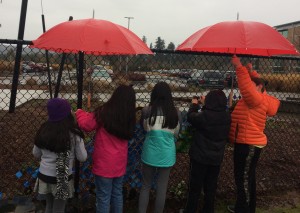 When people ask me what I do, I tell them I am an artist and an environmental advocate. I also tell them that I am a Teaching Artist. And it has never been truer than this year as I am spening so much time diving into the classroom. I just finished an artist residency at one school, I am in the middle of another, I am preparing for a Skype presentation with a classroom in Ireland, and I am planning half a dozen other workshops and camps for this spring and summer!
Though I have been in classrooms and working with children for over 25 years, in the last 2 years I have been training to be a Teaching Artist with an organization in Portland called the Right Brain Initiative. How is a Teaching Artist different than an Art Teacher, you might be wondering? As Teaching Artists we are trained to provide an Arts Integration experience to students. The John F. Kennedy Center for the Performing Arts in Washington, D.C., one of the leading organizations that has researched and taught Arts Integration, defines it as “an approach to teaching in which students construct and demonstrate understanding through an art form. Students engage in a creative process which connects an art form and another subject and meets evolving objectives.” Or in my words, we develop creative experiences to help students understand academic subjects such as math, science, social studies, history, reading, or writing.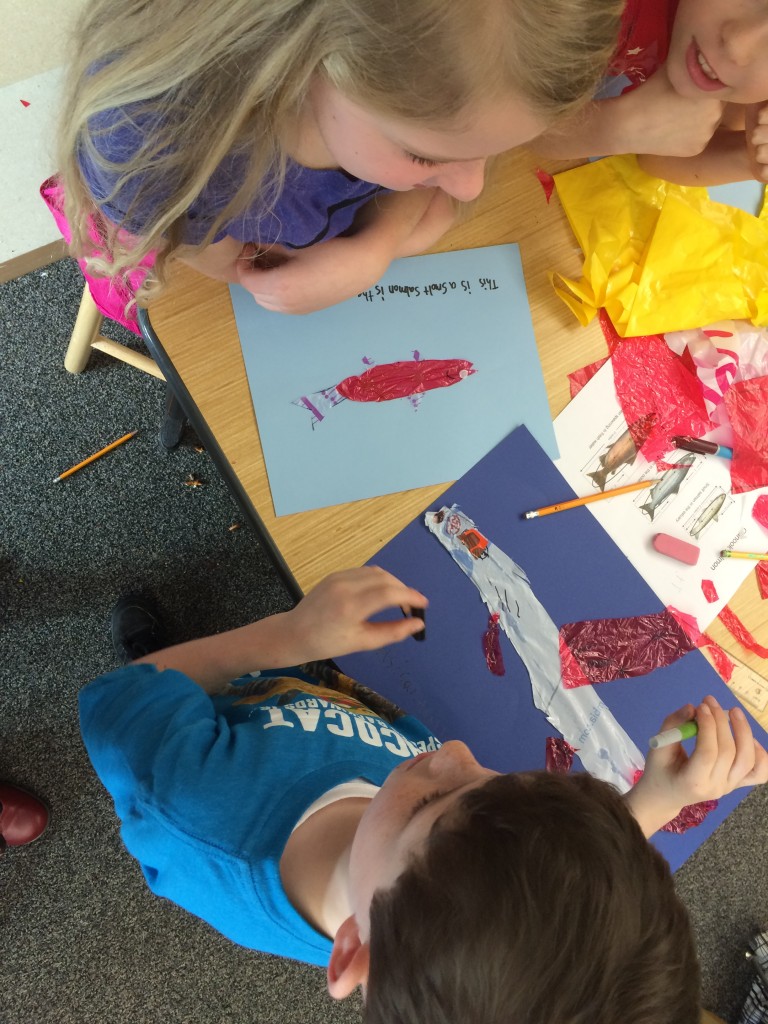
My first Right Brain Initiative residency last year was with two 3rd grade classrooms at Quatama Elementary School west of Portland Oregon. The students had just studied the life-cycle of salmon and were working on fractions. I started my time with them by having small groups use a creative movement activity to act-out each stage in a salmon’s life-cycle from little eggs, to swimming out to sea, to coming back and laying eggs. Next we used plastic, something that fish mistake for food when littered in waterways and oceans, to create a collage of a Salmon. We used fractions to determine where on the body the fins should go. You can see in the photo below that the students were also asked to write specifically what stage of life their Salmon was in, and what it was doing. Thus theater, visual, and literary arts were used to “construct and demonstrate understanding” of what they were learning about salmon.
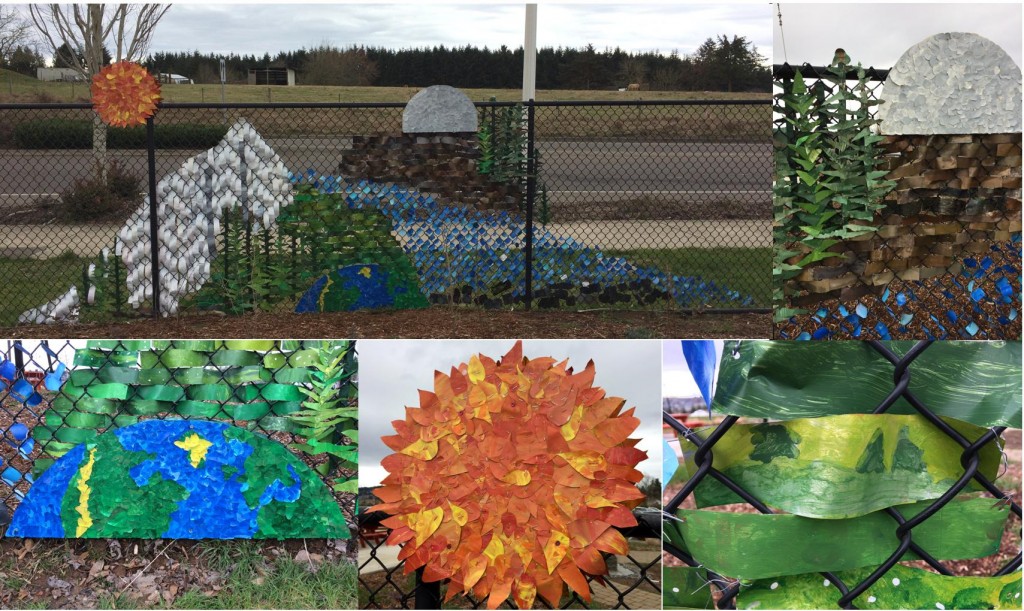
I recently finished a MUCH LARGER residency at Verne Duncan Elementary school just south of Portland. Here I worked with all of the 3rd, 4th and 5th grade classes (11 class rooms) and I visited each class 4 times, for a total of 44 sessions! When the school initially contacted me they asked if I could create a mural with their students on a chain-link fence using upcycled materials. Knowing that I usually create “trashions”, they were not sure I would be interested but since I am always up for a new challenge, I said I would be happy to step outside my usually art form and try something new.
I then had a meeting with the principal and the 11 teachers whose classes I’d be working with, where we co-created the content of the mural and residency. The theme was a natural habitat in the North West that included geological and weather/climate features, in addition to a river, plants, and planets. Each classroom contributed an element of the mural related to specifically what they were studying.
On my first day, besides showing photos of my work and talking about my career as an artist, as might be expected, I also shared my challenges as a student with the learning disability, dyslexia. I often try to tell my story of overcoming my learning disability because, in addition to giving hope to students that face similar challenges, it supports general concepts that most schools are trying to teach such as perseverance and “growth mind-set”. Plus, I think the lessons I learned from my dyslexia have contributed to my ability to face the challenges of being an entrepreneur and have actually enhanced my creativity! If this is true, I want to share this inspiration with them!
During the residency I took the students through the process of creating the mural. I decided to use painted aluminum cans which became an opportunity to bring science into the session. The general scientific inquiry process I went through to decide to use aluminum rather than plastic went something like this:
- Question – Which will hold paint and stand up to the elements better, aluminum or plastic?
- Experiment – Cut pieces of an aluminum can and from a plastic detergent bottle; paint them with an outdoor acrylic paint; bury them in the snow for a couple of days; and then submerge them in water for 24 hours.
- Observe/Analyze – The paint scratched off the plastic, but not the aluminum.
- Conclusions – The aluminum will hold paint better, and over time will not become brittle and break down as plastic does. (I decided to use the conclusion I arrived at to also teach about plastic pollution. As an aside I asked, “Did you know that plastic never decomposes? It just breaks down into tiny little pieces that pollute the soil and water– so all the plastic that has ever been made still exists!) I certainly did not want this mural becoming a source of litter and pollution!
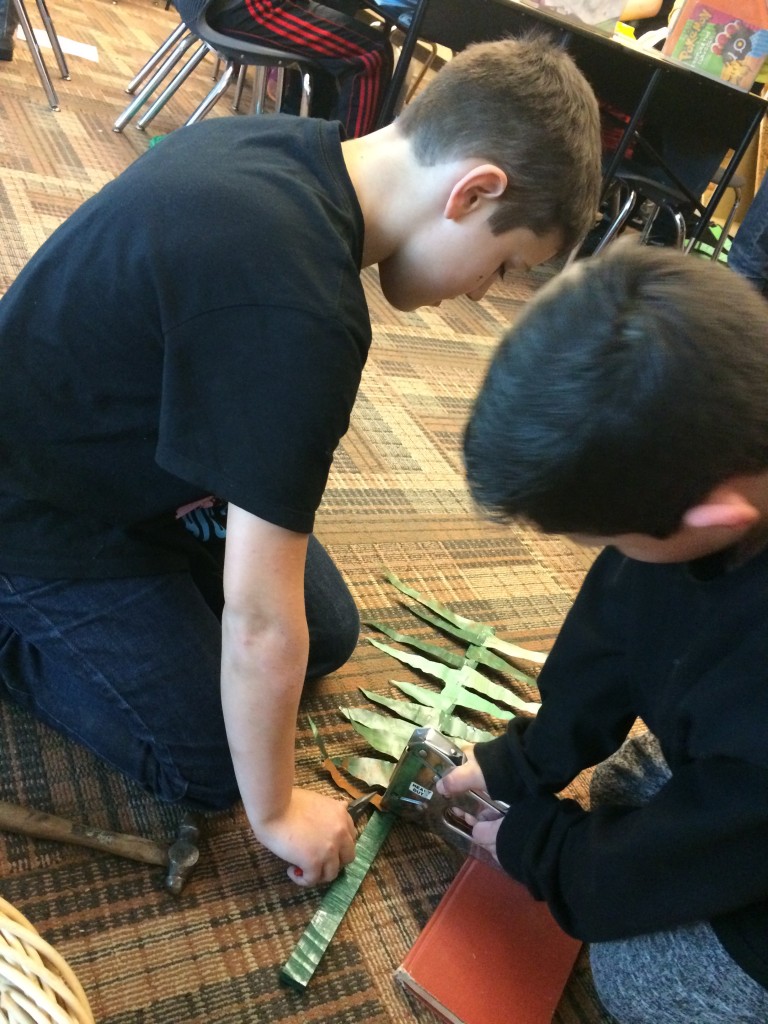
A dedicated parent (Krisen, who’s children were not even part of my residency) cut the tops and bottoms off around soda 500 cans! The students sanded the strips of aluminum, painted them and using normal scissors cut them into different shapes. At this point some of the classes poked holes in the corners and ventured out into the rain (and snow!) to attach the pieces onto the fence. The other lucky students got to stay warm inside and staple their painted aluminum pieces onto pieces of wood that were transformed into trees, the earth, the sun and the moon which would later be attached to the fence.
In an Arts Integration Residency we start with a “big idea.” The Big Idea the teachers and I crafted was: “The earth and everything that lives on it (plants, animals, and humans) are INTERDEPENDENT on each other.” The big idea is then woven throughout the sessions. To bring this theme into focus, I started my sessions exploring this quote by Chief Seattle, the chief of the Duwamish and Suquamish tribes who lived around the Puget Sound area:
This we know: the earth does not belong to man, man belongs to the earth.
Man did not weave the web of life, he is merely a strand in it.
Whatever he does to the web, he does to himself.
During each session we explored one line from the quote in-depth. On the last day I told the students a story about Chief Seattle that many people do not know. Even though the City was named after him, Chief Seattle was never allowed to live in the city limits. This was an opportunity to discuss the concept of discrimination, and link it to words the kids are familiar with like “bullying”. We also connected this to the idea of social INTERDEPENDENCE.
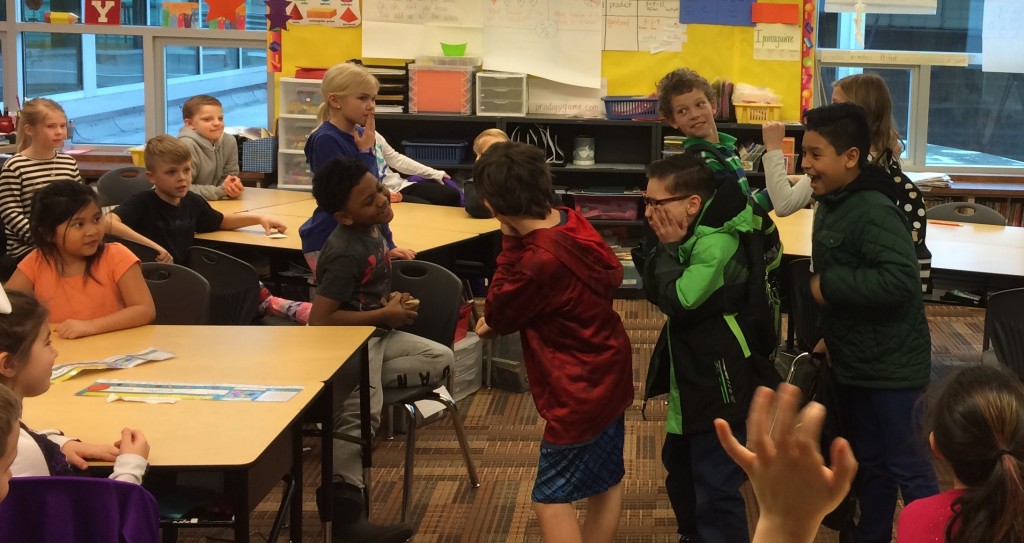 For me discussing the big idea was actually more important than the mural itself. In fact, instead of spending any of the last session working on the mural, we spent the entire time reflecting on how the mural and the Chief Seattle quote connected to the idea of INTERDEPENDENCE between us and our earth as well as amongst people and creatures. Another teaching artist tool that I employed is called “Tableaus,” where the students act-out scenes, in this case with environmental and interdependent themes, and freeze action in the middle of them. As a teaching tool, Tableaus help the students put into context the actions that they are acting out as well as the actions of their fellow students, hopefully coming away with a deeper understanding of the themes. The following are examples of the themes we explored through Tableau:
- Show how the trees in the mural are dependent upon the sun and river.
- Show ways of caring for the earth by acting out conservation actions like turning off the water and lights, or recycling and not littering.
- Show students helping each other.
- Show students demonstrating about an issue they care about such as equality or clean water.
- Show students writing and calling their leaders about issues important to them.
After each Tableau, the other students that were watching got to guess what theme was being represented and the students in the tableau would explain how their scenario connected to the Big Idea of INTERDEPENDENCE.
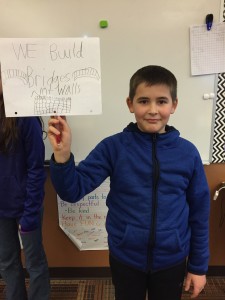 In the last part of my session with the students, I took a bit of a risk and tied these ideas to the politics of the day. Specifically discussing the different forms of discrimination we see our federal government taking against Muslims and immigrants, and the power that is being taken from the Environmental Protection Agency to protect our air, water, soil and climate. Like a broken record, I kept returning to the idea that: “If we take care of the earth, the earth will take care of us, and if we take care of each other then we will be taken care of too.” I talked to the students about the power they have to model caring for the planet, and other people. I also told them that they can be powerful young activists standing up for the issues that they believe in.
I was not sure how the school and the teachers would feel about my brining these current issues into the classroom. However, I am deeply concerned about how the new administration is impacting the planet and my fellow human beings and, because these issues are so related to the idea of INTERDEPENDENCE, I felt like I needed to make these environmental and social justice connections. The feedback I received from the teachers afterwards was positive and they said that they appreciated that I brought up what is happening politically because they felt like they could not. Also they liked that I focused on facts, not my personal opinions.
I really enjoyed all aspects of this residency, and will miss the students, teachers and staff at Verne Duncan, it was an honor to be part of their community for a couple of months!
My current residency at Hollydale Elementary school just east of Portland is focusing on making “trashion costumes” and connecting this to the Big Idea of cycles. Specifically, we are comparing the sustainable cycles we see in nature with the unsustainable cycles of consumerism specifically the fashion industry.
If you are a teacher, school administrator, or parent please know that I would love to visit your children’s school too! As mentioned I even give Skype presentations to classrooms across the country and world! Contact me at Nancy@RecycleRunway.com if you would like more information.
The Trash Man’s Suit, 2016
The Trash Suit was commissioned by Rob Greenfield during an “eco-stunt”, where he wore his trash for 30 days! It is made of clear plastic film that was sewn onto a pair of military pants and a coat supported by an old back pack frame. See photos of the suit filling up over the month in Rob’s “Trash Me Time Line”.
Read more about my experience making the suit and working with Rob in this blog post.
Watch a video Rob’s team made about my process creating the Trash Suit.
Bella, 2016
A Bride on a Mission!
This sculpture is made from discarded plastic Tyvek® (used in sterilization pouches and bags for the medical industry) that was cut into strips and sewn to the dress. The flowers were made primarily by people attending medical industry conferences across the US in 2016. Bella’s goal is to bring awareness to the recyclablity of Tyvek®, and inspire the creation of recycling programs for this plastic film.
Commissioned by Beacon Converters in 2016.
Read this blog post to learn more about the creation and mission of Bella.
The first in a series of blog posts about the true costs of the clothing we wear
 Ask me to make a dress from a pile of trash and the inspiration flows! Ask me to make one from “normal” fabric and…it’s not quite that easy. Thus, it was an unusual challenge when I was invited to participate in a fashion week event last month in Seattle. Fashion? Couture maybe, but I have a dubious relation with fashion. However, this event was no normal fashion week. This was ECO FASHION WEEK (#EFW), the world’s largest sustainable fashion event happening, in 2016 for the first time, in Seattle Washington! Originally launched in Vancouver, BC, Canada in 2010, they sought to break into the international market by bringing the event to the US. Held over four days with two jam packed evenings, the event was filled with runway shows, a meet and greet, and a full day of presentations called the Collective Conversation. Meant to explore the environmental and social issues related to the fashion industry, I was invited to both participate as a panelist in the Collective Conversation and to share new work on the runway. The pace was thrilling and exhausting!
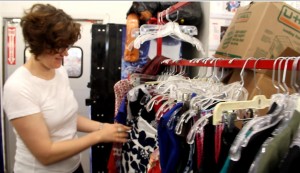 For the runway portion of EFW, I was one of 10 designers and stylists that participated in the Runway ReImagined: Project 8.1. So there I was in Value Village at 6 o’clock in the morning, standing toe to toe with the other clothing sorters except I was pulling clothing for fabric and labels, not for resale (hence my foray into creating a garment made solely from repurposed “normal” fabric). Individually, each of the 10 designers used 8.1 pounds of recycled clothing to create a small collection of garments. But collectively, we created couture weighing a total of 81 lbs. What is the significance of 81lbs, you may ask? It’s the staggering weight of textiles that the average North American discards annually! Hard to imagine isn’t it?
The EPA estimates that 3.8 billion pounds of post-consumer textile waste goes into the landfill every year.1 Luckily most of these textiles we discard — even if they’re worn, torn, or stained — can be recycled! You can even recycle a single shoe! Items simply need to be clean and dry. There are lots of thrift stores happy to take your textiles, such as one of the main sponsors of the 8.1 challenge and Eco-Fashion Week: Value Village (aka Savers, Inc.). The clothing recycling market can reuse and recycle 95% of the enormous amount of apparel that we purchase and discard every year. About 45% of discarded clothes are usable clothing, however, because of the huge glut of clothing in the world only a small percent is resold in secondhand clothing stores. The rest is sent to developing countries for reuse. The other 50% of discarded clothes are turned into a variety of new products where 30% become wiping cloths (used in repair shops, construction, stores, and maintenance or custodial departments) and 20%, when processed back into fibers, are turned into paper, yarn, insulation and carpet padding.2 Unfortunately, of the 81lbs of clothes we throw away every year, the clothing recycling market is only capturing 15%. The rest goes into landfill.
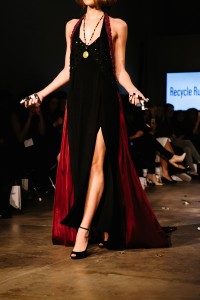
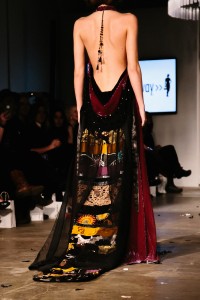 However, the disposal of textiles is only one problem with the fashion industry. Let us pause here as our minds conger up images of slim models with hair blowing in the wind, garments unimaginably sleek, revealing sensuality, or audacious juxtaposition usually affordable only through extravagant expense. My first piece in the collection (shown in the images to the left) I created for ECO FASHION WEEK was meant to represent this notion of fashion and the opulence of conspicuous consumption. But let these realms stay in the pages of Vogue, Elle, W, and GQ.
The thing is, when I talk about the fashion industry I am also referring to the sneakers worn by 8-year-old boys, T-shirts worn by the guy next door, and the bathrobe worn by your grandma. All our attire including coats, shoes, hats, and accessories are part of this mammoth industry. Which by the way, is the SECOND most polluting industry in the world after oil–YES, the second!
This blog post starts a series about fashion and its critical role in the exploitation of resource use and in climate change. In the series, we will explore 81lbs of waste, pollution and mistreatment from fast fashion, the exportation and globalization of toxicity, and what steps we can take individually and collectively to combat our decreasing value of clothing. I will return to more about my ECO FASHION WEEK collection and performance piece in this series, but first I am going to share with you some of the information I learned in my research preparing for the project.
I thought this series a very fitting way to begin the New Year as we open ourselves to resistance against the old ways of thinking that no longer serve us. Continue reading the next post in the series here.
1 Digitek, Potomac. “SMART: Consumers & Green Advocates.” Professional Trade Association. SMART: Secondary Materials and Recycled Textiles Association. N.p., 12 Aug. 2015. Web. 19 Dec. 2016. http://www.smartasn.org/consumers/index.cfm#
2 SMART: Secondary Materials and Recycled Textiles. The Lifecycle of Rags. N.p., 2015. Web. 19 Dec. 2016. http://www.smartasn.org/consumers/lifecycleofrags.pdf
This series was co-researched and co-written with Nicole Morris.
Photo Credits: All photos by Nicole Morris, except runway photos by Alfonso Arnold.
The video above was recently released by the Huffington Post about the work I do. It is part of an excellent series they are doing called RECLAIM: REDUCING THE WORLD OF WASTE . In this series, they cover positive stories across the globe ranging from smog vacuums in China; to Rob Greenfield’s story of wearing his trash for a month; to a story called, “You Make Reckless Decisions When You Shop After Work.”
The Huffington Post piece focused on my use of fashion as a means to engage people in conversations about what is happening to our planet. As I prepare to dive into the world of fashion at Eco Fashion Week in Seattle this week, this is a perfect focus.
At EFW, I’ll be participating in two ways but I’m going to talk about the second event first. On Friday November 4th I will be part of a panel, during Session 2, in a day-long event called the “Collective Conversation” which explores how to make our clothing more sustainable. I will discuss this in further detail later this month in a blog post covering what I learn this week. For now I want to share with you one staggering piece of information I discovered recently:
FASHION IS THE SECOND MOST POLLUTING INDUSTRY AFTER OIL & GAS!
At first this seemed unlikely to me, especially considering industries such as nuclear energy and weapons. But as I thought about it more I realized that each of the 7 billion people on this planet wear cloths and many have copious amounts of them! The price of fashion is huge when we consider the varied activities that take place around clothing, for example:
- the pesticides used to grow cotton;
- the petroleum products used to make nylon and polyester;
- the staggering amounts of water that are both used and polluted in the garment industry (it takes over 700 gallons of water to make ONE T-SHIRT!);
- the overwhelming energy requirements to power the massive facilities where our clothes are dyed, bleached, woven, cut, and sewn;
- the energy used on washing and drying clothes;
- all of the packaging used to protect the materials and finished garments as they move from one place to another before they end up in our closets;
- the fuel used and pollution created to transport clothes across the world and back again;
- the waste created while we wear clothes and later dispose of them (the average American throws away 81 lbs of textiles a year!)
- And then of course there are the often unfair and unsafe working conditions for the millions of people in the garment industry.
When you consider the many and far reaching arms of the fashion industry, you can begin to understand why it holds this regrettable distinction!
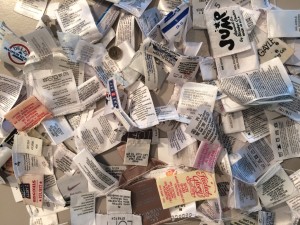
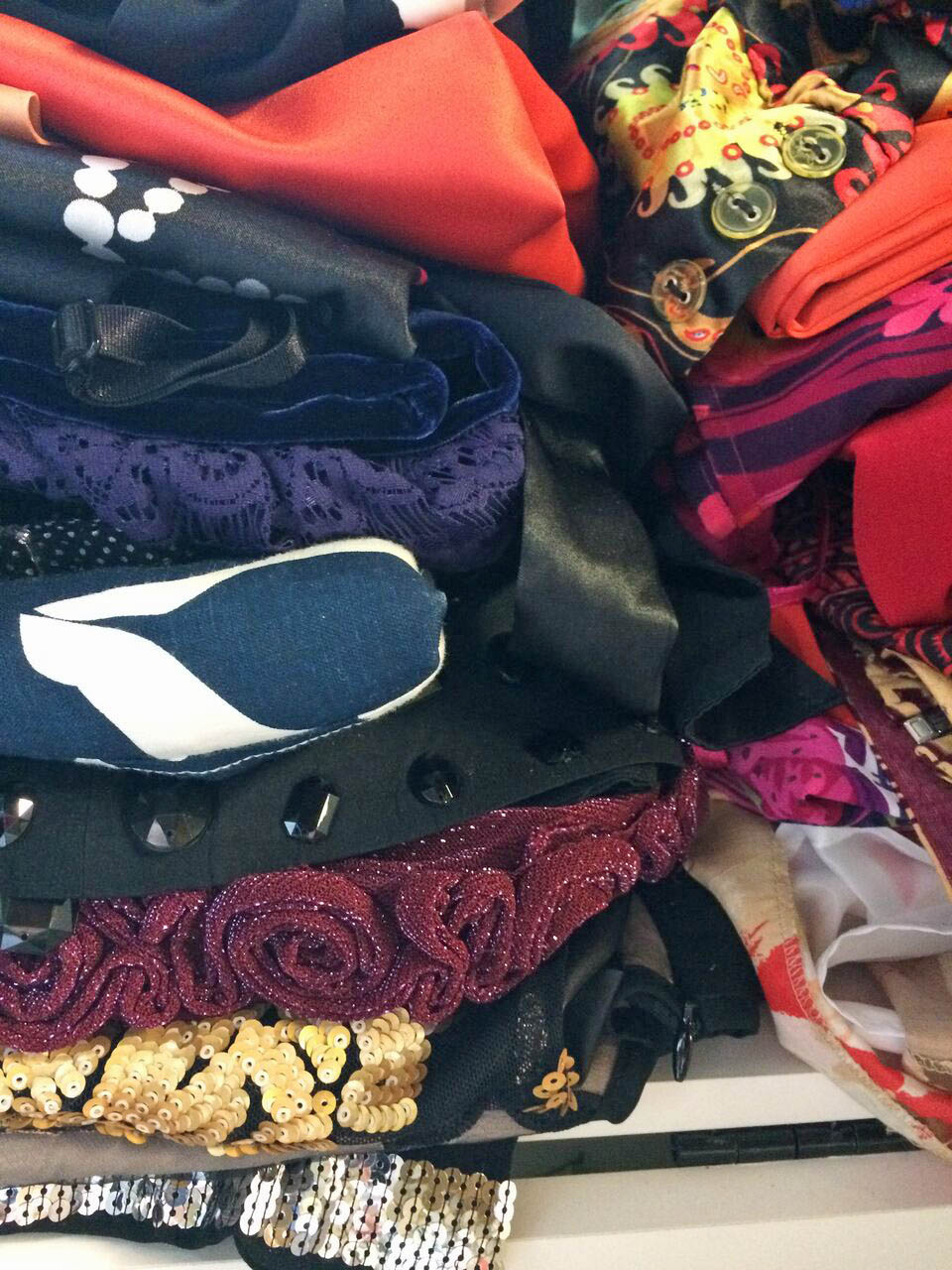
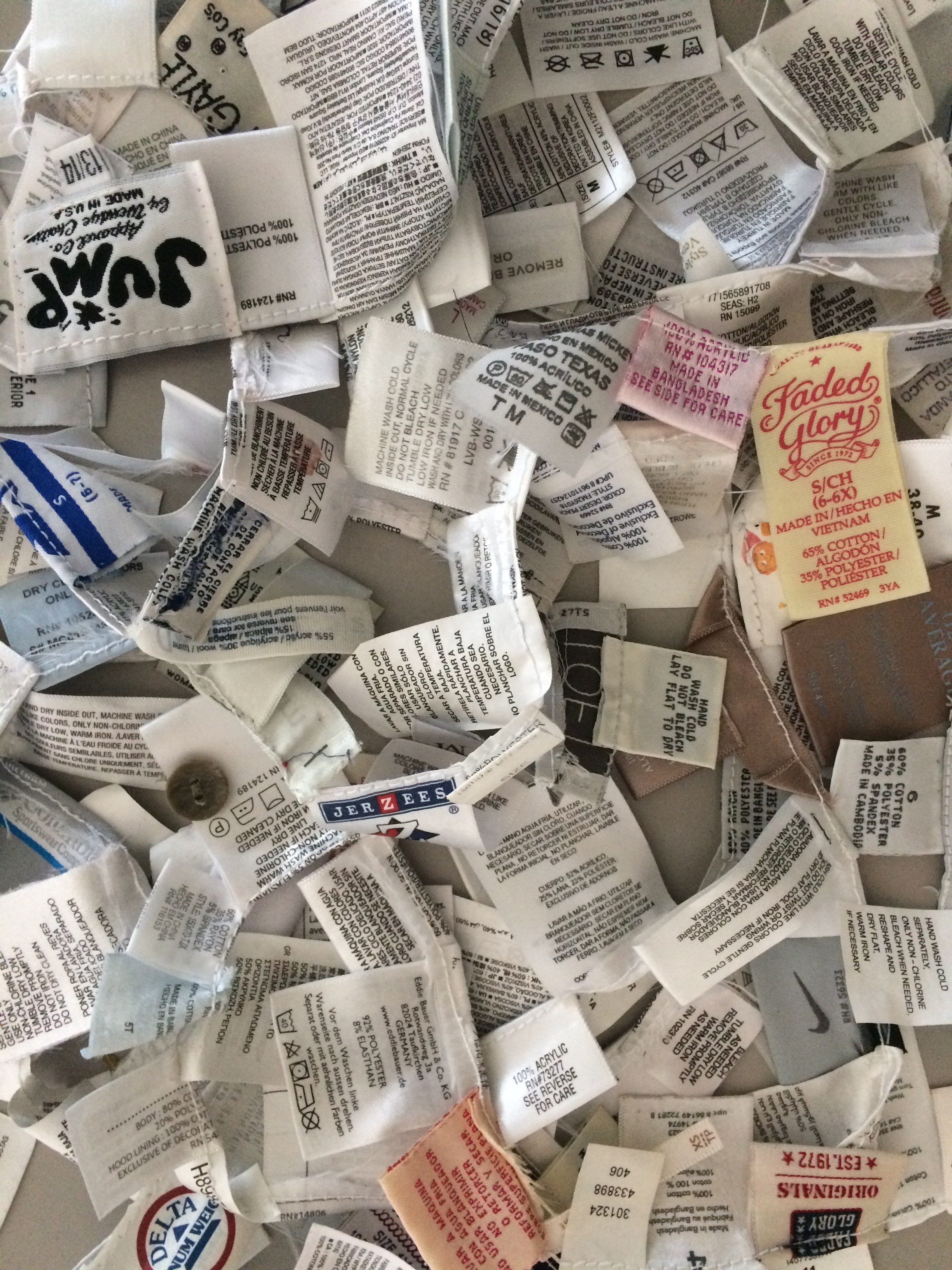
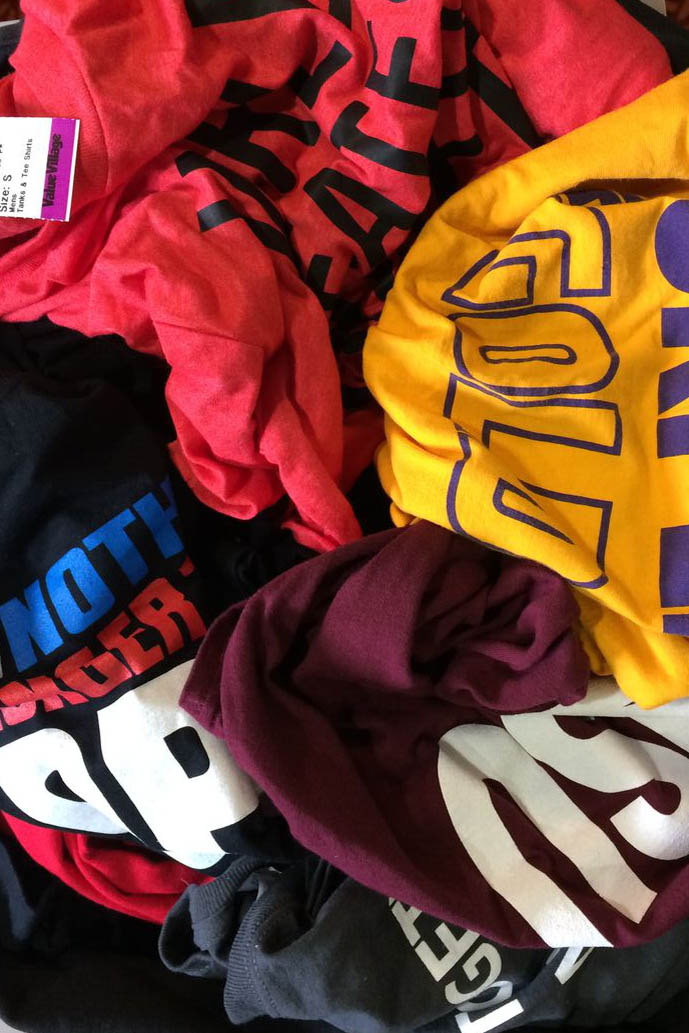
The first event I will present in is a segment called RUNWAY REIMAGINED on Wednesday November 3rd where I will be unveiling a visual exploration of the price of fashion on the runway. (If you live in Seattle, please come! Details can be found here: ) For the show, I have created three garments that raise questions about the labels in our clothing and the stories they tell us about the environmental and social costs of what we wear. I consider this work to be performance art, using the fashion stage as my “canvas”. It’s new territory for me and I’m very excited!
Below are photos of the materials I am working with for this collection. After the garments are unveiled at Eco Fashion Week, I will send out photos and video of the full garments and collection. Stay tuned!
 |
 |
 |
PDX Weather Advisory, AKA April
One of my very favorite words is from Nepal: रङ्गी-चङ्गी; written in letters, raṅgii-caṅgii; and pronounced, rungy-chungy. This fabulous word (which does not have an English equivalent in my opinion) means crazy, multi-colored, splendid, fancy, exciting and fun! It was the design inspiration for one of my newest sculptures, PDX Weather Advisory, created for the Port of Portland which runs the Portland International Airport.
This raṅgii-caṅgii adventure began after listening to a presentation about the PDX Airport’s waste minimization efforts at a meeting about reuse of commercial waste streams. As I listened to Kaileigh Westermann, a Waste Minimization Project Lead from the Port of Portland, I was astounded to learn that the Port has implemented a five-year plan to achieve 90 percent or greater landfill diversion rates at its facilities. Let me repeat that: 90% landfill diversion– that is a TRULY impressive goal! To achieve this, they have an extensive on-site recycling program and provide technical assistance to airport tenants and airlines to reduce waste and recycle a wide variety of materials. Their composting program (unusual for an airport to have!) has diverted over 1,300 tons of food waste from the landfill and they also have a food donation program that has donated 130,000 lbs of food, or 85,000 meals, since its inception in 2013. I also learned that the Port has FOUR other equally impressive sustainability programs!
Next it was my turn to give a presentation to the group about my work. After the meeting, Kaileigh asked if I could help the Port tell the story of their sustainability programs in a creative, eye-catching way for Earth Day. “YES, I’m your gal!” I proclaimed enthusiastically and a dynamic collaboration began. We met many times over the next several months, fleshing out details such as:
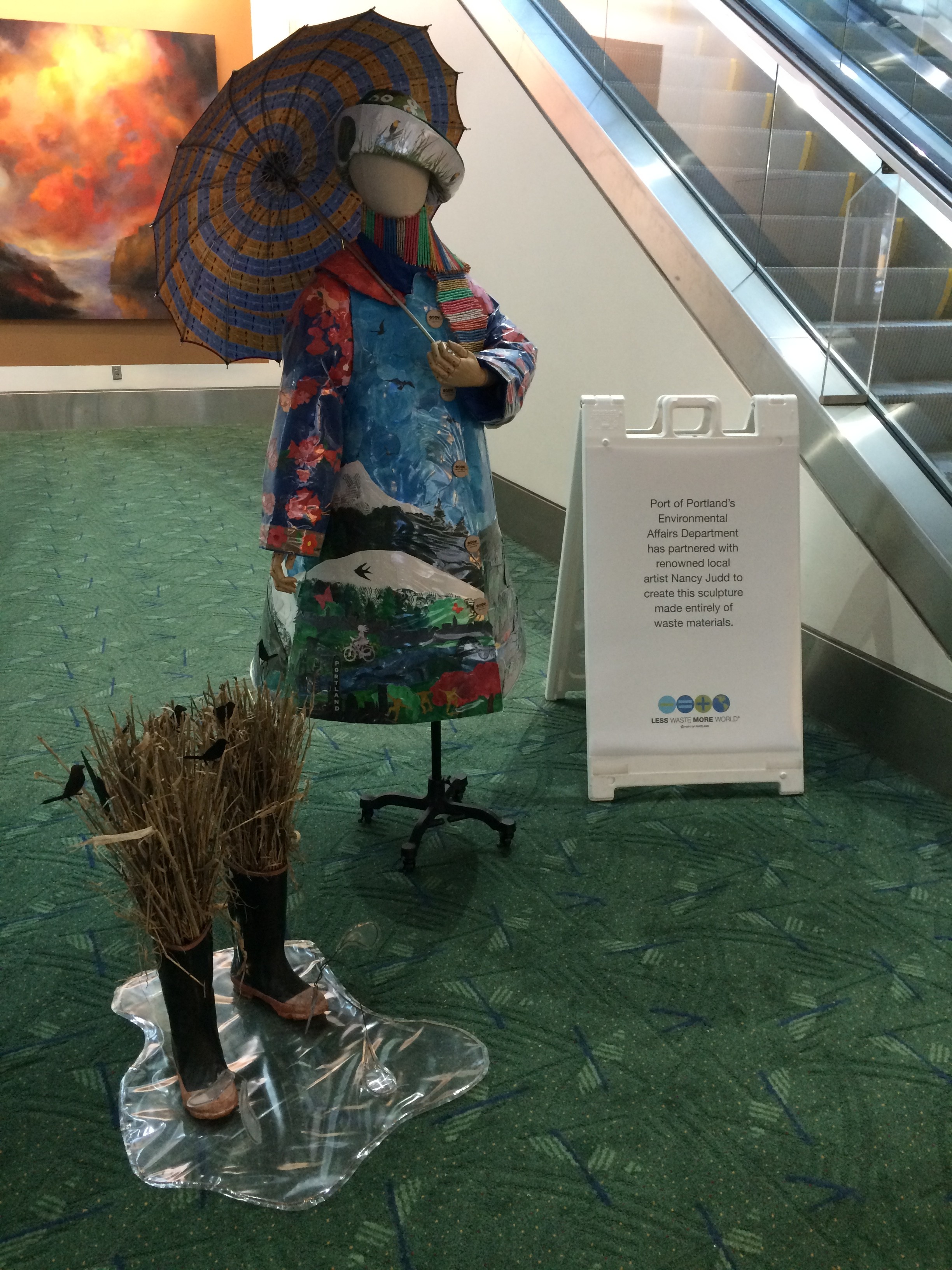
April on display at the PDX Airport
- The overall design concept- we settled on a rain gear outfit with five parts (umbrella, hat, scarf, coat and boots) that would each represent one of the Port’s five sustainability programs, and reference Portland’s notoriously wet climate.
- The message – we met with representatives from each of the five sustainability programs (air, water, energy, natural resources and waste minimization) to discuss what message they wanted to convey and the waste materials they generate that I could use in the garment to tell their story.
The day that Kaileigh delivered the materials, she looked at the mix-matched pile of coffee cups, electrical wire, old magazines, invasive dried grass, and parking garage tickets with an overwhelmed expression on her face and said:
“I’m glad you’re the one making this thing, not me!”
“Yes, well that is my specialty!” I said with a confident smile, but internally feeling as befuddled as she looked.
And the uncertainty continued for a week until I said to my partner: “I’m kind of drawing a blank here. How am I going to make a cohesive design with FIVE different elements from such diverse materials?” In a flash of inspiration Nicole said: “Maybe you should lean into the miscellany of the materials and create something that is multi-colored, multi-patterned and multi-textured so that what ties it together is the craziness of each element!” In that moment my favorite word popped into my head and the ideas started to flow! “YES, it will be raṅgii-caṅgii– a crazy, multi-colored, splendid, fancy, exciting and fun extravaganza!”
Thus off we went down the winding path of creating PDX Weather Advisory, AKA April. We choose the name as it has several pertinent meanings:
- The word “weather” references the fact that it is rain gear, AND relates to climate change.
- The word “advisory” in conjunction with weather, refers to a weather term AND implies a warning… which is really the subtext of all my work.
- Her nickname is April though because PDX Weather Advisory does not exactly roll off the tongue, and she was finished in the month of April for Earth Day.
Yes, April needed to be completed by Earth Day. I stated after Valentine’s Day and it took 440 hours to make the sculpture, it was a pretty raṅgii-caṅgii ride! There is no way I could have done it without the help of more than 35 very generous volunteers: people ranging from Port employees, neighbors I had never met before, mothers of high school classmates, and old friends I had not seen in 30 years helped me finish April by Earth Day. We held work parties at the Port, in a local brew pub, at SCRAP (a local reuse center) and my studio. Thanks to each and every one of you– I see your contributions all over this sculpture and it is part of what makes it so special to me!
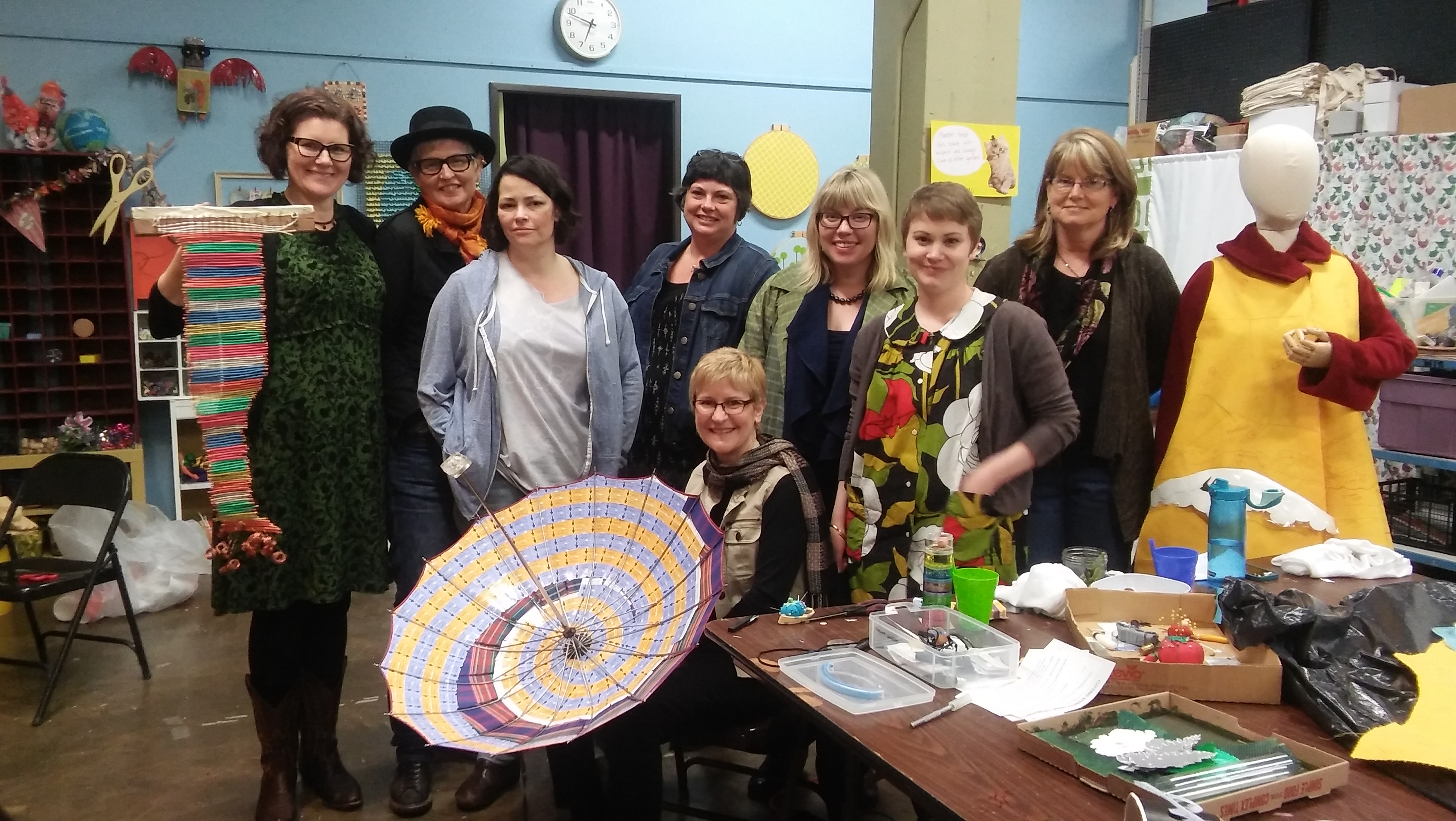
One of the volunteer work parties
So let me introduce you to April (AKA PDX Weather Advisory):
- RAINCOAT: Representing the Waste Minimization Program, disposable coffee cups cut into iconic Portland images are sewn to the coat and encourage travelers to reuse items such as coffee cups and water bottles.
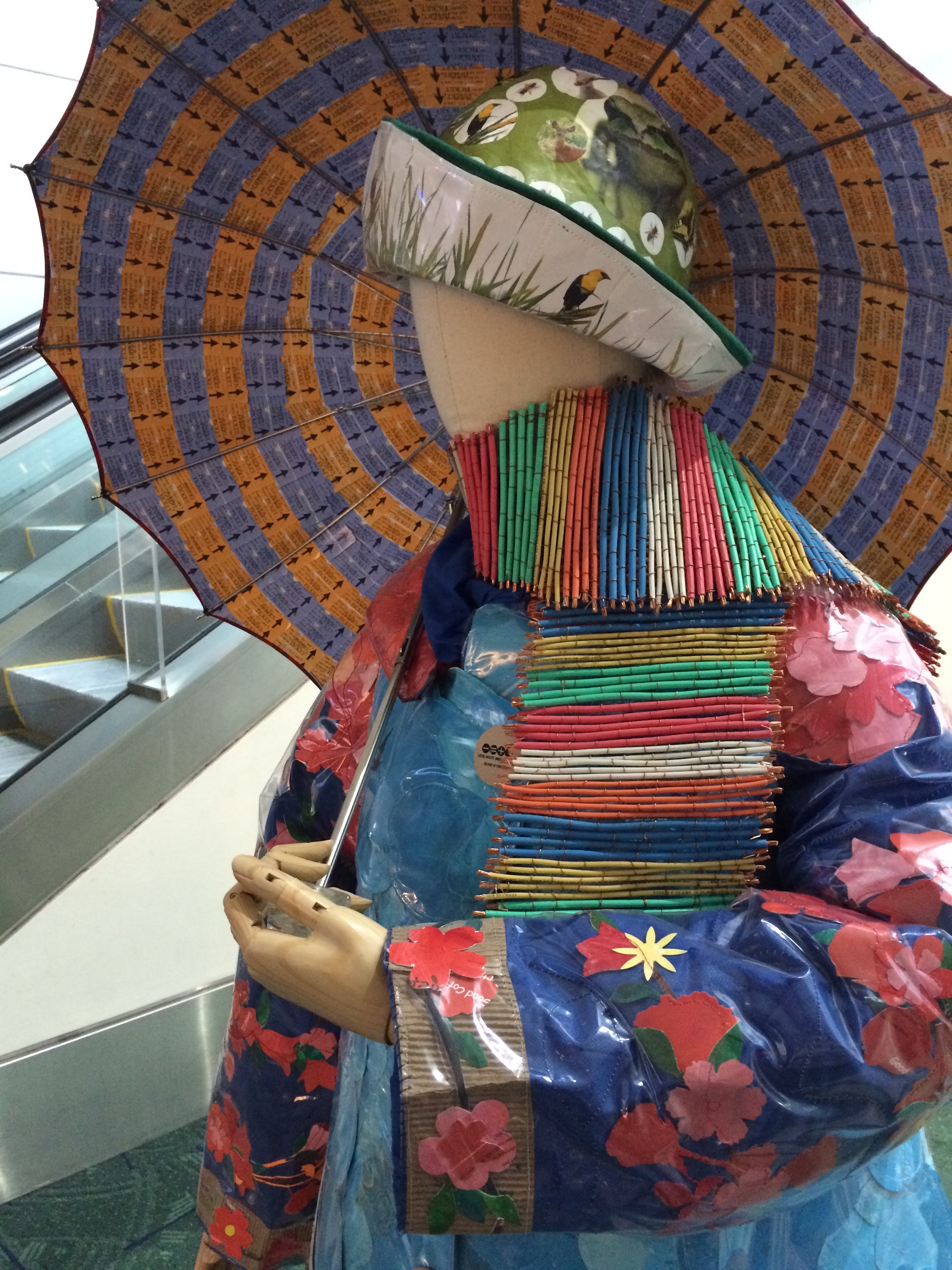
- UMBRELLA: Representing the Air Quality Program, this umbrella is swirling with parking garage tickets, highlighting their program’s reduction in emissions from idling vehicles.
- HAT: Representing the Natural Resources Program, a hat-collage of insects and wildlife photos cut from old periodicals emphasizes the Port’s various protection programs and mitigation projects.
- SCARF: Representing the Energy Program, scrap electrical wire is woven into a scarf to highlight the clean energy and energy efficiency programs.
- BOOTS: Representing the Water Quality Program, these boots feature Reed Canarygrass, an invasive species that threatens wetlands. The Port works to manage this invasive species on mitigation lands, as well as many others, to support healthy watersheds and water quality.
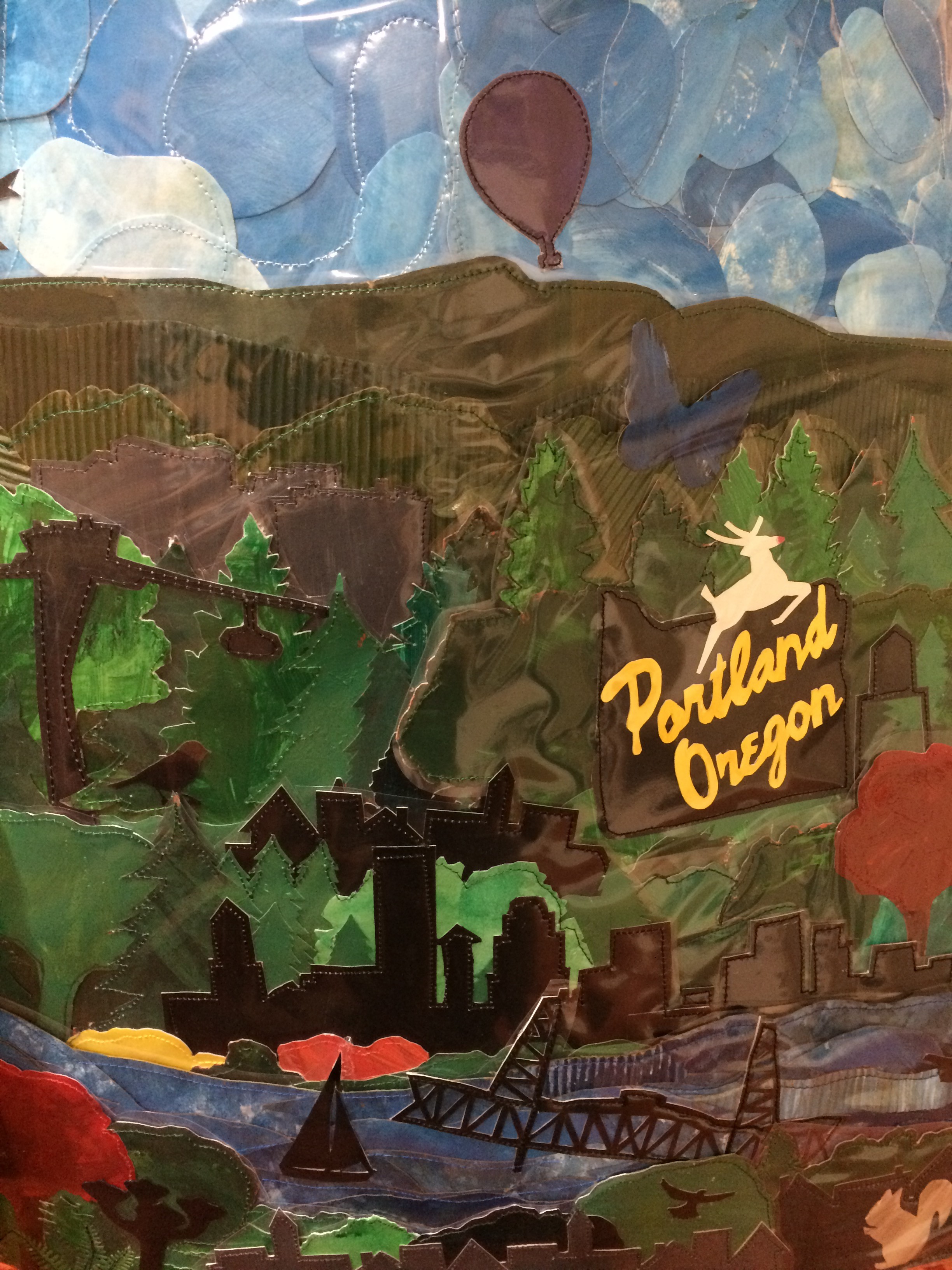
Detail of the coat, covered with scrap plastic film to provide protection from the rain!
One of the neat things for me about making the raincoat specifically was the connection to Portland in the collaged images. I was born and raised here, but left when I went to college. I returned two years ago and having been away almost 30 years it has been lovely rediscovering my home town. This coat was a surprising way to become reacquainted with the places I knew growing up and that are new to me as well. Cutting out the silhouettes of the Oregon Health and Science buildings called “Pill Hill”, collaging the bumps and shadows on Mt. Hood, and sewing down the Marcum bridge that my sister climbed before it opened in 1970. I found after making this coat that I had a new and surprising intimacy with the details of my beloved City.
When April was completed, she was on display in the Airport and now Port staff is taking her to various events around Portland to inform people about their sustainability programs. She will then become part of an exhibition of about six pieces I will have at Portland Fashion Week in September and then join 20 other of my new works in a major yearlong solo exhibit in the Atlanta Airport in 2017/2018!
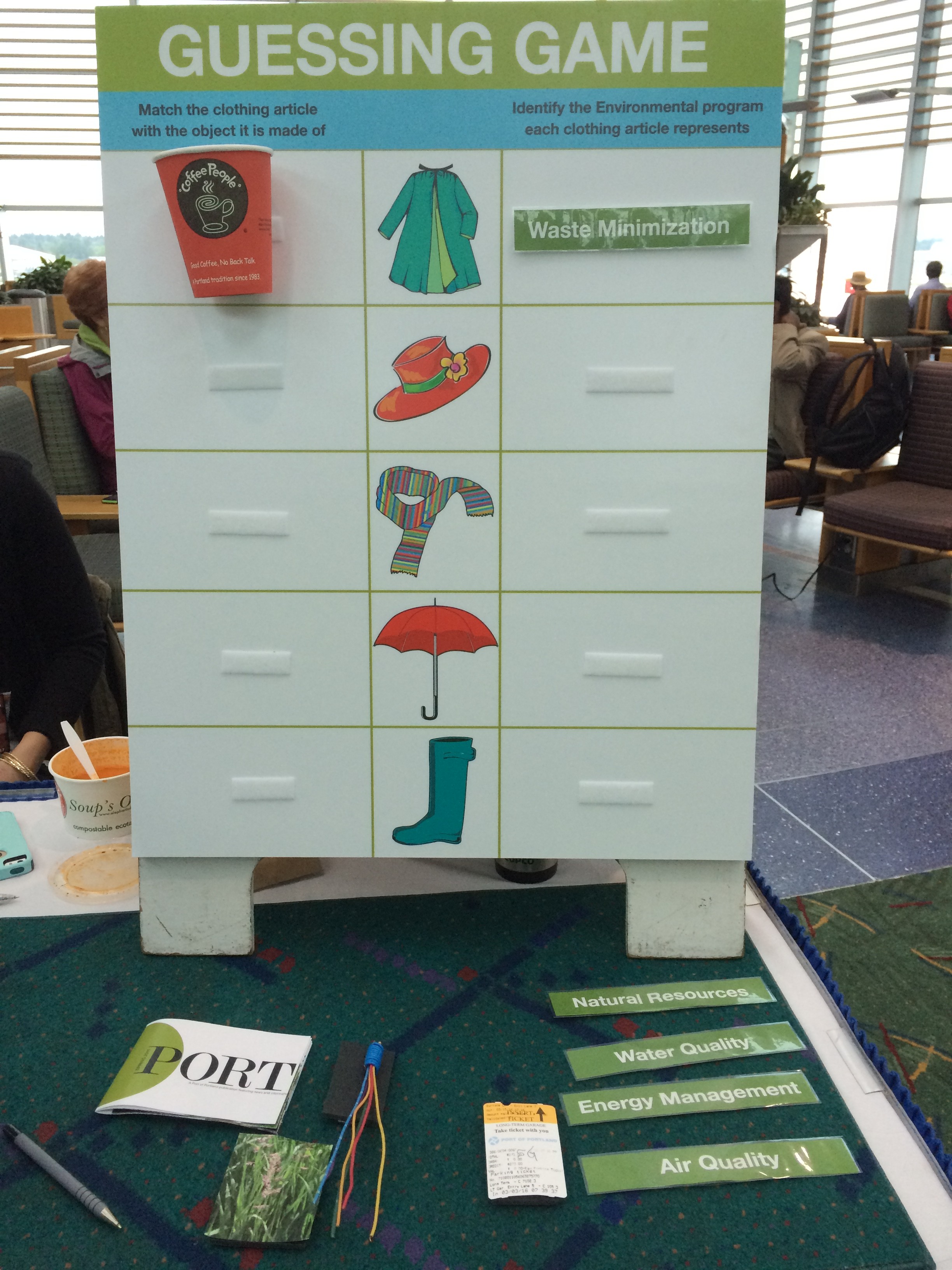
Interactive sculpture description
Kaileigh Westermann and the Port’s Corporate Communications, created a fabulous hands-on interactive display to accompany the sculpture. The board has three columns, the first has the materials (attached to Velcro) used to create April; the second has images of the coat, hat, boots, umbrella and scarf; and the third column has the name of each sustainability program on pieces of foam core. People can then match the material with the piece of clothing and the program it represents. It is a great way of engaging people in learning both about the sculpture as well as the airports sustainability programs. However, the story that PDX Weather Advisory tells is just the tip of the iceberg; the Port has many more inspiring sustainability programs! For example in their headquarters located at the Airport, their waste water is recycled through a “Living Machine” made of plants and underground gravel chambers!
Part of what made creating PDX Weather Advisory such a raṅgii-caṅgii experience, was that I had just finished (two days before) another sculpture called “Bella”, and was simultaneously working on a third piece, “Pacifica”, for the Nature Conservancy, also due at the same time. There was literally no way I could have completed these three sculptures in four months if it were not for ALL the people who volunteered their time to help!
I want to give a special thanks to Kaileigh for chauffeuring this project through all of the bureaucratic windy roads that needed to be navigated. To Erin, Grace and Lisa also from the Port for your many contributions, and to Stan Jones, Kaileigh’s boss who said “Go for it!” when she came to him with the initial idea. It was great to work with and get to know all of you, thank you for this wonderful opportunity!
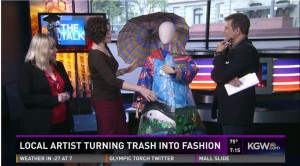
Click here to watch TV coverage of PDX Weather Advisory!
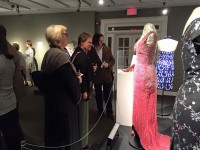
ReDress: Upcycled Style at the Stamford Museum
In September my traveling exhibition, ReDress: Upcycled Style, opened in the Stamford Museum and Nature Center in Stamford, Connecticut. I visited the exhibition to give a presentation and workshop. I also had an unexpectedly empowering experience, but first, a bit about the trip. One of the neat things about the Stamford Museum is that in addition to the museum they have a huge farm with animals. I am excited to have my work there because their mission blends the arts, environmental stewardship and life-long learning.
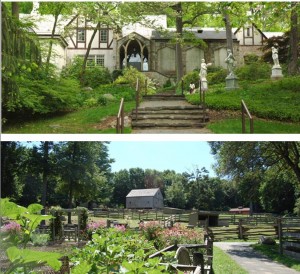
Stamford Museum and Nature Center
I also found the history of the site to be quite interesting, it was built by a fashion magnate, Henri Bendel. Mr. Bendel made his mark by becoming the first retailer to brand himself. Having registered his own trademark in 1895, he created the now legendary brown and white striped shopping bag and hatbox. Bendel was the first luxury retailer with an upper Fifth Avenue address, and the first to stage a fashion show. This fact was particularly interesting to me since I began creating my sculptures for (recycled) fashion shows, so I feel indebted to his creation of this now ubiquitous event, a fashion show. He was also responsible for bringing Coco Chanel to the United States. He built the large 10,000 square-foot, neo-Tudor mansion as a summer home in 1929 and the Museum moved into the property in 1955. I really enjoyed exploring the house, grounds and beautiful marble sculptures shipped from Italy. I like to think that Henri would have enjoyed my exhibition of couture fashion with a twist!
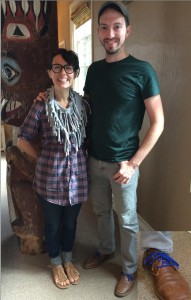
Check out Justin’s awesome new shoelaces and Amy’s fall scarf!
After a well attended gallery tour and talk, the staff held a beautiful farm-to-table meal that was also a fundraiser for the Museum. Coincidentally, it was my Birthday and I was delighted to have over 50 people sing to me while I blew out the candle on the tallest cupcake I had ever seen! The next day I taught one of my favorite workshops, transforming old T-shirts into new objects. We began by making over 20 dog toys for a local animal shelter, and then the 15 participants created items ranging from shoe strings to scarves and reworked shirts with new style. I was excited that Amy and Justin from the Trashion Fashion Show joined us, they stage “trashion” shows on the East Coast using ballet dancers as models. I also met a wonderful woman who’s family-owned business is interested in sponsoring a new sculpture from me. Thank you to all the Museum staff for hosting me and my traveling exhibition.
Now, back to my unexpected experience: whenever I visit my exhibition at a new museum I always spend a little time with the sculptures making minor repairs, mostly gluing glass back on to the Glass Evening Gown! This time I also worked on the Eco-Flamenco dress which is covered with eco-pledges made by 5,000 people. The Museum invites visitors to take their own eco-pledges and so on a whim, I filled out a pledge card and shared it that night during my gallery talk: “I will ask all of the hotels that I stay in to turn down the temperature in the mini-refrigerators”. This is a pet-peeve of mine because I always find them set on high, and I know that these refrigerators are used a very small percentage of the time they are on. When you think about the millions of hotel rooms around the world with refrigerators, this wastes a tremendous amount of energy which adds carbon to the atmosphere, unnecessarily contributing to climate change. So the day before I checked out of the Holiday Express Inn and Suites in Stamford (notably on the night of the full lunar eclipse and blood moon) I wrote my request on a comment card. By the time I returned home I had honestly forgotten about it until I received a note from the hotel manager saying: “We have shared your comments and feedback with our team and have started implementing (your suggestion) in our guest rooms.”
This was an empowering moment for me, I experienced how truly one small action can make a difference and it confirmed why I encourage people to make these pledges. I have since written to the parent company, InterContinental Hotels Group, to ask them to follow the lead of their hotel in Stamford and make this a policy at all of their properties.
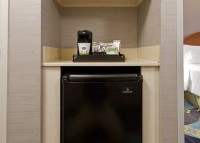
Hotel room refrigerators, unnecessary contributors to climate change
I also did a little sleuthing around on the internet to see if I could find any information on the impact of mini-fridges in hotel rooms, the only thing I found was on www.KeyGreen.com, an organization in Denmark that awards eco-labels to over 2,400 hotels and other sites worldwide. They have their application form posted on-line and I was impressed to see a question asking the applying hotel if they have a policy to TURN OFF refrigerators (and TVs) when rooms are not in use. Not turn down, but turn OFF!
So, the next time you travel you might want to use this site, www.bookdifferent.com, to find a hotel that has a smaller carbon footprint. And if you encounter a refrigerator in your room, turn it to low (or off if you want to be radical) and leave a comment card for the hotel. And if they respond, please let me know!
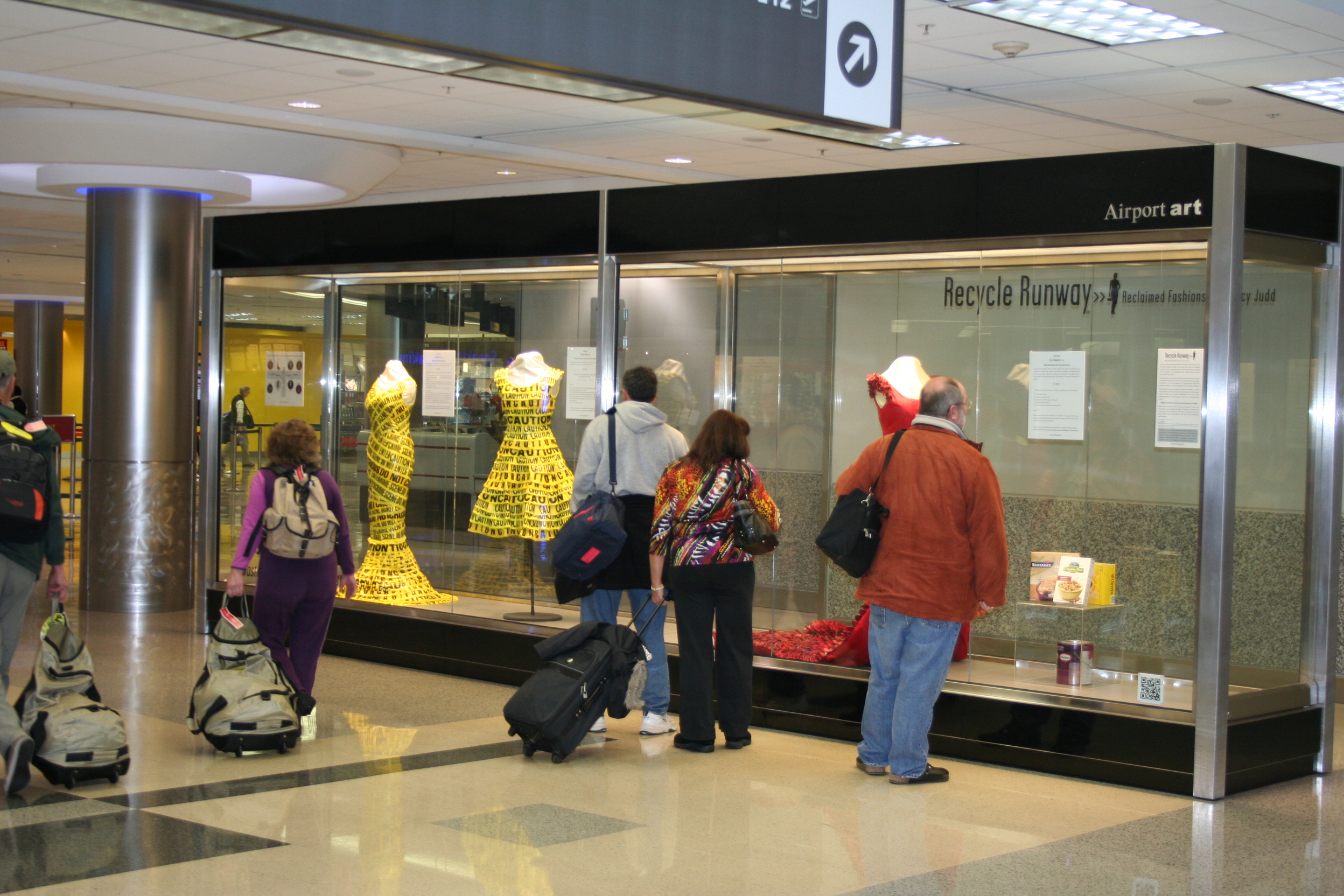
Nancy Judd’s Recycle Runway Exhibition in the Atlanta Airport, 2012
In 2011-2012 I had an exhibition of 21 of my sculptures in the Hartsfield-Jackson Atlanta International Airport for 14 months. The ATL Airport has invited me back for a second show in 2016 because the first one was “one of our most popular exhibits”! The exhibition will open in the fall of 2019.
I’m so very honored that David Vogt and Katherine Dirga, the team behind the Atlanta Airport’s impressive Airport Art Program, have asked me to return– it is a great validation of the work that I have been doing for the last 15 years! I’m also excited because they want me to create a new body of work for the exhibit made with the airport community including airlines, concessionaires and contractors. Many of the sculptures will be made in interactive educational workshops with airport employees, passengers and other ATL community partners including school children. The educational opportunities and reach of this project are really thrilling to me!
In the coming months we will be reaching out to other organizations for collaborations and sponsorship. Please let me know if you are interested in being a part of this exciting exhibition… and stay tuned for updates as the project unfolds over the next three years.
Nancy@RecycleRunway.com
505-577-9712
I de-installed my Recycle Runway exhibition in the Atlanta International Airport last month and sent it home to Santa Fe– it was sad to say goodbye to such a great venue!

Giving a tour of the exhibition to passengers and airport employees
I first met with the Atlanta’s Airport Art Program staff, David Vogt and Katherine Dirga, over 5 years ago for 15 minutes in-between flights. They generously agreed to meet at my gate for a quick introduction and look at my portfolio. When they informed me a couple of weeks later that they would like to exhibit my work, I was thrilled because they have curated such a wonderful permanent collection and rotating exhibitions. Also, knowing that ALT is the busiest airport in the WORLD; I was humbled by such an incredible opportunity to reach so many people with my message of environmental stewardship.
We installed the exhibition in May of 2011 (you can read about our midnight adventures in my blog post from May 10, 2011) and we took it down in the second week of July, 2012. Nineteen garments were initially installed in nine cases and an additional three were added to a tenth case that the Airport Art Program installed in January of 2012 in the entrance to the terminal between the escalator and the information desk. The airport estimates that during this time over 15 million passengers passed through Concourse E!
The exhibition was advertised with a 30 second video on the CNN TV monitors located throughout the entire airport. It was seen several times each day that it was aired. Click here to view the video.
The exhibition was generously sponsored by Coca-Cola, Delta Air Lines, Janome, and Novelis and my Green Partners: Earth911.com, the Georgia Chapter of the Sierra Club, the Georgia Recycling Coalition, Keep America Beautiful, Keep Georgia Beautiful, the Phoenix Airport Museum and the Turner Foundation.
I was overwhelmed by the number of print and electronic media outlets that covered the exhibition over the 14 months it was on display.
| Misc Press Outlets -USA Today Travel -CNN -Yahoo -NBC/ 11 Alive -Delta’s Sky Magazine -Clayton News Daily -Atlanta Day Book -Metromix Atlanta -Future News Network -Orbiz.com Blog Posts -Delta -Atlanta Airport -BlueGreen -Chimeras -Fashiongraphia -Stuck at the Airport -Talking with Tami FlickR -Atlanta International Airport -HaveIgotastory4u’ -FilipinoOnSkis |
Websites -TrendHunter -Chic Republiq -Examiner -Terminal U -Ecouterre -PolarTREC Magazines and Newsletters -Resource Recycling -Southern Seasons -New Mexico Recycling Coalition -Georgia Recycling Coalition -Glass Packaging Institute Pintrist -Click to view numerous “pins” of the exhibition. Other Social Media -FourSquare -Tumblr -Twitcsy -Twyla |
There were so many really heart-harming moments for me during this exhibition, here are a few samples:
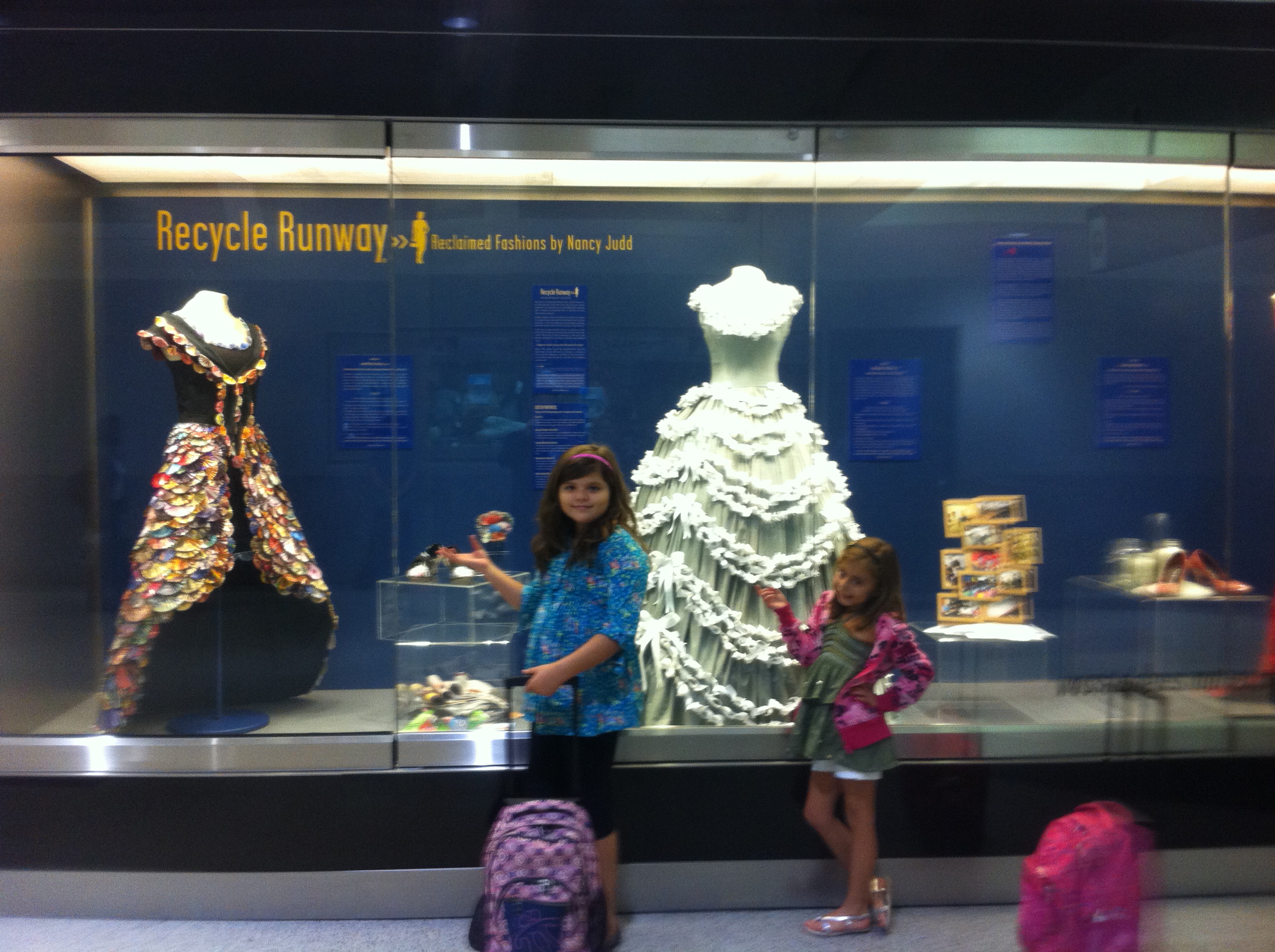
- I received several notes from friends who I have not see for over 20 years that came across my exhibition in the Airport and sent photos of their kids in front of favorite garments.
- An Army Sergeant that flew through Concourse E numerous times while the exhibition was on display wrote to me often. The installation motivated him to contacted the airport to find out how he could help to improve their recycling program.
- A Grecian hair-dresser saw the exhibition and was inspired to start a trash fashion show in Drama City, Greece, outside the National Bank of Greece.
- One of the airport employees, Mr. Jones, who buffs the floor at night in Concourse E told me this: “I will be sad to see this exhibition go, I watched a lot of passengers taking photos of it. In fact I took a photo of one of the dresses and showed it to my son. He got inspired and did a recycling project for his middle school class!”
THANK YOU to everyone that helped to make this exhibition a success!
˜ ˜ ˜
What’s next for the Recycle Runway Collection? Last week it began a tour of museums starting with the New Mexico Museum of Art in Santa Fe. It is also scheduled to be exhibited in the The Bascom Visual Arts and Education Center in North Carolina and the Leigh Yawkey Woodson Art Museum in Wisconsin. If you know of any museums or art centers in your region that might be interested in hosting the exhibition, please let me know!
Art in Review
April 20, 2012
By Michael Abatemarco
Read original article.
Nancy Judd and Nicole Morris: Consumption, New Mexico Arts Centennial Project Space, 54 ‘6 E. San Francisco St., Suite 2, 699-4914; through May 5
Repurposing found and discarded objects, while not a new concept, is given a considerable new twist in Consumption at New Mexico Arts Centennial Project Space.. The objects in the installation assembled by Nancy Judd and Nicole Morris are arranged to resemble a child’s Western-themed
room, complete with a bed, hobby horse, play kitchen, lamp, story books, mobiles. and other odds and ends. These objects were culled from Santa Fe’s Buckman Road Recycling and Transfer Station. Each item has a price tag, but the twist isn’t what you get for your money. Instead, the “price” is explained in terms of environmental impact of the
materials of which the items are made. It is the price we pay for what we, as consumers, throw away. Chemicals in certam paints, for example, leach into groundwater over time, with potentially deleterious effects on human life and wildlife.
Consumption can hardly be reviewed in terms of its aesthetics, like a traditional art exhibition. All that can be said on that note is something along the lines of the verisimilitude of the room compared with one in which a child would feel at home. At the opening on April 13, several children were engaged in playing with the kitchenette and reading the bedtime stories. To them, the exhibition was an obvious success. Adults are given a lot more to chew on. The purpose, after all, is to reclaim these materials and show how the things we no longer want are often still usable as is. Few of the items in Consumption are repurposed specifically as objects of art. An exception is the rusted sheet of corrugated steel hanging on the wall, intended as a decoration but not, essentially, a child’s plaything.
It must be mentioned that Morris and Judd, whose long-running Recycle Runway project presents couture fashion designs made from trash, had only 15 hours at the transfer station to locate these objects. It is remarkable and also
dismaying that within that short amount of time they were able to pull together enough throw-aways to create the installation. Had they been given more time, a completely different environment would be the result.
For the most part, everything in the show is in good condition. With a little bit of repainting and some cleaning up, Judd and Moms present their room as a comfortable, livable space. It doesn’t look dirty, and it doesn’t look like a room full of trash. Besides, once it is repurposed,, trash can no longer be called trash. The merits of Consumption are in its educational component — the information on the price tags. A lot of us in Santa Fe are concerned about the environmental impact of waste and make an effort to recycle, but we may think of recycling largely in terms of bottles and cans, glass and newspapers. The installation underscores the quality and condition of much of what we throw away and deem undesirable, despite its usefulness. In this sense, Consumption is a real eye-opener.

