Eco Trash Couture
To View Project Details


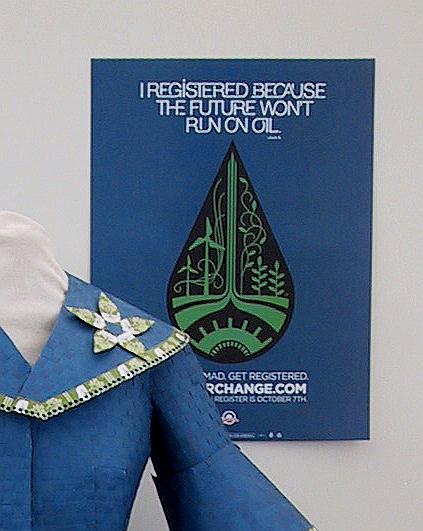
Fashion That’s Meant to be Trashy
 By Kimberly Button
September 23, 2011
Read article on-line.
You wouldn’t want to live next to a landfill, so would you ever consider wearing what’s in it? After seeing the eco-couture fashions of designer Nancy Judd, you might just say yes.
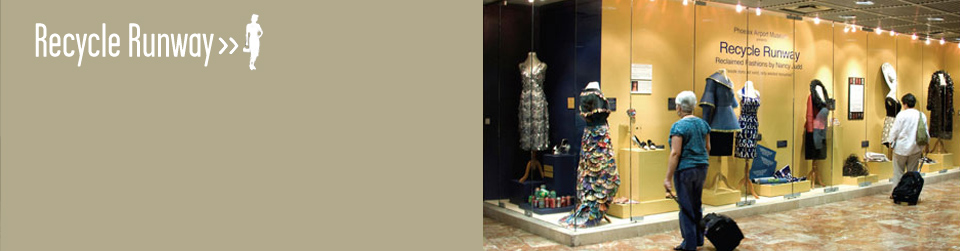
Judd, an educator and artist, started Recycle Runway to bring attention to the overlooked beauty in stuff that’s sent to the trash heap — she creates couture clothing and accessories out of items commonly found in the dumpster. The wearable objets d’art — formal dresses, capes, boots and purses — are displayed in airports, malls, and museums. Including the Smithsonian.
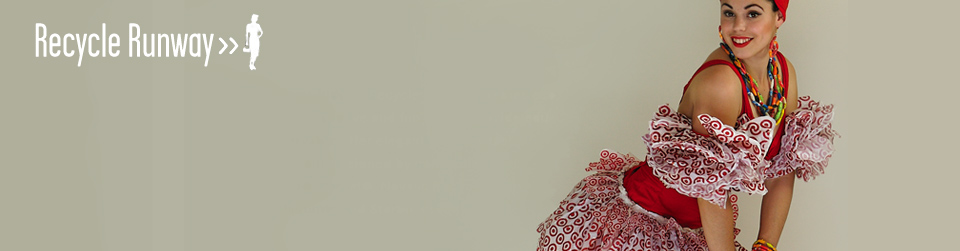
Target flamenco dress Judd’s designs are often sponsored by corporations, who encourage her to take trash that features their logos and turn it into high-end design. She made Target’s familiar red bull’s eye the pattern for her Carmen Miranda-inspired dress, and fashioned Delta’s safety cards and pretzel bags into a cape that complements a uniform made of old seat covers.
Judd is no newcomer to spreading the message of the importance of creative reuse. For more than two decades, she worked in the solid-waste industry, including as the recycling coordinator for the city of Santa Fe. After starting a trash-fashion contest in her arts-loving city to raise awareness, Judd started Recycle Runway in 1998.
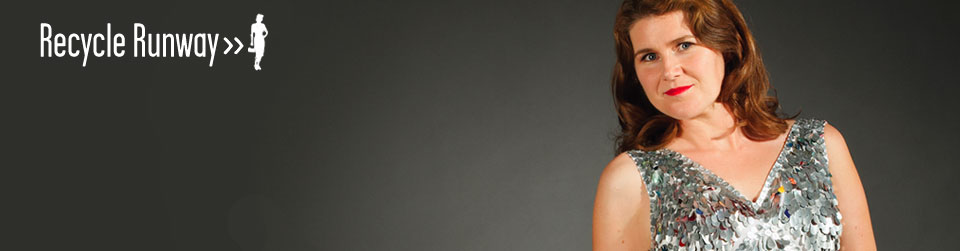
Nancy Judd in a recycled aluminum dress “I find fashion to be an effective way of getting these ideas across,” she said. “People seem to respond positively to a pretty dress. It’s a cheerful way to encourage people to think about deeper issues.”
If you’re at Atlanta International Airport through next April, look for 18 pieces of Judd’s fashion collection in Concourse E. After that, they’ll go on a U.S. museum tour.
Judd doesn’t rest on the laurels of her previous designs, though. She’s constantly creating new pieces and is working on an “Eco Flamenco” dress that’ll be covered in cereal-box ruffles. Each cardboard flair will have a green wish written on the back.
Crime Scene
Police tape is fashioned into “warning-wear”.
Tape from police crime scenes across the west, cover a dress made from torn table cloths. This cautionary costume took 50 hours to create and was completed in 2011.
Read a blog post about creating Crime Scene.
__________________________________________
Scientists estimate that everyone alive today carries within her or his body at least 700 contaminants.
90 percent of the 85,000 synthetic chemicals registered today in the United States, have NOT been tested for their effects on human health. Many of these chemicals persist in the environment and accumulate in our bodies creating susceptibility to cancer as well as many other health problems.
Don’t let your body be a crime scene! Reduce your families exposure to toxins by eating organic food; eliminating pesticides, chemical cleaners and air fresheners from home and work; and “air out” new carpets, painted rooms, furnishings, and anything else with that “new smell” before indoor use. Better yet – buy safer products that don’t off-gas toxic fumes.
Sources: Coming Clean, Breast Cancer Fund, Healthy Child/Healthy World
Albuquerque Journal
N.M. “Obamanos Coat” bound for Smithsonian
By  Kathaleen Roberts / Journal Staff Writer
June 3, 2011
Read article on-line.
SANTA FE – The day after the presidential election, Nancy Judd went Dumpster diving and turned out a coat.
Now the coat – pieced together from 2008 Obama materials, specifically paper door hangers that canvassers left on door knobs – has morphed from trash to treasure as part of the Smithsonian’s National Museum of African American History and Culture.
Using one of the president’s New Mexico campaign slogans, she calls it the Obamanos Coat.
The Santa Fe environmental artist and educator joined the Barack Obama for president campaign for six months before the election, organizing volunteers and canvassing her neighborhood. On Nov. 5, she scoured the trash bins at campaign headquarters across Santa Fe and Albuquerque, going home with yard signs, posters, decals and paper door hanger photo cards.
She picked up a vintage 1950s men’s coat at a consignment shop, then started cutting 1- by 3-inch strips from paper door hangers emblazoned with photos of the candidate and his volunteers.
“I attempted to size it to fit the president,” she said. “I went online and tried to find his dimensions. I found somebody who claimed to be his tailor. I literally had about 30 volunteers in my studio. The coat itself took about 400 hours to make.”
Santa Fe environmental artist and educator Nancy Judd created her “Obamanos Coat” out of recycled 2008 Obama campaign print material. The coat will soon become part of the permanent collection at the Smithsonian’s National Museum of African American History and Culture. (COURTESY PHOTO)
The garment formed part of a trio of “Change Couture” that included a cocktail dress pieced from plastic yard signs and a “Voter Swingcoat” in honor of New Mexico’s political status as a battleground state.
“It’s made of voter registration photos cut into quarter-inch strips woven into material,” Judd said.
The series traveled to the Green Inaugural Ball, as well as a reception honoring the New Mexico congressional delegation and the New Mexico Inaugural Ball. The publicity landed her a front-page story in The Wall Street Journal and international coverage from Mexico City to Paris and Kuwait.
Crafting garments from garbage is nothing new to Judd. The one-time coordinator of the Santa Fe recycling program, she initiated her own company called Recycle Runway and helped launch the city’s annual Trash Fashion contest and Recycle Art Market. Today, she gives workshops on recycling and other environmental issues throughout Santa Fe’s schools and youth organizations.
Her Recycle Runway traveling exhibit (now in Atlanta) has been showcased at airports around the country. It debuted at the Albuquerque Sunport in 2007. She’s made a flounced flamenco dress from fanned pieces of junk mail, a cowboy skirt and vest woven from phone book pages and a flapper dress sparkling with teardrop-shaped “sequins” sliced from aluminum cans.
Judd submitted the “Change Couture” series after her sister heard the Smithsonian was collecting campaign memorabilia. She learned the Obamanos Coat had been accepted when she got a call from a Smithsonian curator.
“I think it was just shock,” she said of her reaction. “For an artist to have a piece in the permanent collection of the Smithsonian is really a dream come true.”
She threw a little “bon voyage” party with the “sealing of the shipping crate” this week at Astilli Fine Art Services in Santa Fe.
She said more alchemy is to come.
“I’d love to do a project for the first lady,” Judd said. “A compost dress.”
The biodegradable garment would be made from fruit and vegetable peels from the White House garden attached to cheesecloth.
“I’d use the cheesecloth to make layers and layers of lace,” she said, adding, “Our immediate environment is our body.”
UpFront is a daily front-page news and opinion column. Comment directly to Kathaleen Roberts at kroberts@abqjournal.com or 505-992-6266 in Santa Fe. Go to www.abqjournal.com/letters/new to submit a letter to the editor.
— This article appeared on page A1 of the Albuquerque Journal
Read article on-line.
Designer and environmental educator Nancy Judd creates wearable art out of recycled materials

Nancy wearing the Caution Dress during her TED talk
Over a year ago I asked my cousin, Grant, and my friend, Michele, who are both police officers, if they would save “police tape” from crime scenes for me. Within about 6 months I received big tangles of yellow tape, some with stories I did not want hear. I also began gathering “caution tape” from less dramatic locations on the side of the road. A big pile of bright yellow plastic sat in my studio like a bunch of spaghetti for another year before two perfect dresses presented themselves to me.
The first was The Caution Dress. I was scheduled to give a TED talk in Albuquerque, and needed something memorable to wear. Because of the message of my talk, buying a new outfit was definitely out of the question! What should someone who designs clothing from trash wear when she is being asked to talk about what she does?Well, something made from garbage seemed pretty obvious! Further, I wanted my visual image to be a quick summary of my talk regarding my concerns about the effects that humans are having on the earth. A dress made from caution tape seemed like the obvious answer! View my TED talk and read my blog post about the experience here.
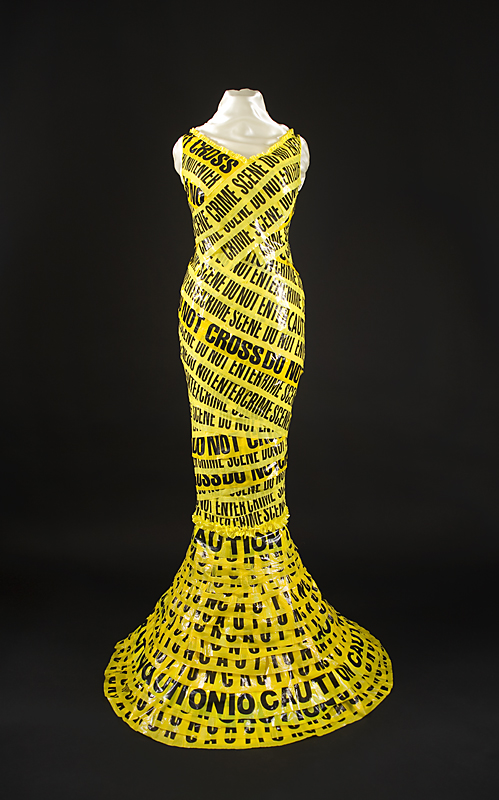
Crime Scene
The second dress, it is called Crime Scene. It is made from police tape that reads: “Crime Scene Do Not Enter”. At first I thought it would be an edgy and fun garment, but soon I realized that this piece is very serious… for me it’s the most provocative work of art that I have ever created. It is about many forms and levels of violence: It is about sexual abuse. It is about the destructive effects of the fashion industry on the people who grow, sew and model clothing as well as those of us who are made to feel inadequate in numerous ways so as to “feed” the industry with consumers. It is about the destruction we have done to the body of mother earth. It is about the over 200 toxic chemicals deposited in each of our bodies from our poisoning of the earth.
No, this did not end up being a fun dress. But like many of my pieces it is deceptive. From afar people may find it to be an appealing design, and only upon closer inspection will they discover some of the deeper meanings.
Crime Scene, The Caution Dress and Eco-Flamenco, which I made this fall in Grand Rapids, will join the rest of my 18 garments on exhibit in the Atlanta Airport (International Concourse E) in about 2 weeks. They will be showcased through May of 2012 in a new case that the Airport has just built in the entrance to the concourse, at the top of the escalator.
As the year comes to a close I want to thank all of you who have supported me in many ways as I installed my exhibition in the Atlanta Airport, presented my TED talk, created new garments in Evanston, IL and Grand Rapids (Eco-Flamenco), and gave numerous workshops around the country. It was a busy year, and I could not have done it without the help and support of so many of you! I look forward to an equally, exciting year in 2012! Stay tuned….
Crime Scene photographed by Jay Studevant.
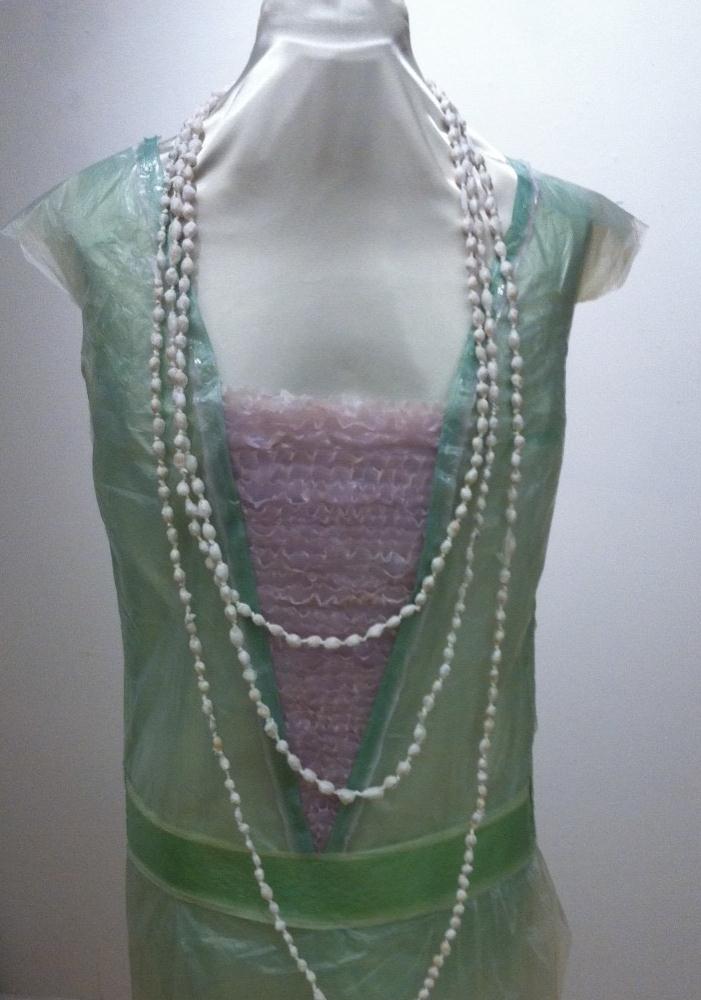 This past Sunday I was honored to be the featured artist in the 3rd annual Green Arts Show in Evanston, IL, just north of Chicago. I was asked to create a new dress from recycled plastic bags to bring attention to an ordinance being considered by the Evanston City Council that would ban retailers from giving plastic bags to customers. A ban that I wish every City had! The organizers collected a bunch of reclaimed plastic bags and sent them to my studio in Santa Fe. For some reason, I immediately envisioned a 1920’s flapper dress made from layers of plastic bags ironed into silky looking fabric. (Back to that topic later.)
Anne Berkley, my host, asked me if the dress could be partially created in a public workshop prior to the opening. Though I wondered if I would be able to finish the garment before the opening, I agreed. Luckily a wonderful group of about 20 people came to my rescue, and workshop! After a presentation on my work, I taught the group how to create “ruffles” from compostable bags, and “fresh-water pearl necklaces” from white plastic grocery bags. I was amazed at how quickly they learned from my harried directions—what a helpful and talented group of women, men and children!
Amazingly, we finished the dress just as the exhibition began! I slipped on my new Caution Dress, created for my TED talk the previous weekend, and enjoyed a lovely evening talking with the talented artists in the show, and the devoted members of the Citizens Greener Evanston committee that organized the event.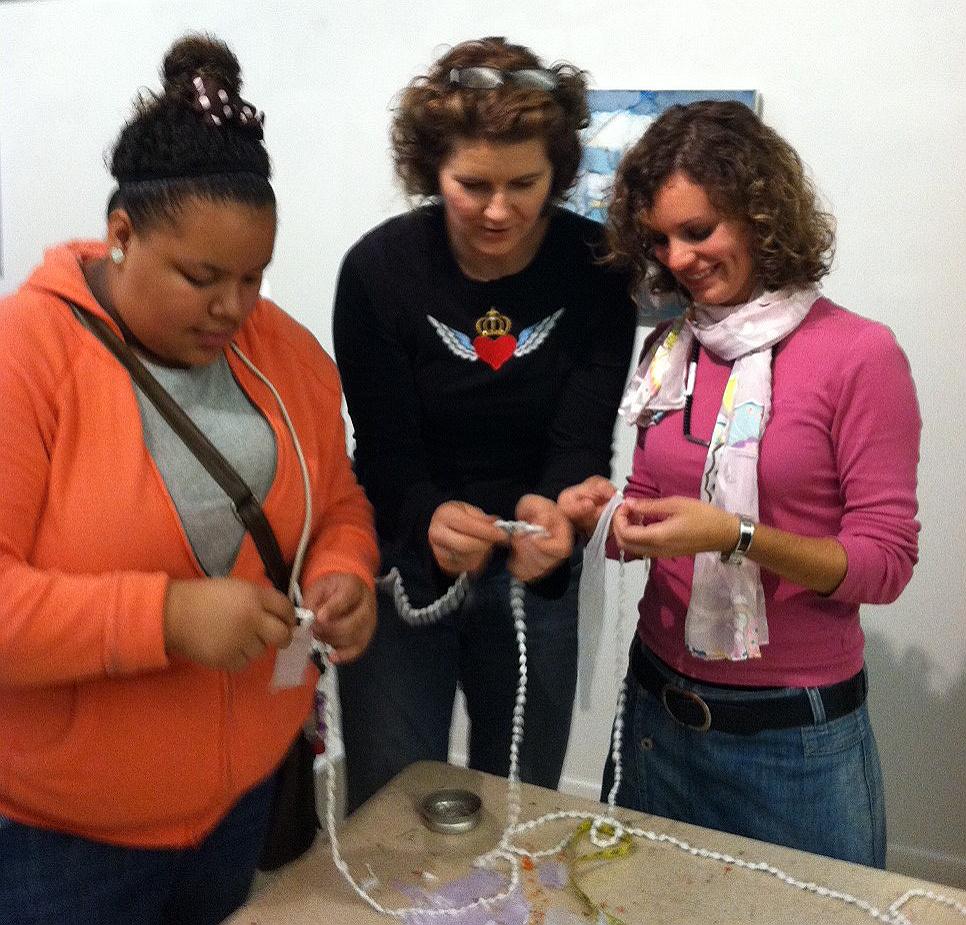
A little back story to this adventure– when I landed in Chicago, I immediately began thinking about my maternal Grandmother, Mimi, who was a very glamorous and fashionable woman. And while waiting for my luggage, I received an unexpected e-mail from my Mom reminding me that Mimi had grown up in Chicago, and had even lived in Evanston for a while. Evidently in 1920 she attended Northwestern University in Evanston at the age of 15! As a girl she skipped ahead two grades in grammar school. But her parents decided that the University was too big for such a young girl and sent her instead to the Art Institute of Chicago to study interior design. After graduation she received a job at Marshall Fields Department Store designing display windows.
On this trip to Evanston, I bega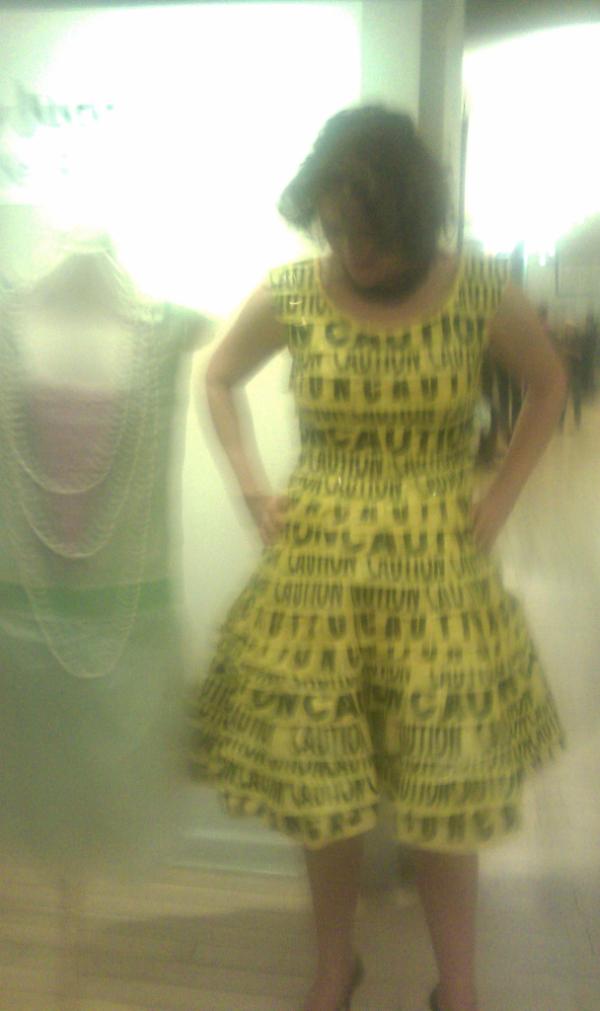 n to wonder if Mimi has been looking out for me all these years. I remembered that it was during my last trip to Chicago 5 years ago that the idea of showing my work in airports came to me like a bolt of lightning. And last week I found out that a prominent museum in Chicago is seriously considering hosting my exhibition of 20 garments after the show leaves the Atlanta Airport next year! I also realized that my love for vintage clothes, which so influences my sense of design, was born from the photos and actual dresses of my glamorous grandmother.
Which brings me back to the flapper dress I made for the Green Arts Show. Where did this inspiration come from? As I thought about the day in my studio in Santa Fe when the image of the flapper dress appeared in my mind’s eye, I wondered if Mimi was with me…inspiring me to create a dress similar to what she must have worn in the 1920s when she was a designer in Chicago!
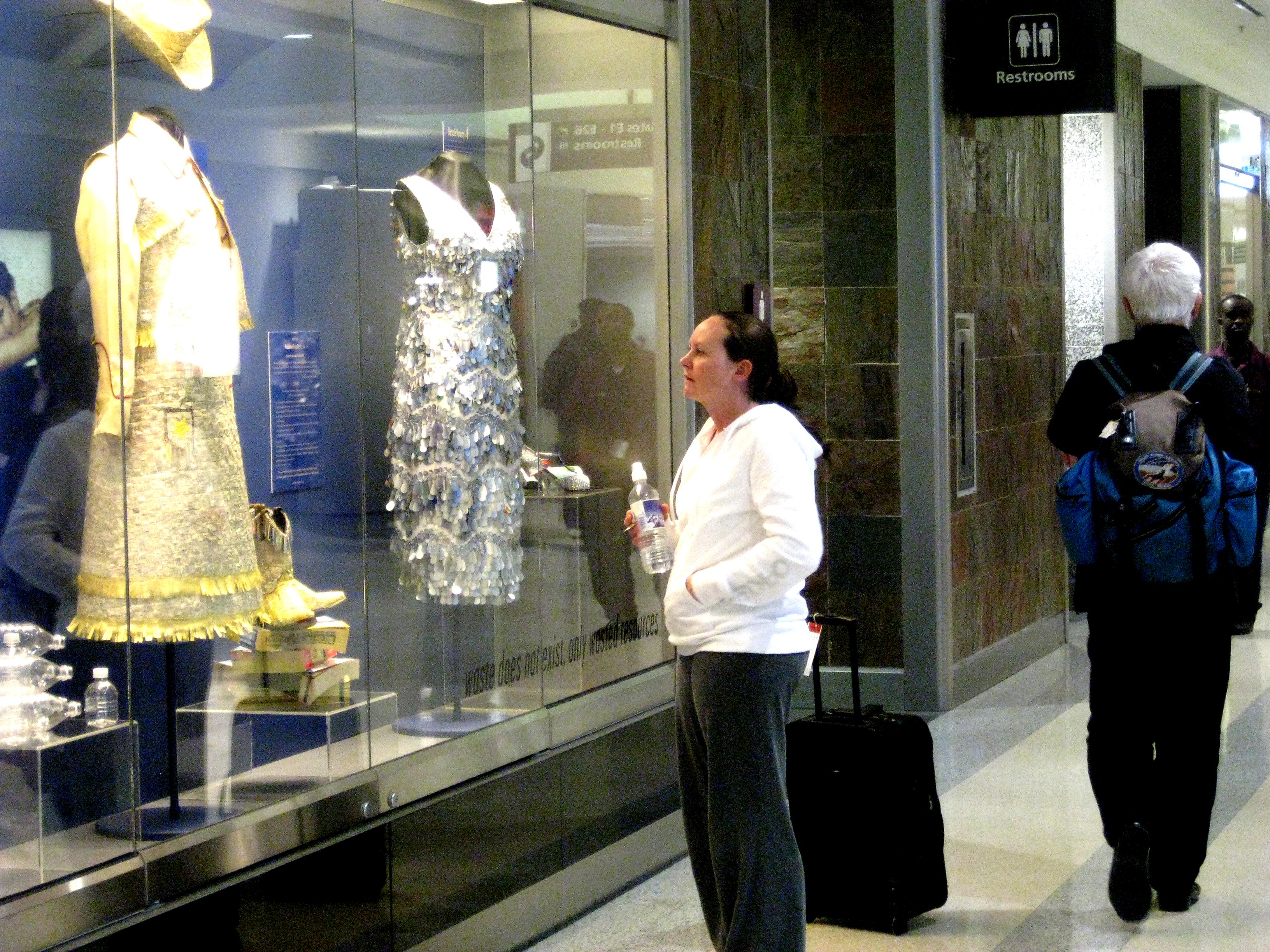
Recycle Runway Exhibition in the Atlanta Airport
The dust has settled from my two week adventure in Atlanta installing the Recycle Runway exhibition, “waste does not exist, only wasted resources.” I have returned, finished up some minor details and gotten some well needed rest.
After three years of preparations, eighteen of my recycled fashion designs are now on display in nine cases throughout International Concourse E. To access Concourse E take the “Plane Train” (AKA the Concourse Shuttle) or just walk from any one of the concourses or the main terminal. (Note to Atlanta residents: Concourse E is on the secure side of the airport, so you will need a ticket to get there.)
I started the first week with a presentation on resources to some students at the International School in Atlanta sponsored by Novelis. Whenever I go somewhere to install an exhibition or make a new garment I like to give school presentations and working with kids is always a thrill – their minds are so fresh and innovative I always end up learning from them.
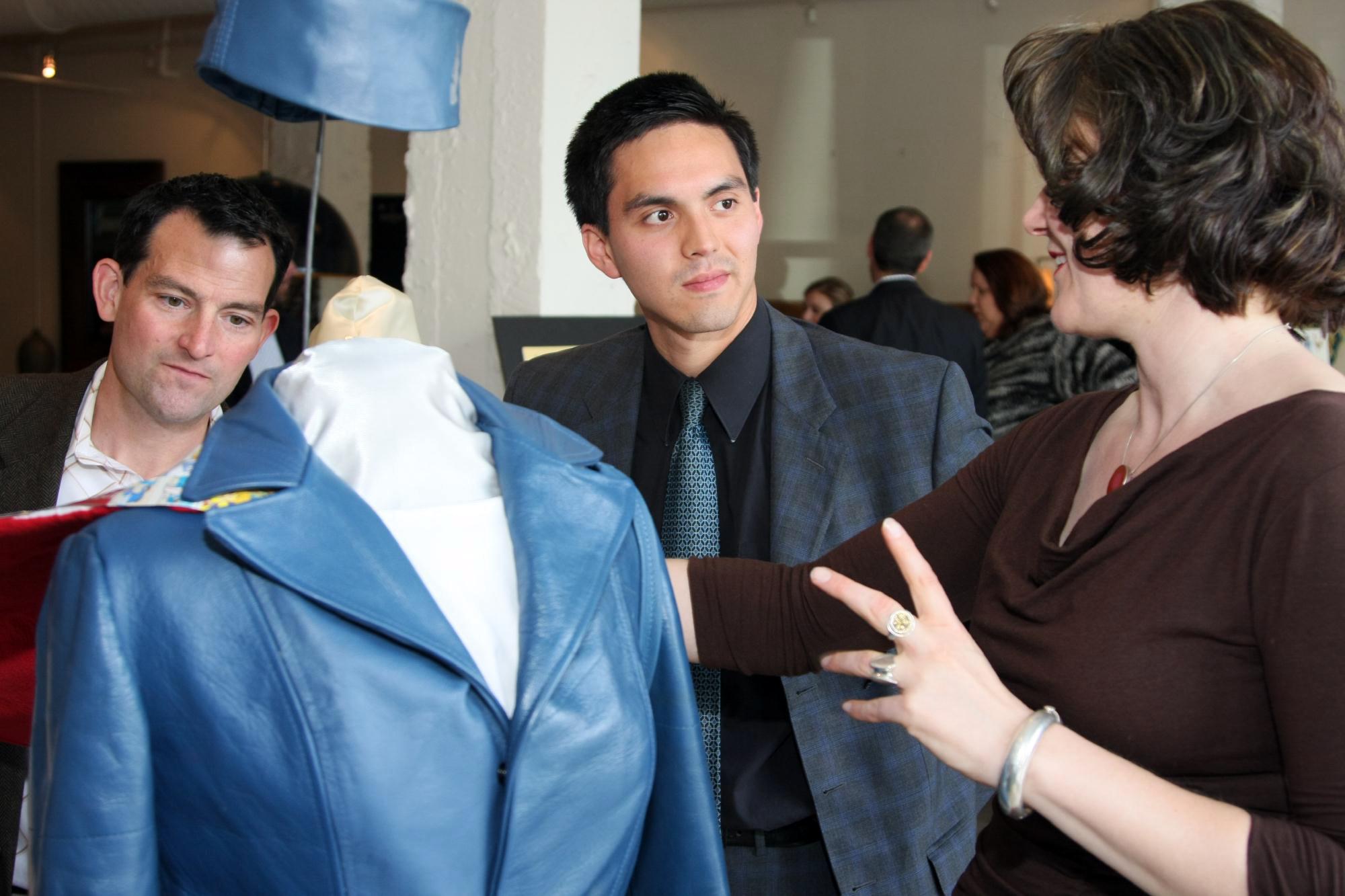
Introducing the Environmental Steward-ess to my sponsors, Frank and Aaron from Delta Air Lines!
On Wednesday we held a big launch party for my show at a sustainable furniture company called “Environment”. I had arranged a number of my garments, including Delta’s new Environmental Steward-ess, amid the furniture made from reclaimed, recycled, and sustainably harvested wood, so all night guests were weaving in and out of the display – truly a visually interesting mix! Approximately 50 people turned up including the press, some of my sponsors, local designers and artists, community environmental activists and even a few friends. But the best part of all was finally meeting some of the people that are sponsoring this exhibition and supporting my work.
I spent the rest of first week meeting Katherine and David from the Airport Art program, settling preliminaries like which size and style of pedestals to use in the airport art cases, and returning in the evenings to my vacation rental to prepare and eat the chard I had smuggled on the plane. For those of you who are interested, chard travels well.
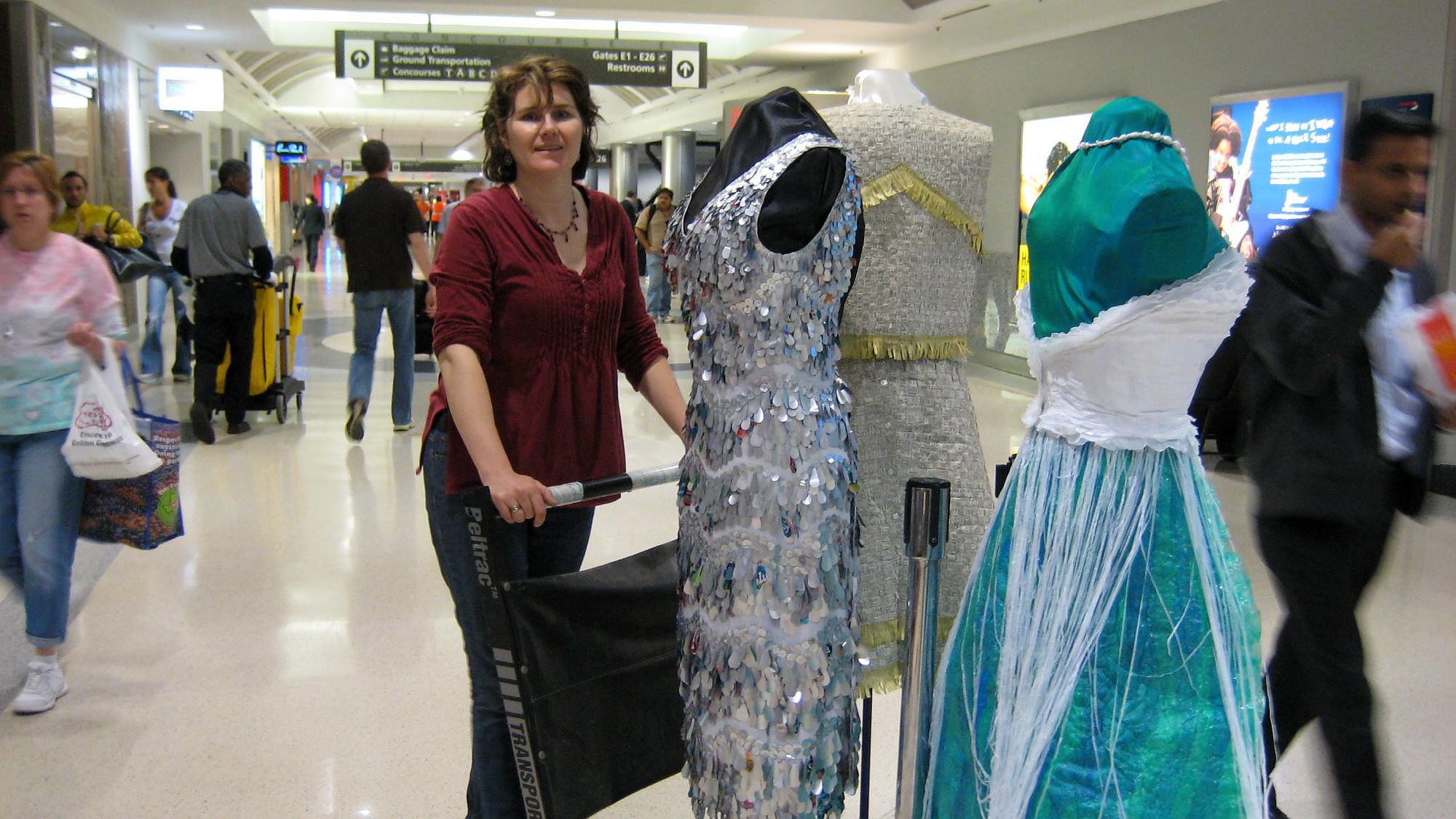
Transporting the Dresses Through the Concourse
I had no idea what I had really signed up for in the second week when we finally began installing the show! Nothing can prepare you for working in an airport. It is so very different from being in one for travel only. You really have no idea how dazed people are in new, large and busy surroundings, trying to keep track of their luggage and keep their families together. I felt as though I got a fresh peek at what I must look like traveling thither and yon.
I had agreed to do the installation between 7 PM and 4 AM so we came in for work while the airport was still hopping and within the next couple of hours would begin winding down for the day. Yes, the
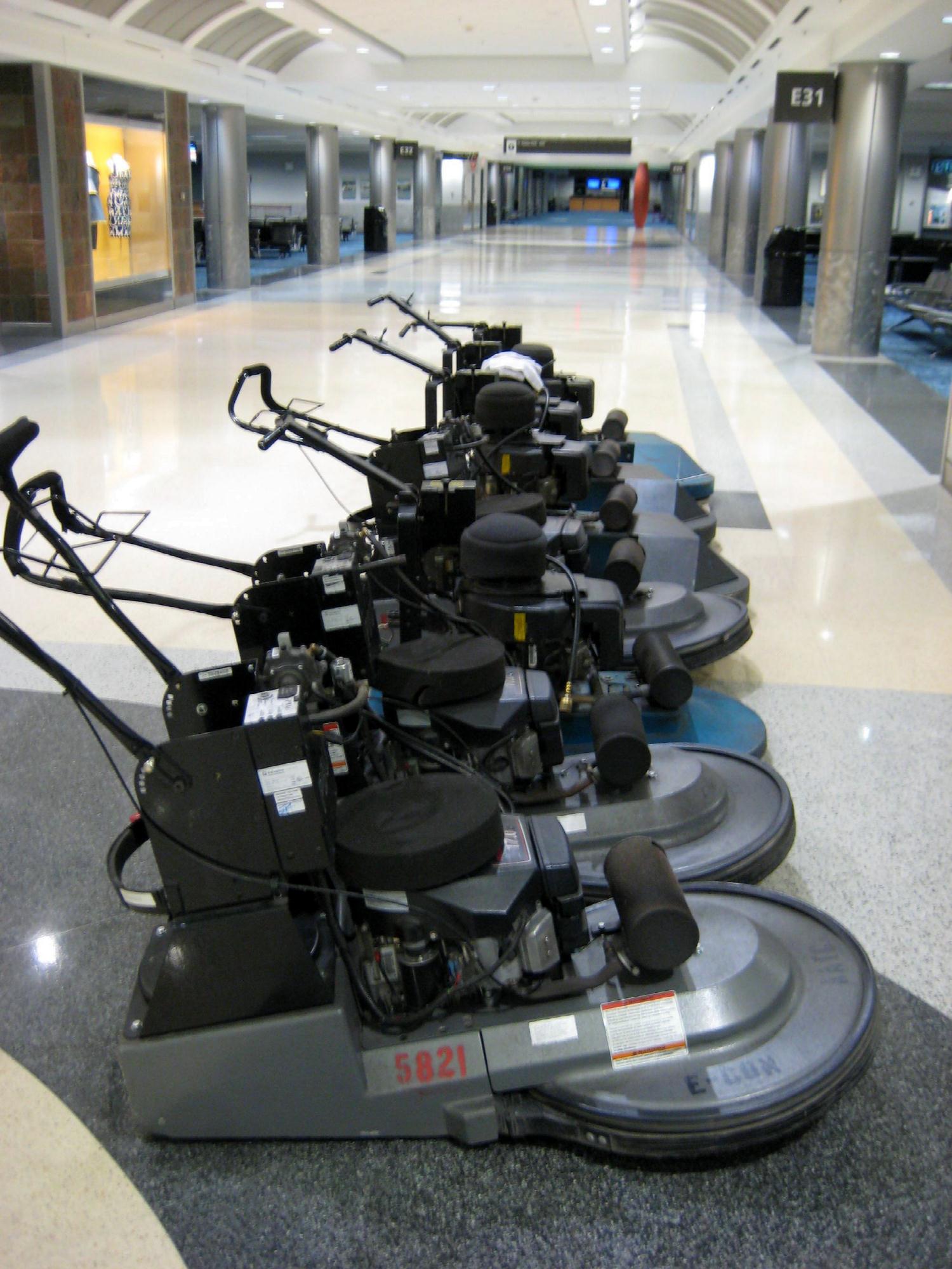
Floor Polishing Equipment
Hartsfield-Jackson Atlanta International Airport actually closes down somewhere between 11 and midnight and the empty halls begin to fill will all kinds of cleaning apparatus and work relations banter. Imagine the number of night staff you have to have to maintain the busiest airport in the world!
Inside the halls of Concourse E Katherine and David trekked vast distances from case to case, applying vinyl lettering and information placards while I and the fourth member of our team, Nicole, spent hours and hours locked in a windowless room filled with my dress forms and garments and a wide variety of other art installation materials. It began to get a little surreal as I unboxed the pieces and prepped the garments for their “in case” debut but I was eventually grateful that I couldn’t really tell what time it was and I was so busy I didn’t care. Our little team was actually fighting to get the installation done within the time we were given – 3 nights.
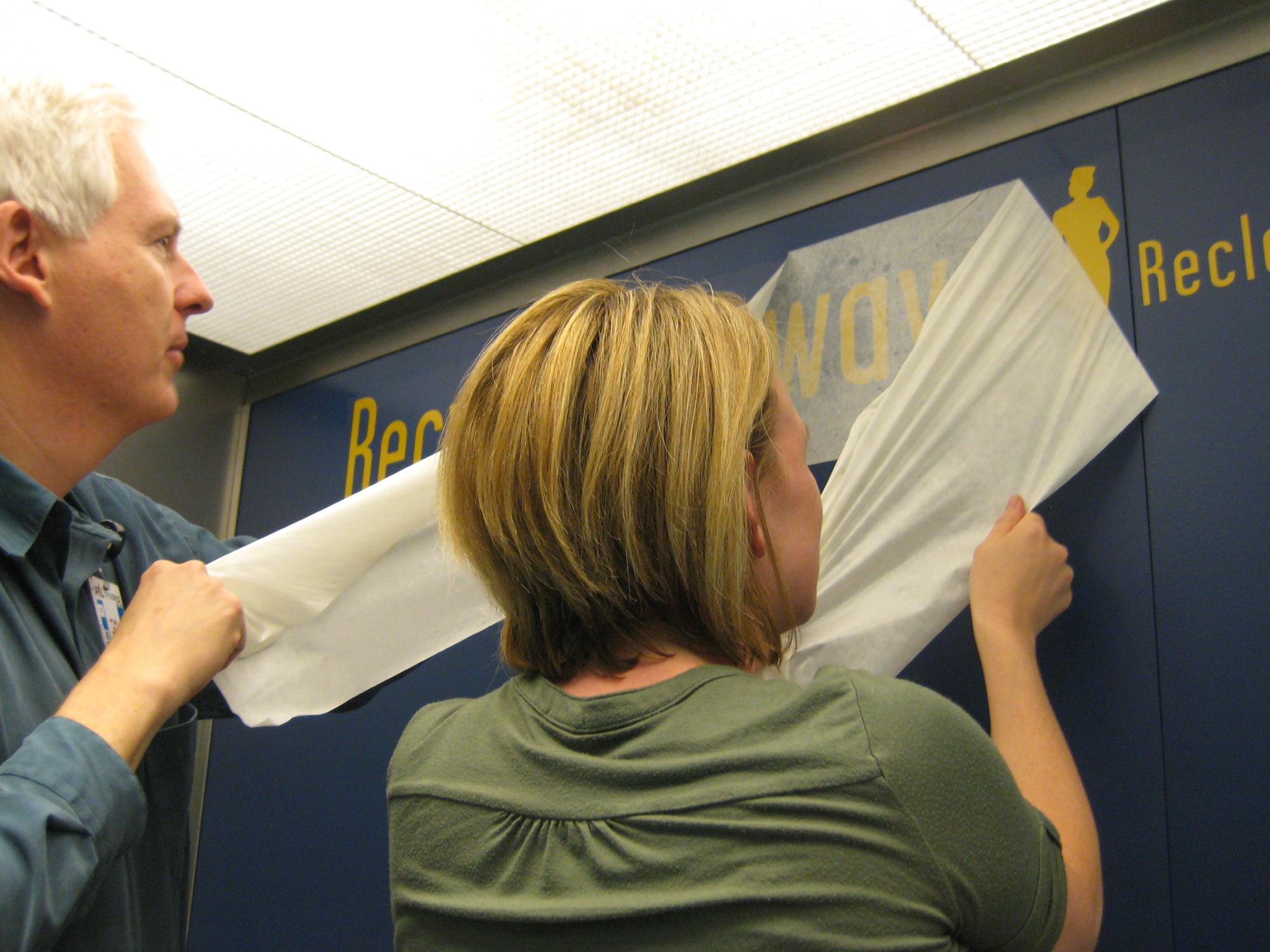
Applying the Vinyl Exhibition Titles
The amazing and very sweet compliments of the night staff kept us going as we pushed dollies full of dresses throughout the concourse. Bleary eyed we’d exit every morning at 5 AM heading back home to sleep, eat and take a nap before doing it all over again. We squeezed every last minute out of our allotted time and in the end everything just fell together. It was a truly inspiring piece of team work and I am so thankful to all those that helped!
This exhibition would not be possible without the support of my case sponsors: Coca-Cola, Delta Air Lines, Janome, and Novelis and my Green Partners: Earth911.com, the Georgia Chapter of the Sierra Club, the Georgia Recycling Coalition, Keep America Beautiful, Keep Georgia Beautiful, the Phoenix Airport Museum and the Turner Foundation. And of coarse thank you to my host, Atlanta’s Airport Art Program! It is such an honor to be part of their impressive group of permanent and rotating art exhibitions! If you have been through this airport before you are sure to have noticed all the great art…my favorite of the permanent collections are the Zimbabwe sculptures in the walkway between Concourse T and A.
Thus far the exhibition has received great press, in the last couple of weeks articles have appeared on the front pages of cnn.com and yahoo.com. I have received so many encouraging e-mails from all over the world!
Well, as mentioned, I did have a few details to iron out when I got home. There is a short video presentation on the show and my work that CNN will run throughout the airport for the entire year the pieces are on display but we have had a hard time finding the requested digibeta tape. RESOURCE RE-THOUGHT Number 1 – The terrible earthquake and tsunami from March 11 that devastated Japan has also taken its toll on many of the electronic resources for the entire world. The reason that the digibeta tape has been so hard to get is that most of the manufacturing of these tapes is done in Japan. Where do your resources come from?
See more photos of the exhibition installation on my facebook page.
Yahoo
Designer turns trash into high fashion.
 By Joanna Douglas, Shine Staff
April 25, 2011
Read article on-line.
Designer and environmental educator Nancy Judd creates wearable art out of recycled materials
Once an odd and unusual concept, in recent years, “recycled clothing”—that is, wearable garments made from unconventional materials—have become more and more mainstream . Most every season of the reality show “Project Runway” features a challenge where contestants use non-traditional items to create new sartorial designs, and more than a few young women have made duct tape prom dresses. We’ve even seen edible dresses made out of eggplants and bubblegum. That said, we love seeing people get creative with their fashion, especially when they re-purpose used materials and send a positive message about recycling.
Artist and environmental educator Nancy Judd, of Santa Fe, New Mexico, turned down a spot on “Project Runway” because she’s happy with her own project, Recycle Runway. She creates high fashion from what others may perceive as trash, all while teaching people about conservation.
“I love taking garbage—something that people want to push away from and not think about—and transform it into something elegant,” Judd recently told CNN. “I love when they look at a dress and say, ‘Wow, those are bottles or cans,’ or whatever.” While she says maybe designers are doing good things, she likes remaining an outsider. “I am an artist making wearable art,” she told CNN. “I’m also not attracted to the fashion industry. It creates a tremendous amount of waste, and there are a lot of social justice issues.”
Judds work has been displayed in malls, museums, and airports across the country, and her latest exhibit will be featured at Atlanta’s Hartsfield-Jackson International Airport this week. Don’t worry if you can’t make it—we’re highlighting the best pieces here. First up: The Glass Evening Gown. This stunning dress is made from 12,000 pieces of crushed glass! The Glass Packaging Institute commissioned this gown and the glass jars and bottles used came from the City of Albuquerque’s recycled program. The foundation for the garment was made of old upholstery.
Flip through the slideshow and head over to Recycle Runway for more on Judd’s creative designs.
CNN
Wearable art plucked from trash
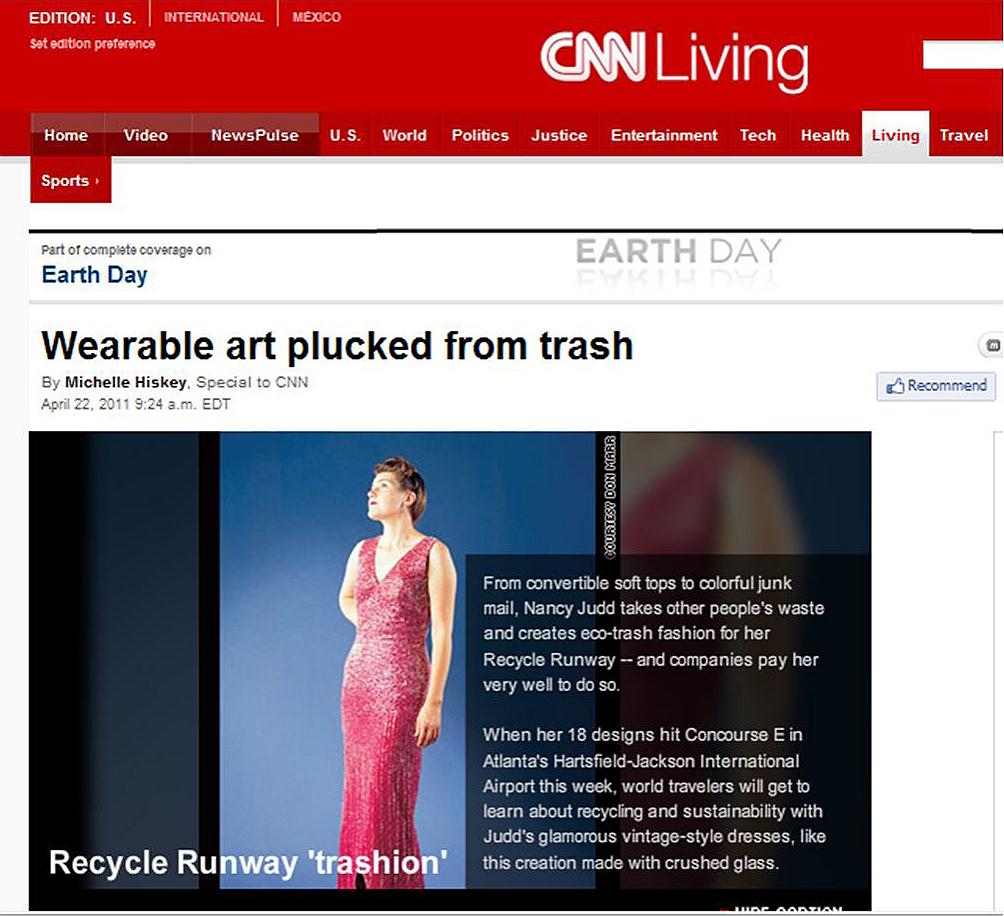 By Michelle Hiskey, Special to CNN
April 22, 2011 9:24 a.m. EDT
Read article on-line.
(CNN) — Nancy Judd turns an orange rind into sequins. A can of Coke becomes shiny bangles. Plastic bags melt into chic crinkly fabric.
What others call trash is her high fashion.
Her newest creation is “The Environmental Steward-ess,” a 1940s air hostess suit sewn from leather seat covers donated by sponsor Delta Air Lines. Judd stitched the suit’s superhero cape from safety cards once found in seatback pockets.
Her apparel is more for learning than wearing.
“I love taking garbage — something that people want to push away from and not think about — and transform it into something elegant,” said Judd, 42, of Santa Fe, New Mexico. “I love when they look at a dress and say, ‘Wow, those are bottles or cans,’ or whatever.”
After her cocktail dress made of vinyl Obama-Biden banners made it to the Inauguration, Judd declined a spot on “Project Runway.” She prefers grass-roots projects that she details on her website Recycle Runway.
“I am an artist making wearable art,” she said. “I’m also not attracted to the fashion industry. It creates a tremendous amount of waste, and there are a lot of social justice issues, although a lot of designers are doing good stuff.”
Her work has been displayed across the country at shopping malls, museums and airports. The latest installation of her “Recycle Runway” exhibit of 18 eco-trash garments will go up this week at Atlanta’s Hartsfield-Jackson International Airport.
Judd recently spoke with CNN.com about her creative process.
CNN: How did you start making recycled fashion?
Judd: My mother owned a gallery and directed a college of art, and I spent my whole life in art classes. I loved to sew. In college, I got a degree in art and sociology. One year, my art school got a new pop machine. The garbage can next to it grew with all the pop cans. Seeing them thrown out just seemed wrong. I put a recycling bin next to the pop machine. I started wondering: Where does trash go? Who picks it up? After that, my career path was in solid waste and recycling. As the recycling coordinator for Santa Fe, to promote a weekend-long exhibit of recycled art, I threw together a little outfit made of bubble wrap. Each year, I made another dress, getting more and more intricate. Now, I can’t imagine using anything but trash. If somebody gave me a $200-a-yard fabric, I would be at a loss.
CNN: Besides the landfill, where does your art come from — the vision?
Judd: Honestly, it feels like divine intervention. Artistically, I have a sense of confidence that doesn’t really line up with the rest of myself. I don’t know why I can say to Delta or Toyota, “Send me your waste and I will create something I know you will love.” All I can say is that my art comes from a spiritual, creative relationship that is so interesting to me.
CNN: Do you have a favorite piece?
Judd: That’s like picking a favorite child. The Eco-Dress really pulls together everything. It’s a Scarlett O’Hara-style dress made of [scrap paper] pledges written by 2,000 children across the country. Having people involved really feeds the mission of what I’m doing.
CNN: Do you use a special sewing machine?
Judd: I use a regular one from my sponsor Janome. I’ve sewn inner tube tires fine, and the soft top of a Toyota convertible.
CNN: Explain how the stewardess cape of safety cards only looks cheery.
Judd: The cards are really colorful, really whimsical. I researched the super-heroine Wonder Woman, created in the 1940s — the same era this type of suit was worn by Delta stewardesses — by a psychologist to provide a strong role model for young girls. In addition to her invisible plane and bulletproof bracelet, Wonder Woman was given a lasso of truth that made men be honest. This garment is about being a role model who is strong and stands up for the environment. The safety cards are scenes of people preparing for a crash. The cards ask, “What if?” That sort of emergency is happening around the world with the environment, because of our decisions. My art is about what we can do in our lives to live lighter on the Earth, and to prepare ourselves. Like the safety cards, the message is about conservation and preparation.
CNN: What details are less obvious?
Judd: The cape looks windblown because of the wire armature holding it up, made from yard signs from the Obama campaign.
CNN: How much do you charge for a commission, and who pays?
Judd: About $10,000. A dress will take anywhere from 150 to 450 hours to make. The contract allows me to keep the dress for future exhibitions. I only work with organizations that are doing something substantial for the environment. One of my sponsors, Coca-Cola, is creating bottles that are plant-based and has started the first bottle-to-bottle recycling plant!
CNN: What are some of the environmental hazards of creating eco-conscious art?
Judd: I only iron plastic outside. I wear a heavy-duty respirator mask around chemicals and when I drill metals.
CNN: Is your tetanus shot current?
Judd: It should be, but I don’t think it is.
CNN: What size are your dresses?
Judd: For a while, I made all my pieces about a size 12, because honestly, I was the only available model.
CNN: Describe a future piece.
Judd: The Biodegradable Dress starts with cheesecloth — a lot of people in Santa Fe make their own cheese. Attached are sequins in a turn-of-the-century pattern. The sequins are being made in public workshops from oranges and tangerines. After eating, people punch peels into small circles and dry the circles on a pin.
This dress will be sturdy enough to last 100 years. Throw it on a compost pile, and it could disappear in a month.
Michelle Hiskey writes occasionally about the creative process for CNN.com.
Terminal U
Delta Air Lines’ superhero stewardess uniform unveiled
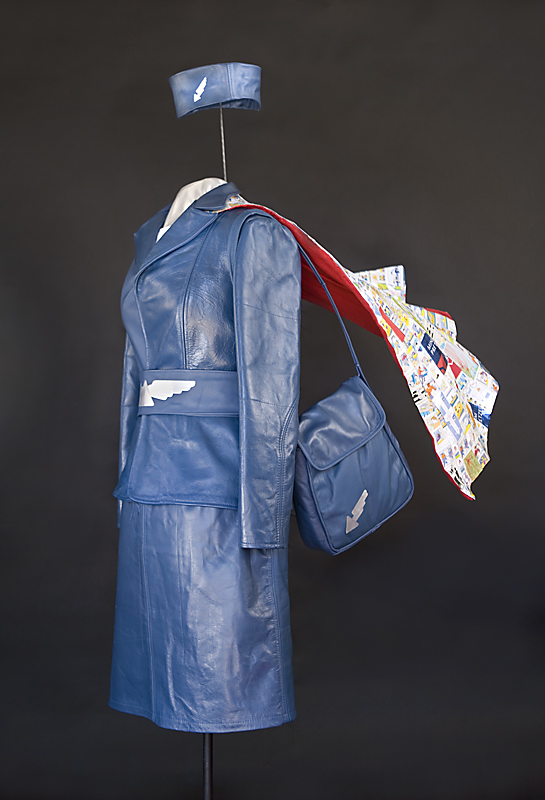
The Environmental Steward-ess
April 14, 2011
Read article on-line.
A “superhero stewardess” uniform, made entirely out of bits of Delta Air Lines scrap, is among the eye-popping pieces of eco-fashion gracing an exhibition at Hartsfield-Jackson Atlanta Airport.
Delta Air Lines commissioned Nancy Judd – an artist known for turning trash into “couture fashion” – to create the striking uniform, which she has aptly named “The Environmental Steward-ess”.
It is one of 18 centrepieces on display at the artist’s “Recycle Runway” exhibition, which will run in Atlanta Airport’s International Concourse E until April 2012.
The uniform, and the matching accessories – a hat and purse – have been sewn from worn-out leather seat covers from Delta planes.
The outfit wouldn’t be complete without a superhero cape – for a super cool throw-on and-go look.
The cape is made up of old safety cards, plane tickets, Delta Sky magazines and pretzel wrappers, stitched into worn pillow cases, before being lined with an old Delta blanket.
To wrap up, the artist used aluminum cans for the Delta logo, which is featured on the purse, hat and belt.
As TERMINAL U reported earlier this year, Delta Air Lines is among a few major carriers to join the “upcycling” craze, where cabin fixtures and fittings that would otherwise be discarded are refashioned into something of greater value- and sold off as fashion.
USA Today
Airports cater to art lovers with intriguing installations
 By Harriet Baskas
April 12, 2011
Read article on-line.
At Hartsfield-Jackson Atlanta International Airport, you’ll soon find an exhibit of couture fashions made entirely from trash by Nancy Judd of Recycle Runway.
Included among the 18 pieces is an outfit commissioned by Delta Air Lines that Judd has dubbed “Environmental Steward-ess.” The vintage-style flight attendant uniform, which includes a hat and purse, is made from worn-out leather seat covers from Delta planes. The purse, made by Tierra Ideas, has a liner made from recycled wool curtains. The best part: The cape, which was inspired by Wonder Woman’s invisible plane from early comic book days, is made from outdated seatback safety cards, discarded pretzel bags, old plane tickets and past issues of Sky Magazine.
Find it: The Recycle Runway exhibit opens April 18th and continues until April 2012 in nine cases on Atlanta International Airport’s Concourse E. A video about Recycle Runway will also run on the airport’s CNN channel at each gate.
